


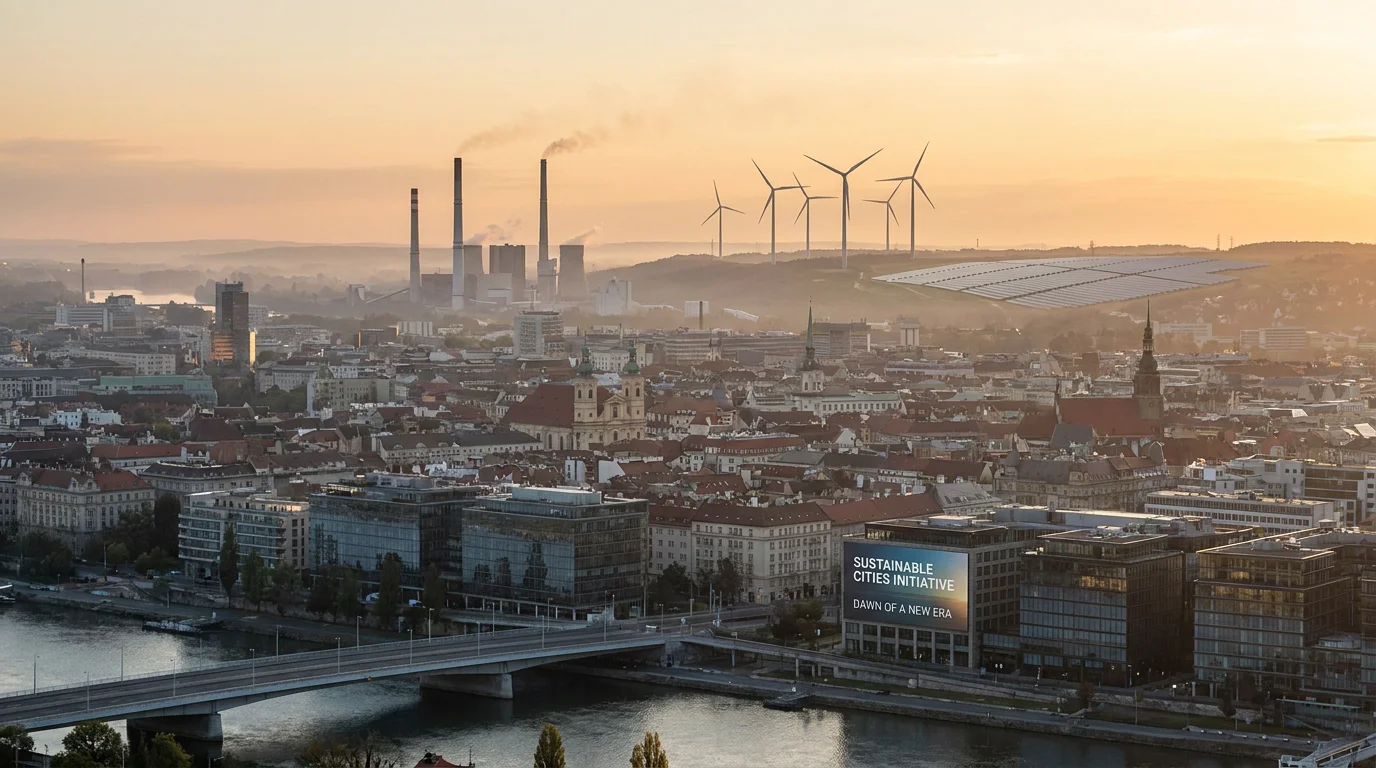

Carbon pricing in Europe has never carried more weight than it does in 2026. EU carbon permits recently increased to EUR 81.35, the highest level since February 2026, and the regulatory landscape is shifting faster than at any point in the system's two-decade history. For compliance buyers, financial participants, and corporate strategists alike, understanding the EU Emissions Trading System is no longer optional; it is a prerequisite for doing business across the European Economic Area. For a foundational overview of market-based climate instruments, see our guide on Emissions Trading Systems explained.
What makes this moment distinctive is the convergence of several forces: the definitive stage of the Carbon Border Adjustment Mechanism (CBAM), a planned directive revision, the phase-out of free aviation allowances, and full maritime compliance obligations starting this year. This article unpacks every layer of the system, from its core mechanics to practical trading considerations, so that you can navigate each development with confidence.
What Is the EU Emissions Trading System and Why Does It Matter?
The EU ETS became the world's first carbon market in 2005. Built on a cap and trade principle, the system places a ceiling on the total volume of greenhouse gases that regulated entities may emit. Each EU Allowance (EUA) grants its holder the right to emit one tonne of CO₂ equivalent. Companies that reduce emissions below their allocation can sell surplus allowances; those that exceed it must purchase additional ones on the market.
The strengthening of the system in line with the target to reduce net greenhouse gas emissions by at least 55%, together with the 2022 energy crisis, pushed average carbon prices up to EUR 80 in 2022 and 2023, before they decreased to EUR 65 in 2024. In 2025, prices fluctuated between EUR 60 and EUR 80, and futures markets signal only slight increases by 2027.
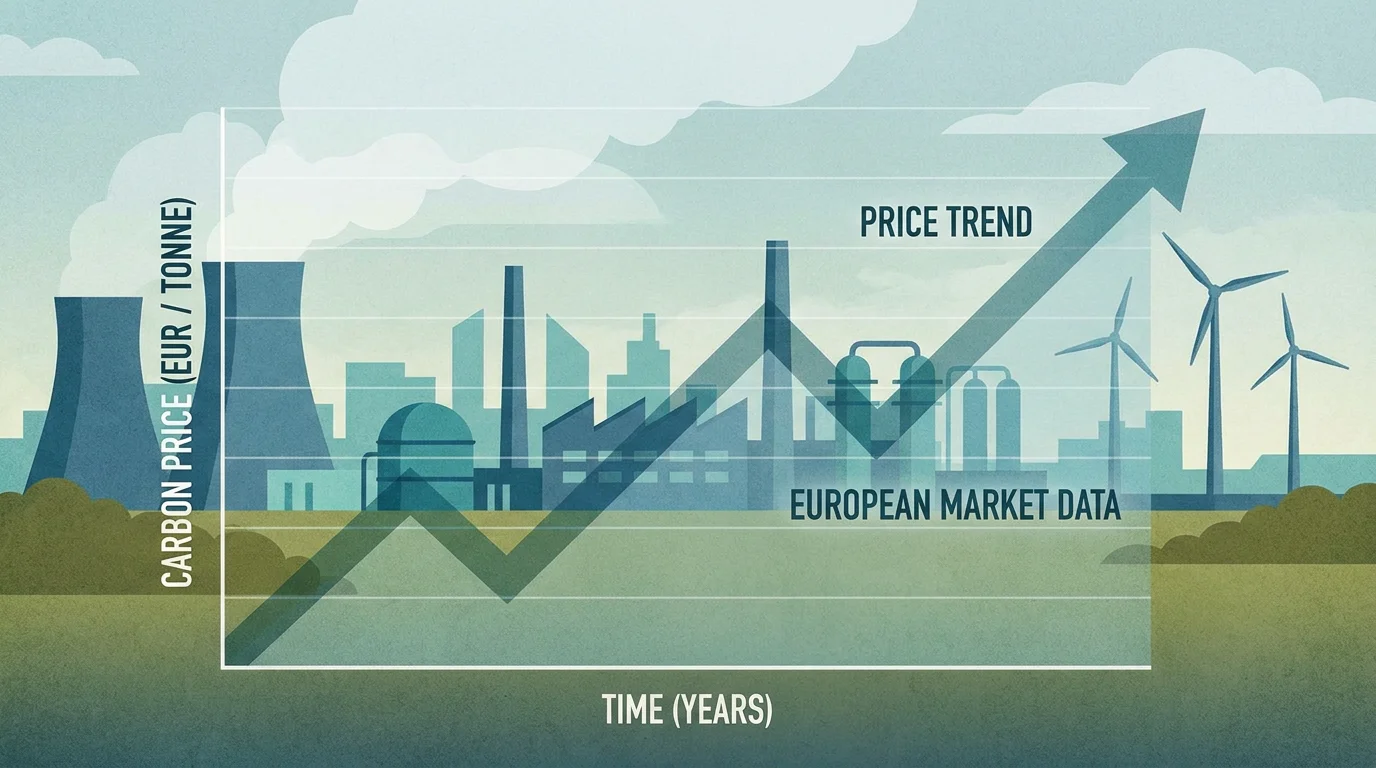
This price trajectory reflects a market in transition. ABN AMRO revised its 2026 EUA price forecast downward to an average of EUR 82 per tonne of CO₂, reflecting weaker demand, geopolitical volatility, and policy-driven market uncertainty. Even so, the system continues to deliver measurable emissions reductions, making it the cornerstone of EU climate policy.
Scope and Coverage: Sectors, Gases, and Geography
The EU Emissions Trading System operates across all 27 EU member states plus Iceland, Liechtenstein, and Norway. As of 2026, the system covers around 35% of the bloc's total emissions based on 2023 data, with preliminary 2024 figures suggesting a further decrease to around 33% as a result of significant emissions reductions in the power sector. Wikipedia, citing 2026 data, places the broader coverage at approximately 40% when maritime transport is fully included.
In terms of entities, the data reported under the EU Emissions Trading System cover more than 16,000 stationary installations, 1,600 aircraft operators, and 2,600 maritime operators. Covered gases include CO₂ across all sectors, N₂O from specific industrial processes, and perfluorocarbons from aluminium production. From 2026, methane and nitrous oxide emissions from maritime transport also fall within scope.
How Cap and Trade Works Inside the EU ETS
If you are unfamiliar with the general mechanism, our detailed guide on how cap and trade schemes work covers the fundamentals. Within the EU ETS specifically, the process unfolds in three stages.
Setting the cap. The European Commission sets an annual EU-wide cap on total allowable emissions. In Phase 4 (2021 to 2030), the linear reduction factor was increased from 2.2% per year (for 2021 to 2023) to 4.3% for the period 2024 to 2027, and will rise again to 4.4% from 2028. In addition to the linear reduction, the cap was reduced by 90 million allowances in 2024 and a further 27 million in 2026, bringing the stationary installations cap for 2026 to approximately 1,185 MtCO₂e.
Distributing allowances. Auctioning is the primary allocation method, accounting for up to 57% of the cap. The remainder is distributed as free allocation based on sector-specific performance benchmarks, primarily to industries deemed at risk of carbon leakage. To understand the mechanics of allowance allocation and trading, explore our resource on EU carbon market allowances.
Trading and compliance. Regulated entities must surrender enough allowances to cover their verified emissions by the annual compliance deadline. Surplus allowances can be banked for future use or sold on the secondary market, creating a dynamic carbon price signal that incentivises decarbonisation investment.
Key Regulatory Changes Shaping 2026 and Beyond
Several landmark developments are converging in 2026, making this year a pivotal one for the European carbon market.
CBAM Enters Its Definitive Phase
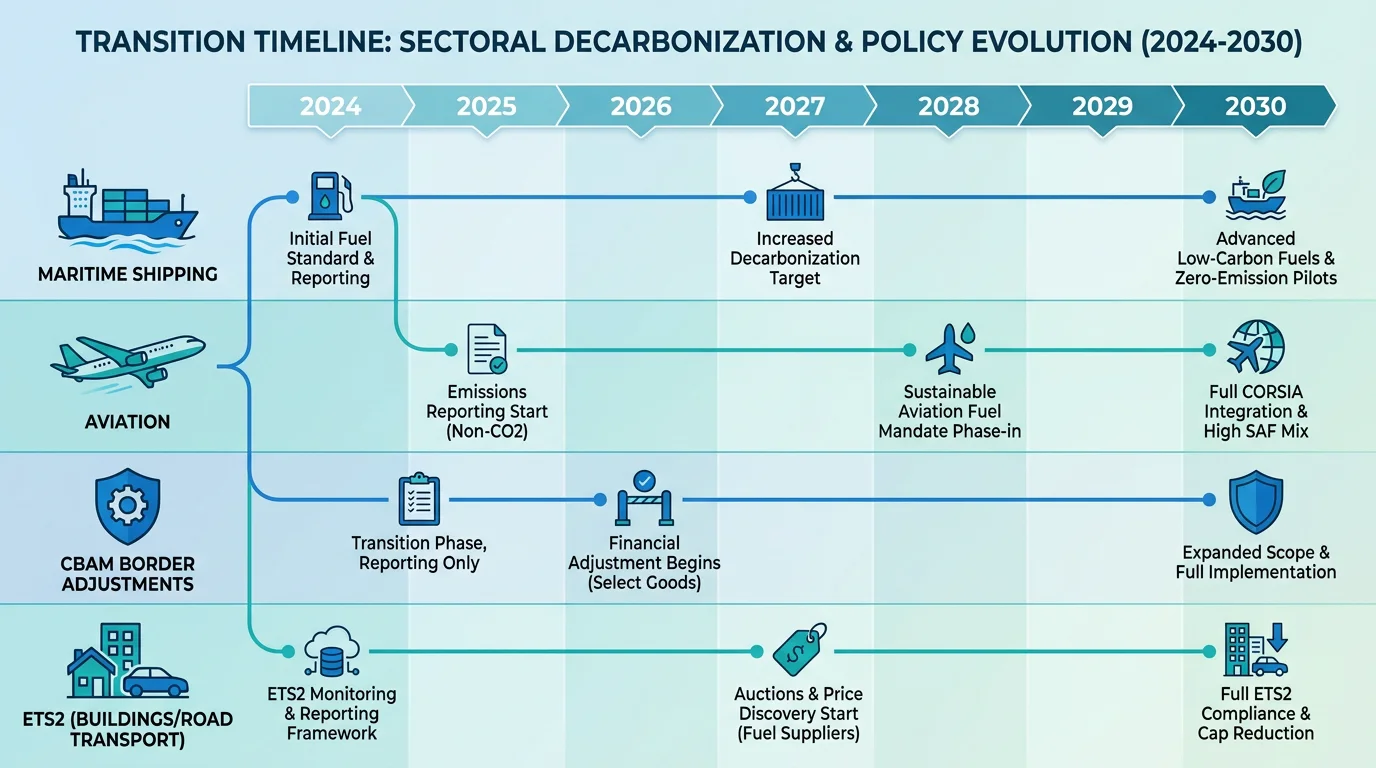
As of 2026, the Carbon Border Adjustment Mechanism will gradually replace the free allocation of ETS allowances as the main policy tool to mitigate carbon leakage risks. CBAM covers electricity, iron and steel, aluminium, cement, fertilisers, and hydrogen products, and in 2026 free allowances for covered sectors will be reduced by 2.5%. EU importers will need to surrender CBAM certificates for embedded emissions in relevant goods, with the first surrender deadline set for September 2027.
Full Maritime Compliance and Expanded Gas Coverage
Shipping companies must surrender allowances equal to 40% of their verified 2024 CO₂ emissions and 70% for 2025 emissions. From 2026, the surrender obligation rises to cover 100% of reported emissions for the 2026 reporting year onward. Methane and nitrous oxide emissions from large vessels are also brought into scope this year.
Aviation: Free Allowances Fully Phased Out
In aviation, free emission allowances for operators were reduced to 50% in 2025 and are fully phased out as of 2026. A per-tonne financial support mechanism for sustainable aviation fuels (SAF) has been introduced to incentivise cleaner fuel adoption during this transition.
EU ETS Directive Revision and ETS2 on the Horizon
A revision of the ETS directive and the Market Stability Reserve decision is planned for 2026, opening the way to a reform of different aspects of the system with regard to its future ambition, scope, and design. In parallel, the second emissions trading scheme (ETS2), covering the road transport and buildings sectors, is expected to start operating in 2027. The combination of these changes will expand the share of EU emissions covered by carbon pricing to approximately 75%.
EU ETS Revenue: Funding Europe's Climate Transition
The allowance market is not only a compliance mechanism; it is also one of Europe's largest climate finance engines. By the end of 2025, the EU ETS had raised a cumulative total of EUR 265.7 billion (USD 297.1 billion) since its inception. Since June 2023, EU member states have been obliged to direct all relevant ETS revenue toward climate action and energy transformation.
These funds flow into several channels: the European Commission's economic analysis notes that revenues support the Modernisation Fund, the Innovation Fund, and RePowerEU objectives under the Recovery and Resilience Facility. Under ETS2, a Social Climate Fund of EUR 65 billion for the period 2026 to 2032 will help mitigate the price impact on vulnerable households, transport users, and micro-enterprises.
Emissions Reductions: Is the System Delivering?
The evidence is compelling. In 2024, the EU ETS recorded a 5.7% year-on-year reduction in emissions from stationary sources, largely driven by the power sector where renewable electricity production from wind and solar increased substantially. With this development, emissions from installations at the start of 2025 were around 50% below 2005 levels and well on track to achieve the 2030 target of a 62% reduction.
Independent academic research supports these findings. As the International Carbon Action Partnership (ICAP) documents, the system has consistently driven down covered emissions across multiple trading phases. A 2024 study estimated the emission reduction effect at approximately 7%, while a separate 2023 study found a 10% reduction between 2005 and 2012 with no negative impacts on profits or employment.
Carbon Price Outlook: What Market Participants Should Watch
Looking ahead, several factors will influence EUA pricing dynamics over the coming years.
According to a survey of International Emissions Trading Association members, the average EU ETS carbon price is projected to rise to almost EUR 100 per metric ton of CO₂ during the period 2026 to 2030. However, the path to that level is far from linear. ABN AMRO notes that the initial surge in EUA prices in 2026 was reversed as sentiment shifted due to the upcoming ETS review and geopolitical tensions, leading to a revised long-term outlook of EUR 138 per tonne by 2030.
Key variables include the outcome of the 2026 directive revision, the potential linking of the EU and UK emissions trading systems (possibly in 2028), which would slightly lower prices, and the inclusion of carbon removals from 2031. For participants who need to track these developments in real time, our platform offers live pricing and configurable alerts. Staying ahead of regulatory shifts matters, and EU ETS auction calendars provide essential scheduling data for compliance planning.
Trading in the EU ETS: Practical Considerations
Participation in the European carbon market takes multiple forms. Compliance entities, including power generators, industrial operators, airlines, and shipping companies, must hold and surrender EUAs annually. Financial participants, such as banks, asset managers, hedge funds, and carbon brokers, trade allowances in spot and derivatives form to manage risk or generate returns.
Traditionally, standard lot sizes on major exchanges have been set at 1,000 EUAs, which can present a barrier for smaller compliance buyers or firms seeking granular portfolio adjustments. This is where our approach differs: we allow members to trade from as little as 1 EUA (equivalent to 1 tonne of CO₂), with competitive fees, transparent live pricing, and API-enabled automation for seamless integration with existing risk systems.
Whether you are a mid-market industrial operator planning compliance purchases or a trading firm deploying algorithmic strategies, the ability to execute in smaller increments, combined with real-time price monitoring and pre-trade risk controls, can meaningfully improve cost management and execution quality.
Frequently Asked Questions
What is the current EU ETS carbon price?
As of late June 2026, EU carbon permits are trading near EUR 81 per tonne of CO₂. Prices have fluctuated between EUR 60 and EUR 81 over the past year. For real-time monitoring, our trading platform provides live pricing and configurable price alerts.
Which sectors does the EU Emissions Trading System cover?
The system covers power generation, energy-intensive manufacturing, aviation within and departing the EEA, and maritime transport for large vessels. From 2027, a separate ETS2 will extend carbon pricing to road transport, buildings, and additional industrial sectors.
How does the EU ETS differ from a carbon tax?
A carbon tax sets a fixed price per tonne of emissions, while the EU ETS sets a cap on total emissions and allows the market to determine the price through supply and demand. The cap and trade approach provides certainty on the environmental outcome (total emissions) rather than on the price.
The EU Emissions Trading System stands as the most consequential carbon pricing instrument in the world, and 2026 marks one of its most transformative years. With CBAM entering its definitive phase, maritime obligations reaching full coverage, aviation free allowances eliminated, and a major directive revision underway, the regulatory complexity facing market participants is substantial. Yet with complexity comes opportunity: firms that understand the mechanics, monitor live carbon price data, and execute with precision will be best positioned to manage compliance costs and capture value. Our exchange is purpose-built for this environment, offering fractional lot sizes, transparent pricing, and professional-grade risk controls. To explore how our platform can support your carbon trading strategy, discover EU ETS trading for corporates and request access to our demo environment.



Let’s connect
Do you want more information about what we do?