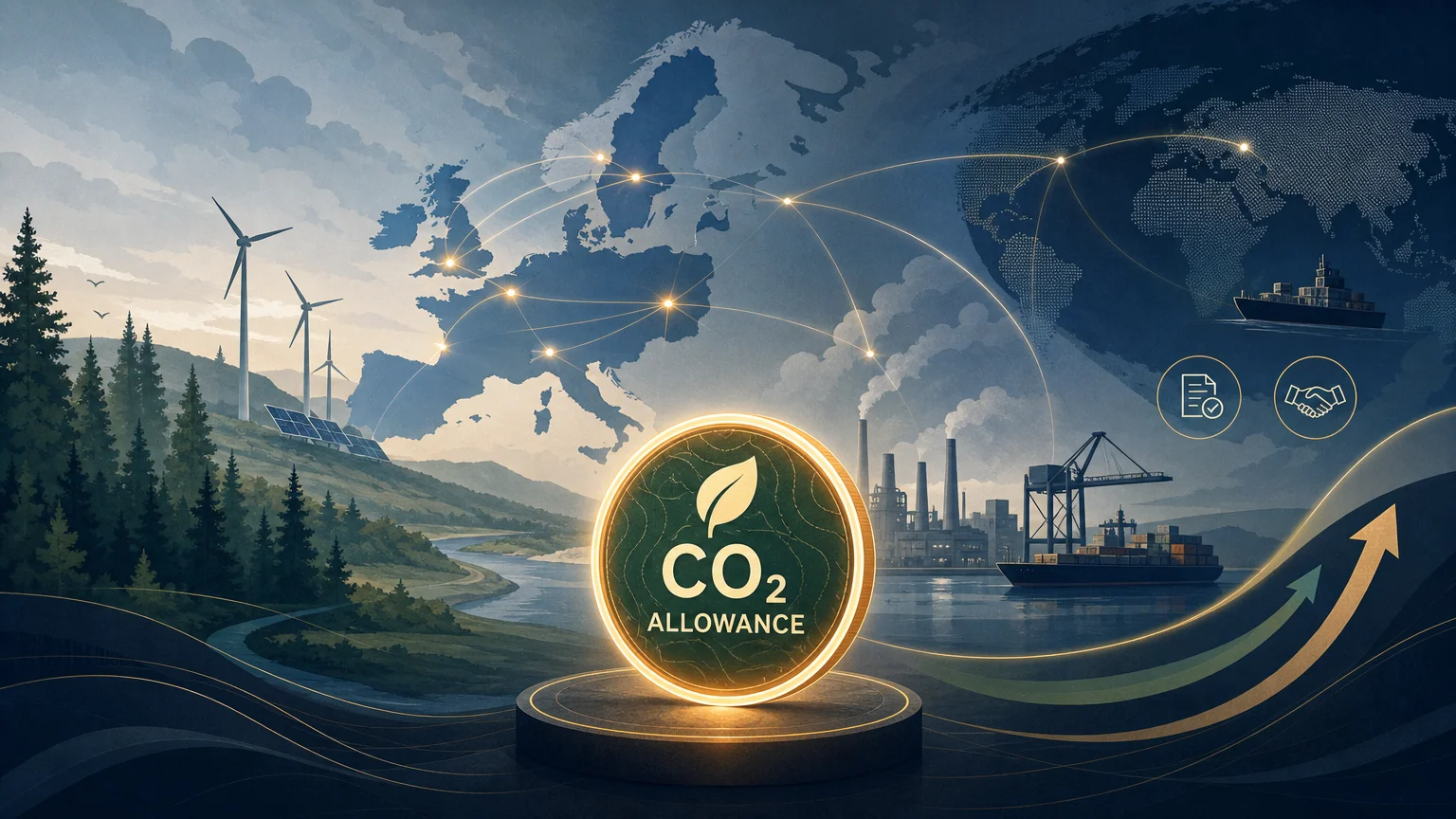


Summary: Emissions trading has cut greenhouse gas emissions in EU covered sectors by around 50% since 2005, proving cap and trade delivers measurable, cost-effective decarbonisation.
What if a single market mechanism could cut pollution from power plants and heavy industry roughly in half within two decades? That is precisely what carbon markets have achieved across Europe. By placing a firm limit on pollution and letting companies trade the right to emit, policymakers turned emissions trading into a tool for cutting greenhouse gas emissions at scale. If you want the foundations first, our explainer on emissions trading systems sets out the core mechanics.
The principle is straightforward, yet its impact has been substantial. A regulator caps total emissions, distributes or auctions allowances, and requires every covered installation to surrender one allowance per tonne emitted. According to the European Environment Agency, the EU ETS now covers around 37% of total greenhouse gas emissions across the European Economic Area, making it one of the largest carbon pricing instruments in the world.
How Emissions Trading Reduces Greenhouse Gas Emissions
The data on how emissions trading greenhouse gas emissions reduced over time is now well documented. A binding cap guarantees the environmental outcome, while the market finds the cheapest path to get there. Installations with low abatement costs reduce more and sell their surplus, while those facing higher costs buy allowances instead.
This flexibility is the heart of any cap and trade scheme. Because every tonne carries a price, each operator has a direct financial incentive to invest in cleaner technology, switch fuels, or improve efficiency. To understand the mechanics in depth, our guide to cap and trade schemes walks through allocation, surrender, and compliance step by step.

How Much Have Emissions Actually Fallen?
The headline figure is striking. EEA data show that carbon pricing, fuel switching and renewable energy policies supported a 51% decline in emissions from stationary installations between 2005 and 2024. Over the same period, sectors outside the system fell far more slowly.
The progress continued year on year. In 2024, emissions from stationary installations dropped by a further 7% compared with 2023, driven primarily by the power sector. Independent analysis from the 2025 State of the EU ETS Report estimated an overall reduction of 4.8% in 2024, noting that more than half of the 62% target set for 2030 has already been met.
These reductions are not evenly spread. The power sector has done the heavy lifting through the rise of wind and solar generation and the displacement of coal by gas. Industrial emissions have fallen more modestly, and part of that decline reflects lower production output rather than structural decarbonisation alone.
Why the Market Approach Works Cost-Effectively
Consider two factories facing the same emissions target. One can cut a tonne of CO₂ for a few euros; the other would need to spend many times more. A rigid rule forcing identical cuts wastes money. A market lets the low-cost emitter reduce more and sell allowances to the high-cost emitter, achieving the same total reduction for less.
This is why emission abatement through trading has consistently lowered compliance costs without weakening environmental goals. Banking unused allowances for future periods adds further flexibility, encouraging early reductions. If you are evaluating where to direct investment, our overview of emission abatement strategies compares the practical options available to operators.
Accessible Carbon Markets for Professional Participants
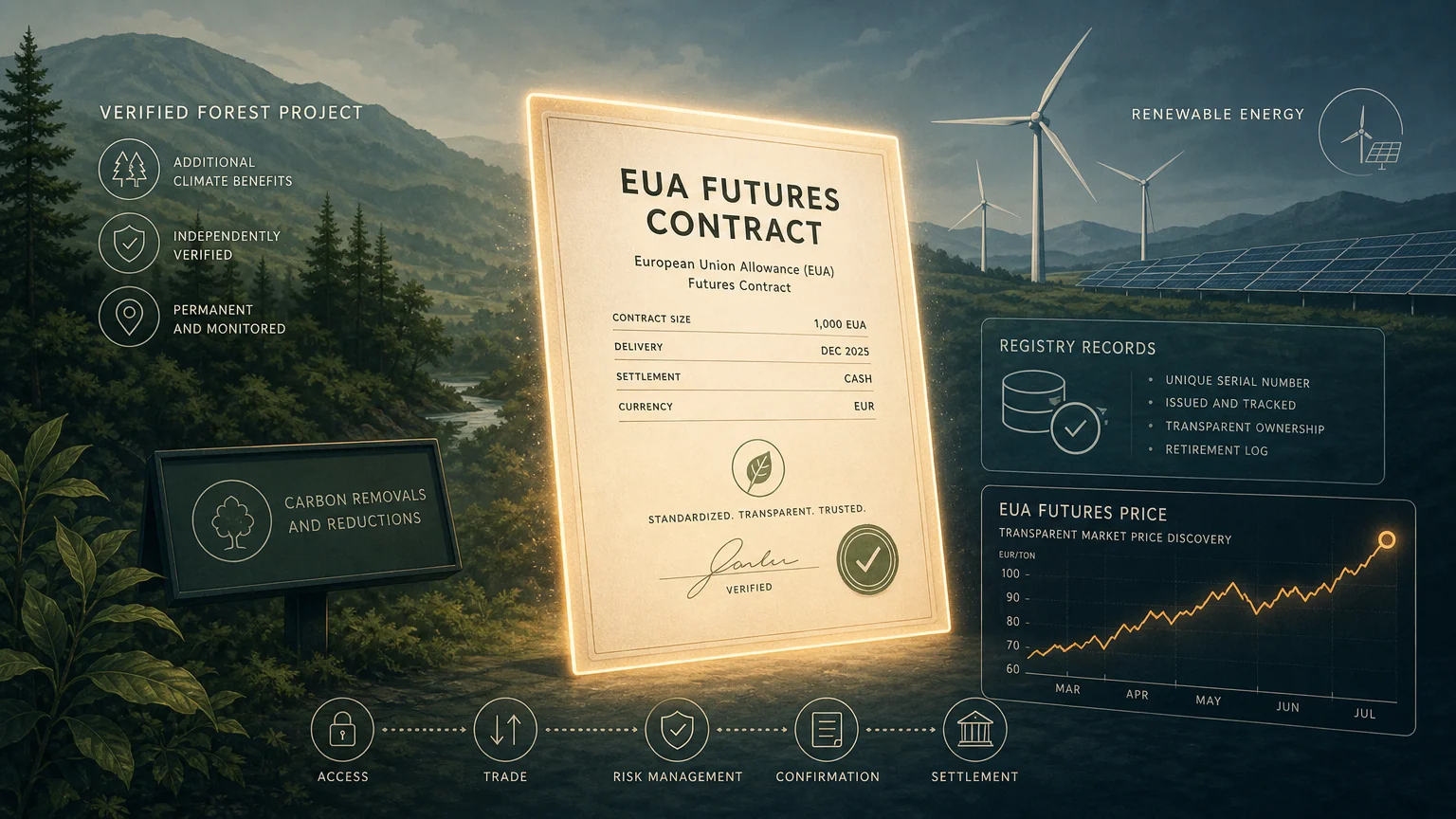
For years, participating in the carbon market meant trading in large standard lots, which kept many firms on the sidelines. We built our infrastructure to change that, allowing trades to start from a single EU Allowance, equivalent to one tonne of CO₂, rather than the traditional 1,000 EUA lot.
That difference matters for compliance operators and financial participants who need precision, transparency and speed. The table below summarises how our approach compares with the traditional exchange model.
| Criterion | Traditional exchanges | Our platform |
|---|---|---|
| Minimum trade size | Standard lot of 1,000 EUAs | From 1 EUA (1 tonne CO₂) |
| Live pricing | Often limited transparency | Transparent real-time monitoring |
| Automation | Variable | API access and configurable alerts |
| Risk controls | Variable | Pre-trade risk controls |
| Cash protection | Varies | Guaranteed up to 100 k€ by the FGDR |
Whether you manage compliance under the EU ETS or trade allowances as a financial strategy, our tools for traders and corporates are designed for professional-grade execution.

Revenue That Funds the Clean Transition
Reducing emissions is only half the story. Carbon pricing also generates significant public revenue. According to the European Commission's 2025 Carbon Market Report, the EU ETS raised €38.8 billion in 2024, bringing total lifetime revenue above €250 billion.
Cumulatively, the figures are even larger. The International Carbon Action Partnership reports that by the end of 2025 the system had raised EUR 265.7 billion since its inception. Member States have directed these funds toward renewable energy, grid and storage upgrades, building efficiency, and clean public transport.
What Comes Next for Carbon Markets
The system continues to tighten. Adjustments taking effect in 2026 include a one-off rebasing of the emissions cap and the extension of maritime coverage to methane and nitrous oxide emissions. These changes are designed to keep the trajectory aligned with the 2030 goal of a 62% reduction below 2005 levels.
A second system, ETS2, will extend carbon pricing to buildings, road transport and smaller industrial sources. Its operational launch has been scheduled for 2028, and once active it is expected to bring a far larger share of European emissions under a price signal. For market participants, this expanding scope signals deeper liquidity and growing strategic importance for carbon as an asset class.
Conclusion
The evidence is clear: by capping pollution and letting the market find the cheapest path, emissions trading has reduced greenhouse gas emissions in covered sectors by roughly half since 2005, all while raising hundreds of billions of euros for the clean transition. As caps tighten and ETS2 approaches, the carbon market will only grow in scale and relevance for compliance entities and financial participants alike. Acting early, with precise execution and transparent pricing, gives you a measurable advantage as allowances become scarcer. Our platform lets you trade from a single tonne with real-time monitoring and professional-grade risk controls, removing the barriers that once kept participants out. To take the next step, explore our exchange for traders and corporates and start trading on your terms.
Frequently Asked Questions
How does emissions trading reduce greenhouse gases?
A regulator sets a binding cap on total emissions and issues a matching number of tradable allowances. Companies that cut emissions cheaply can sell their surplus, which rewards low-cost reductions and guarantees the overall environmental target is met.
How much has the EU ETS reduced emissions?
Emissions from stationary installations fell by around 51% between 2005 and 2024. The power sector drove most of this decline through renewable expansion and the shift away from coal.
Can smaller participants access the carbon market?
Yes. Traditional exchanges typically use 1,000 EUA lots, but our platform allows trading from a single EU Allowance, with API access and pre-trade risk controls suited to professional clients of all sizes.