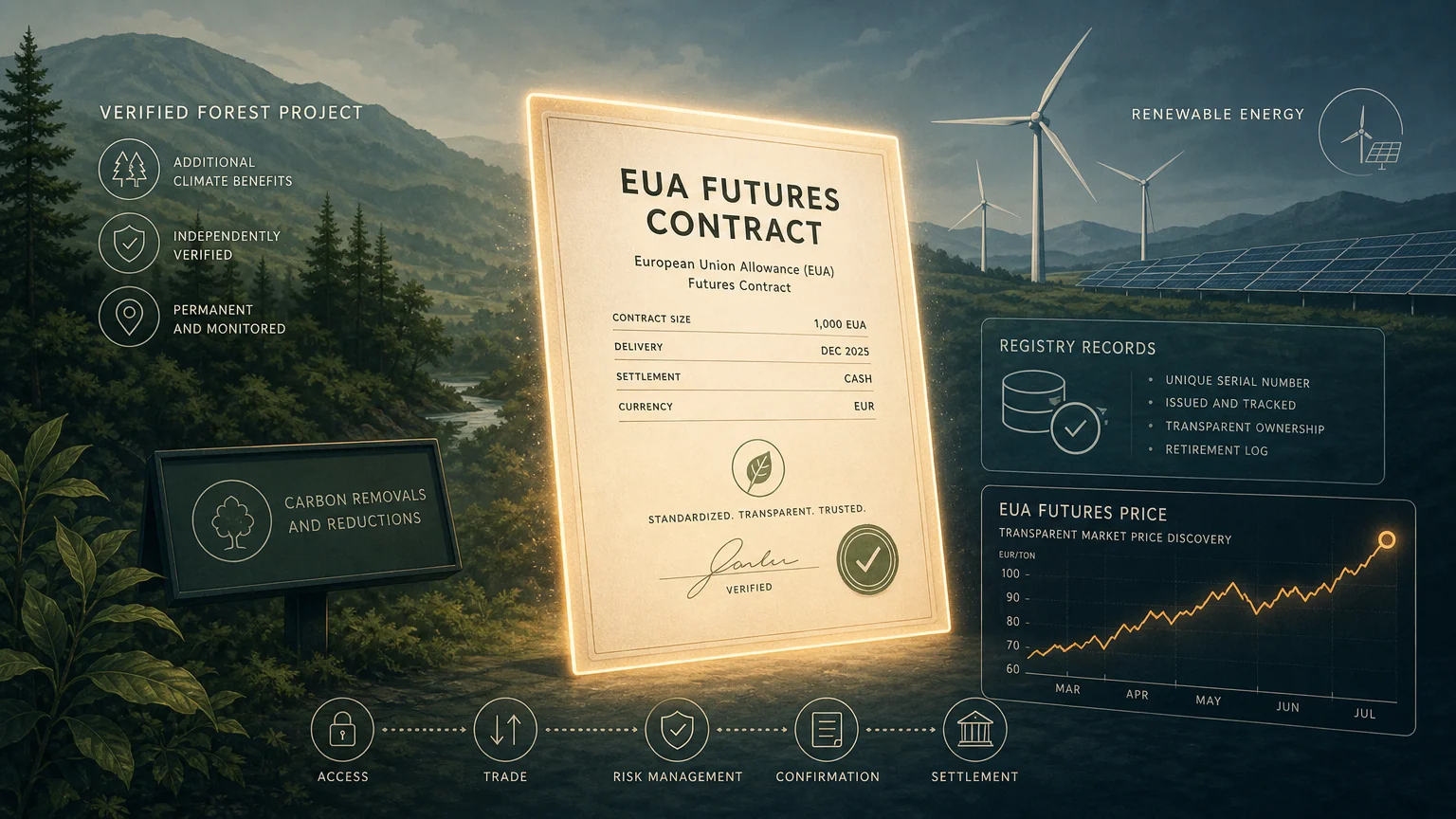

Summary: EU allowances (EUAs) are tradable permits, each covering one tonne of CO₂, used for compliance under the EU Emissions Trading System. In mid-2026, they trade around €80.
One permit. One tonne of carbon dioxide. That is the simple unit at the centre of the world's largest carbon market, where prices have hovered around €80 per tonne through 2026. Behind that single figure sits a complex ecosystem of auctions, compliance deadlines, and financial trading that shapes the cost of emitting across European industry. If you want a deeper primer on the mechanics, our EU Carbon Market Allowances: How EUAs work in 2026 guide breaks down the fundamentals step by step.
Understanding EU carbon allowances matters because the price they carry feeds directly into electricity bills, manufacturing costs, and investment decisions across the continent. According to the European Commission, prices fluctuated between EUR 60 and EUR 80 throughout 2025, reflecting a market that is maturing while remaining sensitive to policy and energy shifts.
What EU allowances are and how cap-and-trade works
An EU Allowance (EUA) is a permit to emit one tonne of carbon dioxide equivalent. The concept of EU allowances sits at the heart of a "cap and trade" system: a ceiling is placed on total emissions, and that ceiling falls every year. The European Commission confirms that as the cap decreases, the supply of allowances to the market shrinks, reinforcing long-term scarcity and underpinning the carbon price.
The compliance cycle is straightforward in principle. Covered companies must monitor their emissions, then surrender enough allowances to match what they released the previous year. If they emit less than expected, they may bank the surplus for future use or sell it. If they emit more, they must buy additional permits or face heavy fines.
Allowances reach the market in two ways: through auctions, which are the default method, and through free allocation granted to sectors at risk of carbon leakage. The system, launched in 2005, is now in its fourth trading phase running from 2021 to 2030. Average auction prices have moved with energy markets; the official EU carbon market report recorded an average of EUR 64.74 in 2024, down from EUR 83.60 in 2023.

Who trades EUAs and how the market is structured
The carbon market is no longer a closed loop of industrial emitters. Since 2018, EU allowances have been classified as financial instruments under MiFID II, opening the door to banks, investment funds, and brokers who add liquidity and absorb price risk. Compliance entities, financial intermediaries, and increasingly maritime operators now interact across a deep secondary market.
The scale is considerable. According to the ESMA carbon markets report, 599 million allowances were auctioned on the Common Platform in 2024, raising roughly EUR 39 billion. Most trading, however, happens on the secondary market through spot and derivatives contracts rather than at the auctions themselves.
One structural feature has historically limited access: trade sizes. Traditional exchanges typically use a standard lot of 1,000 EUAs, equivalent to 1,000 tonnes of CO₂, which prices out smaller participants. This is precisely the barrier our platform removes by allowing you to trade from a single EUA, giving compliance teams and financial participants far more granular control over exposure.
What drives the EUA price in 2026
Why does the carbon price move? Demand for allowances tracks real economic activity: industrial output, heating demand during cold spells, and the share of electricity generated from wind and solar. When renewables surge, fossil generation falls, fewer allowances are needed, and prices soften. Supply, by contrast, is set by policy and declines predictably each year.
In 2026, the benchmark has traded close to €80 per tonne, with recent quotes near €81, the highest level since February 2026. That recovery follows a softer 2024 and reflects renewed confidence in the tightening emissions cap. For a fuller view of the trajectory and forecasts, our EUA Price in 2026 analysis examines the drivers in detail.
Looking further out, analysts expect continued upward pressure as supply contracts. BNEF forecasts ETS prices reaching €149 per tonne by 2030, while longer-horizon modelling from Enerdata projects a rise from €75 in 2025 toward a €400 to €630 range by 2050 under current design assumptions.
Spot, futures, and how to access the market efficiently
EUAs can be traded for immediate delivery (spot) or for delivery at a future date (futures and options). Compliance buyers often use futures to lock in costs ahead of surrender deadlines, while financial participants use them to hedge or take directional positions. Both forms reference the same underlying tonne of carbon, usually at slightly different prices.
Access has traditionally been the friction point. High minimum lot sizes, limited transparency on live pricing, and the need to integrate trading with internal risk systems have kept many participants on the sidelines. We designed our exchange to address exactly these problems, with transparent live pricing, pre-trade risk controls, and API-enabled automation built for professional workflows.
The table below compares the practical access characteristics that matter most to a desk weighing where to trade.
| Criterion | Our exchange | Traditional carbon exchanges |
|---|---|---|
| Minimum trade size | From 1 EUA (1 tonne CO₂) | Standard lot of 1,000 EUAs |
| Live pricing | Transparent, real-time monitoring | Often limited transparency |
| Risk controls | Pre-trade controls built in | Variable |
| Automation | API access for automated trading | Variable |
| Custody | Segregated cash account with clearing support | Varies by venue |
For desks that need smaller tickets, faster execution, and integration with existing systems, our infrastructure is purpose-built for traders and corporates operating under the EU ETS.

The road ahead: tighter caps, CBAM, and ETS2
The direction of travel is clear. The cap is being tightened to cut covered emissions by 62% by 2030 compared with 2005 levels, and free allocation is being scaled down and made conditional on decarbonisation. For aviation, free allowances are fully phased out as of 2026, increasing demand for purchased permits in that sector.
Two further reforms reshape the landscape. The Carbon Border Adjustment Mechanism (CBAM) enters its definitive stage in 2026, applying carbon costs to selected imports as free allocation is withdrawn from CBAM-covered sectors. Separately, a second system, ETS2, will cover buildings and road transport, with futures already trading on ICE since May 2025 at around €75 per tonne.
Revenue from the system continues to climb. By mid-2025, the EU ETS had raised EUR 245 billion since its launch, funding renewable energy, efficiency, and the social cushioning of carbon pricing. For market participants, the message is consistent: scarcity is built into the design, and the cost of carbon is set to matter more, not less.
Conclusion
The logic of EU carbon allowances is deliberately simple yet powerful: a falling cap, a fixed unit of one tonne, and a price that rises as supply tightens. With the benchmark trading near €80 in 2026 and credible forecasts pointing toward €149 by 2030, the cost of emitting is becoming a central line in corporate budgets. The practical question is no longer whether to engage with the carbon market, but how to do so efficiently, with the right trade sizes, transparency, and risk controls. That is where a programmable exchange designed around smaller tickets, live pricing, and API automation gives professional participants a decisive operational edge. To take the next step, discover our exchange for traders and corporates and request demo access.
Frequently Asked Questions
How much does one EU allowance cost in 2026?
In mid-2026, EUAs have traded close to €80 per tonne, with recent quotes near €81. Prices fluctuated between roughly €60 and €80 across 2025, and they move with energy markets and policy signals.
Who can trade EU allowances?
Compliance entities under the EU ETS, banks, trading firms, asset managers, hedge funds, and carbon brokers can participate. Since 2018, EUAs are classified as financial instruments under MiFID II. Our platform serves these professional clients with onboarding subject to KYC and KYB requirements.
What is the difference between spot and futures EUAs?
Spot contracts settle with near-immediate delivery, while futures settle at a future date. Compliance buyers often use futures to lock in costs ahead of surrender deadlines, whereas spot is used for immediate positioning.