




With carbon allowance prices climbing to their highest levels since early 2026 and major regulatory milestones taking effect, the EU carbon market is entering a transformative phase. If you operate in energy, heavy industry, aviation, or maritime transport, or if you trade carbon as a financial instrument, understanding how emissions trading systems work is no longer optional. It is a strategic requirement.
This EU carbon market guide covers the system's structure, the forces driving prices, and upcoming regulatory changes that will reshape compliance costs and trading opportunities. Whether you are a compliance entity, a financial participant, or an institutional investor evaluating carbon as an asset class, the sections below provide a clear, up-to-date foundation for informed decision making.
What Is the EU Emissions Trading System?
The EU ETS cap is expressed in emission allowances, with one allowance giving the right to emit one tonne of CO₂ equivalent. Launched in 2005, the EU ETS is the world's first and largest carbon market, covering about 40% of EU greenhouse gas emissions, including power plants, heavy industry, intra-EU aviation, and, since 2024, maritime shipping.
The system operates on a cap-and-trade principle. A government-set ceiling limits total emissions; that ceiling is divided into tradable units called European Union Allowances (EUAs). Allowances are sold in auctions and may be traded; as the cap decreases, so does the supply of allowances to the EU carbon market. For a deeper look at this mechanism, see our guide on how cap and trade schemes work.
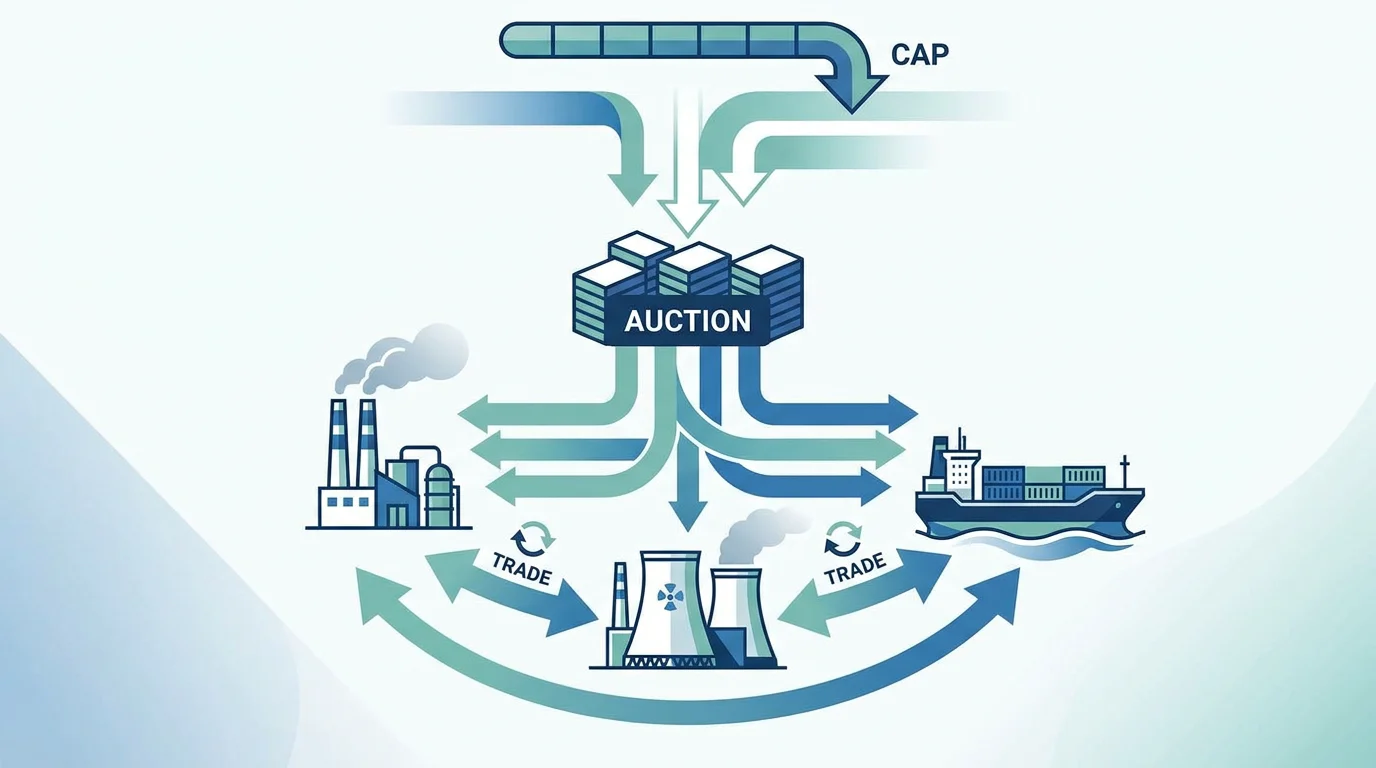
Under the system, companies must monitor and report their emissions on a yearly basis and surrender enough allowances to fully account for their annual emissions. If these requirements are not met, heavy fines are imposed. This compliance obligation is what gives EUAs their intrinsic value and liquidity.
How EUA Prices Have Evolved and Where They Stand
Price history tells a story of structural reform. The ETS1 carbon price increased to levels well above EUR 50 per tonne of CO₂ since 2021, after the introduction of the Market Stability Reserve in 2018 helped re-balance supply and demand of allowances. Subsequently, the strengthening of the system in line with the target to reduce net greenhouse gas emissions by at least 55%, together with the energy crisis caused by Russia's war against Ukraine, pushed average carbon prices up to EUR 80 in 2022 and 2023, before they decreased to EUR 65 in 2024.
In 2025, prices fluctuated between EUR 60 and EUR 80. As of late June 2026, EU Carbon Permits increased to EUR 81.35, the highest since February 2026, gaining 5.32% over a four-week period and rising 10.32% year on year. This recovery reflects tightening supply dynamics and growing market confidence in the regulatory framework's long-term credibility.
For participants seeking to monitor these movements in real time, our EU carbon market allowances resource explains exactly how EUAs function within the trading cycle.
Phase 4 Reforms: A Tighter Cap and Greater Ambition
The EU ETS is currently in its fourth trading phase (2021 to 2030). The 2023 revision of the ETS Directive, adopted under the "Fit for 55" legislative package, introduced significant changes that are now shaping market conditions.
The cap has been tightened to bring emissions down by 62% by 2030 compared to 2005 levels, covering maritime transport emissions included from 2024. Free allocation has been scaled down and made conditional on companies' decarbonisation efforts, and for the aviation sector, free allocation is being removed as of 2026.
The Market Stability Reserve has been revised to foster balance in the reformed carbon market. Member States have committed to using all EU ETS revenues, or the financial equivalent, towards climate action and a just green transition, and the Innovation Fund and Modernisation Fund budgets have been increased accordingly. According to the European Commission, the system had raised over EUR 175 billion in cumulative auction revenue by 2024.
CBAM: The Carbon Border Adjustment Mechanism
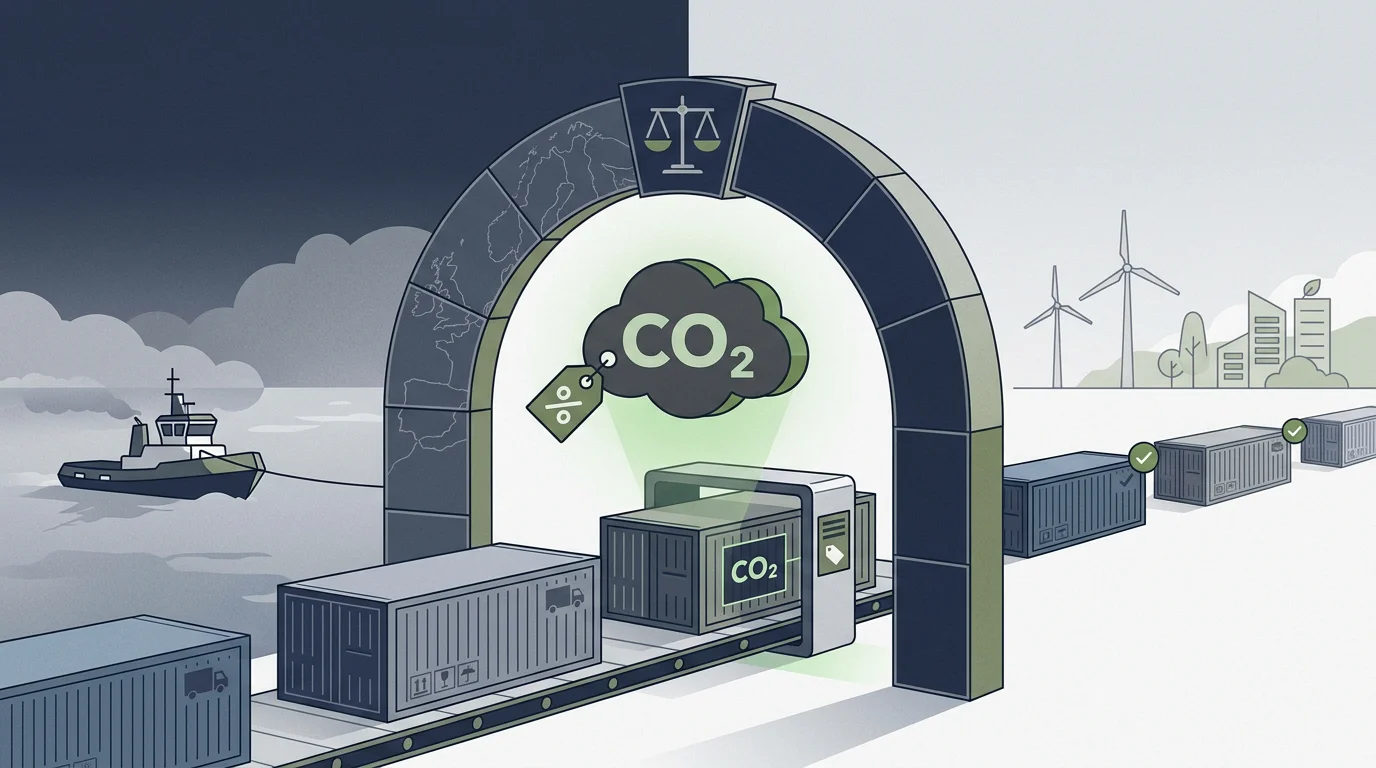
One of the most consequential additions to the EU carbon pricing architecture is the Carbon Border Adjustment Mechanism (CBAM). As of 2026, CBAM will gradually replace the free allocation of ETS1 allowances as the main policy tool to mitigate carbon leakage risks.
CBAM ensures that the ETS1 carbon price also applies to imports, levelling the playing field for EU and non-EU producers on the internal market. It covers electricity, iron and steel, aluminium, cement, fertilisers, and hydrogen products, corresponding to around 54% of the free allowances under ETS1 in the 2021 to 2025 period.
In January 2026, full enforcement began: importers must buy CBAM certificates at the previous-quarter EUA average price. The Q1 2026 CBAM certificate price was EUR 75.36 per tonne of CO₂ equivalent, announced by the Commission in April 2026. The transition is gradual: ETS1 free allowances for CBAM-covered sectors will be reduced by 2.5% in 2026 and 5% in 2027.
ETS2: Extending Carbon Pricing to Buildings and Transport
Beyond the established ETS1, a second emissions trading system is on the horizon. A new emissions trading system, called ETS2, has been created to cover emissions from buildings, road transport, and additional sectors. ETS2 is a separate scheme that adds road transport and building heating fuels to the carbon market from 2027.
ETS2 nearly doubles the share of EU greenhouse gas emissions covered by carbon pricing, to around 75%. The Social Climate Fund will mobilise EUR 86.7 billion from the ETS2 revenue in the 2026 to 2032 period to support vulnerable households and micro-enterprises affected by the expansion.
The precise starting price of ETS2 allowances remains uncertain. According to the European Commission's economic analysis, the modelled ETS2 carbon price for 2030 is EUR 48 per tonne in 2015 prices, corresponding to approximately EUR 69 in 2030 prices. This represents an entirely new asset class for financial participants already active in ETS1.
The 2026 ETS Directive Revision: What to Expect
This year marks a pivotal regulatory juncture. A revision of the ETS directive and the MSR decision is planned for 2026, opening the way to reform different aspects of the EU ETS with regard to its future ambition, scope, and design.
Several structural changes are under discussion. The currently legislated cap trajectory would reach zero emissions around 2040, a timeline judged unrealistic by a majority of stakeholders. The inclusion of additional sectors related to waste and carbon capture utilisation is being considered, as is the option to introduce removals into the system. Changes in the MSR design are also expected, including a possible redefinition of thresholds and intake and release rates, and the suppression of the invalidation mechanism.
According to Enerdata's carbon price forecast, the 2026 revision is precisely expected to induce significant changes in the ETS and MSR designs, to prepare for the next decades where the ETS will switch to a situation of allowance scarcity. For traders and compliance entities alike, these reforms will directly affect long-term price trajectories and hedging strategies.
How to Participate in the EU Carbon Market
Participation in the EU carbon market falls into two broad categories: compliance trading and financial trading. Compliance entities, such as power plants and industrial operators subject to the EU ETS, must acquire and surrender allowances to cover their verified emissions each year. Financial participants, including banks, asset managers, hedge funds, and carbon brokers, trade EUAs as instruments for speculation, hedging, or portfolio diversification.
Both groups access the market through regulated exchanges and trading platforms. Historically, the standard lot size on legacy exchanges has been 1,000 EUAs, creating a significant barrier for smaller participants or those seeking granular position management. Our ETS trading platforms overview explains the access options available.
We have designed our exchange to address these barriers directly. With trade sizes starting from just 1 EUA (equivalent to 1 tonne of CO₂), competitive fees, real-time transparent pricing, and API-enabled automation, our platform serves both compliance and financial participants who need faster execution and finer control over their carbon positions.
Key Risks and Considerations for Market Participants
Regulatory risk remains the most significant factor. As the 2026 revision demonstrates, changes to the cap, the MSR, or free allocation rules can move prices substantially. All of those possible outcomes contribute to an even broader uncertainty as to the carbon price range in the years to come.
Liquidity risk is another consideration, particularly for futures contracts dated beyond 2026. Future markets signal only slight ETS1 price increases by 2027: around EUR 2 higher in December 2026 than in December 2025, and EUR 4 higher in December 2027, with limited liquidity on the future market beyond 2026.
Political risk also warrants attention. In early 2026, the Commission proposed a "simplification omnibus" responding to industry complaints about administrative burden, with key proposed changes including combining quarterly reporting into annual and exempting SMEs below 100 ktCO₂ per year from the EU ETS. While the cap and the price-discovery mechanism remain unchanged, such proposals reflect ongoing political negotiation around the system's scope and stringency.
Robust pre-trade risk controls, real-time price monitoring, and configurable alerts are essential tools for managing exposure in this environment. These are core features of our platform, designed to help you navigate volatility with confidence.
Conclusion: Navigating a Market Built for Scarcity
The EU carbon market is entering a period defined by tightening supply, expanding scope, and heightened regulatory ambition. With EUA prices above EUR 80 per tonne in mid-2026, CBAM now in full enforcement, ETS2 set to launch in 2027, and a major directive revision under way, the market offers both compliance obligations and significant trading opportunities. The participants best positioned to benefit are those with transparent pricing data, flexible trade sizing, and automated execution capabilities. Our programmable exchange for EU carbon allowances provides exactly that, with trade sizes from 1 EUA, competitive fees, and API integration for professional-grade market access. Explore our carbon trading platform for corporates and traders and take the next step.
Frequently Asked Questions
What is one EU Allowance (EUA) worth?
One EUA grants the holder the right to emit one tonne of CO₂ equivalent. As of late June 2026, EUAs traded at approximately EUR 81 per tonne. Prices fluctuate based on supply, demand, energy prices, and regulatory developments within the EU ETS framework.
Who is required to participate in the EU ETS?
The EU ETS covers power generators, energy-intensive manufacturers, intra-EU aviation operators, and, since 2024, maritime transport operators. From 2027, ETS2 will extend carbon pricing to buildings, road transport, and smaller industrial emitters. Both compliance entities and financial participants such as banks and trading firms may trade allowances.
Can smaller organisations trade EUAs without large lot sizes?
Traditionally, exchanges required a minimum lot of 1,000 EUAs, which represented a substantial capital commitment. Our exchange allows trading from just 1 EUA, making the market accessible to a wider range of compliance entities and financial participants seeking precise position sizing.

Let’s connect
Do you want more information about what we do?