




In 2024, the EU Emissions Trading System generated €38.8 billion in auction revenues, underscoring the financial magnitude of the world's largest carbon market. For compliance entities, banks, trading firms, and asset managers, understanding the auction calendars for the EU ETS is not merely an administrative exercise; it is a prerequisite for effective price risk management and capital deployment.
In 2026, several structural changes reshape the auction landscape. A revised European Climate Law, the introduction of Social Climate Fund volumes, and a fresh Market Stability Reserve intake period all affect the supply of allowances reaching the market. This article breaks down the current calendar structure, the key volumes, and the regulatory mechanisms that every carbon market participant should monitor. Whether you procure allowances for compliance or trade them as financial instruments, precise calendar intelligence can sharpen your execution and reduce timing risk.
How the 2026 Auction Calendar Is Structured
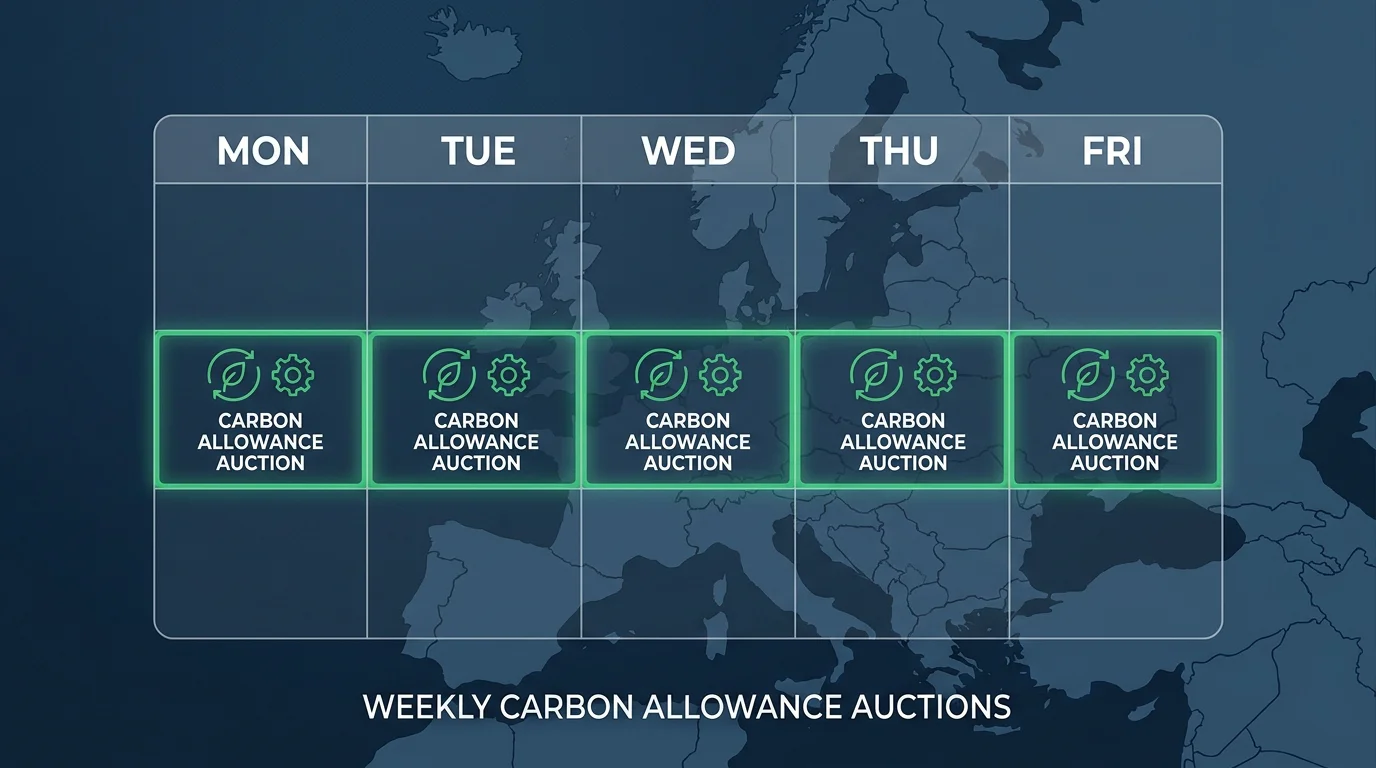
EEX holds EUA auctions in the framework of the common EU auction platform (CAP3) on behalf of 25 EU member states, the EEA EFTA states, as well as the Innovation Fund, the Modernisation Fund, the InnoFundRRF, and the MS RRF. The calendar follows a weekly rhythm with distinct days assigned to different mandates.
The CAP3 auctions are scheduled to take place on Mondays, Tuesdays, and Thursdays during the period from 8 January to 14 December 2026. The weekly EUA auctions on behalf of the Federal Republic of Germany are conducted by EEX on Fridays, between 9 January and 11 December 2026. EUA auctions on behalf of Poland are scheduled bi-weekly on Wednesdays, between 7 January and 9 December 2026.
The bidding window for each EUA auction conducted by EEX is open from 9:00 to 11:00 a.m. CE(S)T. This two-hour window applies uniformly across all mandates, giving bidders a consistent participation schedule throughout the year.
Indicative Auction Volumes for 2026
The total supply of allowances reaching the primary market in 2026 is distributed across four mandates. Based on the EEX auction calendar data, the indicative volumes are as follows:
| Mandate | Auction Day(s) | Indicative 2026 Volume (EUAs) |
|---|---|---|
| CAP3 (25 EU Member States, EEA EFTA, Funds) | Monday, Tuesday, Thursday | 408,235,500 |
| Germany | Friday | 71,334,500 |
| Poland | Wednesday (bi-weekly) | 48,705,500 |
| UK (Northern Ireland) | 7 October 2026 | 782,000 |
These figures reflect updates published through mid-2026. The volumes from September to December 2026 are indicative, as they are subject to adjustments in accordance with Article 14 of the Auctioning Regulation in view of the implementation of the Market Stability Reserve.
For Germany specifically, the German Emissions Trading Authority (DEHSt) confirmed that the calendar was adjusted for the period from June to December 2026 to incorporate provisions of the amended European Climate Law. The auction volume reduction for Germany in this period amounts to about 12 million EUA compared with the calendar published in July 2025.
The Market Stability Reserve and Its Impact on Supply
No discussion of the EU ETS primary auction market is complete without addressing the Market Stability Reserve. The MSR is the mechanism that automatically adjusts auction supply to maintain market balance, withdrawing allowances when surplus is high and releasing them when supply is tight.
For the September 2025 to August 2026 period, the operation of the MSR resulted in 275,531,900 allowances being placed in the reserve. Looking ahead, the European Commission announced in May 2026 that a total of 190,494,202 allowances will be placed in the MSR over a 12-month period from 1 September 2026 to 31 August 2027.
The TNAC is the annual surplus indicator that determines the functioning of the MSR; in 2025, the TNAC stood at 1,023,494,202 allowances. A decrease in the auction volumes will be reflected in the auction calendars that will be adopted around July 2026. This means the September through December 2026 volumes shown above are preliminary and will likely be revised downward.
Additionally, on 1 April 2026, the Commission proposed an amendment to the Market Stability Reserve Decision to strengthen the instrument that ensures a stable, well-functioning carbon market. Under the current system, all allowances in the reserve above 400 million are invalidated; the proposed amendment would stop the invalidation mechanism, allowing these allowances to be kept as a buffer. If adopted, this reform could materially change the long-term supply outlook.
Social Climate Fund and REPowerEU: New Volume Drivers
Two policy instruments have added substantial volume to the 2026 auction calendars. First, the Social Climate Fund (SCF) now draws proceeds from the auctioning of 50 million additional allowances, following the revised European Climate Law adopted in March 2026. Auctioning of allowances in the EU ETS raises revenues for national budgets, the Innovation Fund, the Modernisation Fund, and, starting in 2026, the Social Climate Fund.
According to the European Commission's May 2026 revision, 10 million of the 50 million SCF allowances were sourced from volumes originally allocated to Member States, resulting in a net downward adjustment for individual countries.
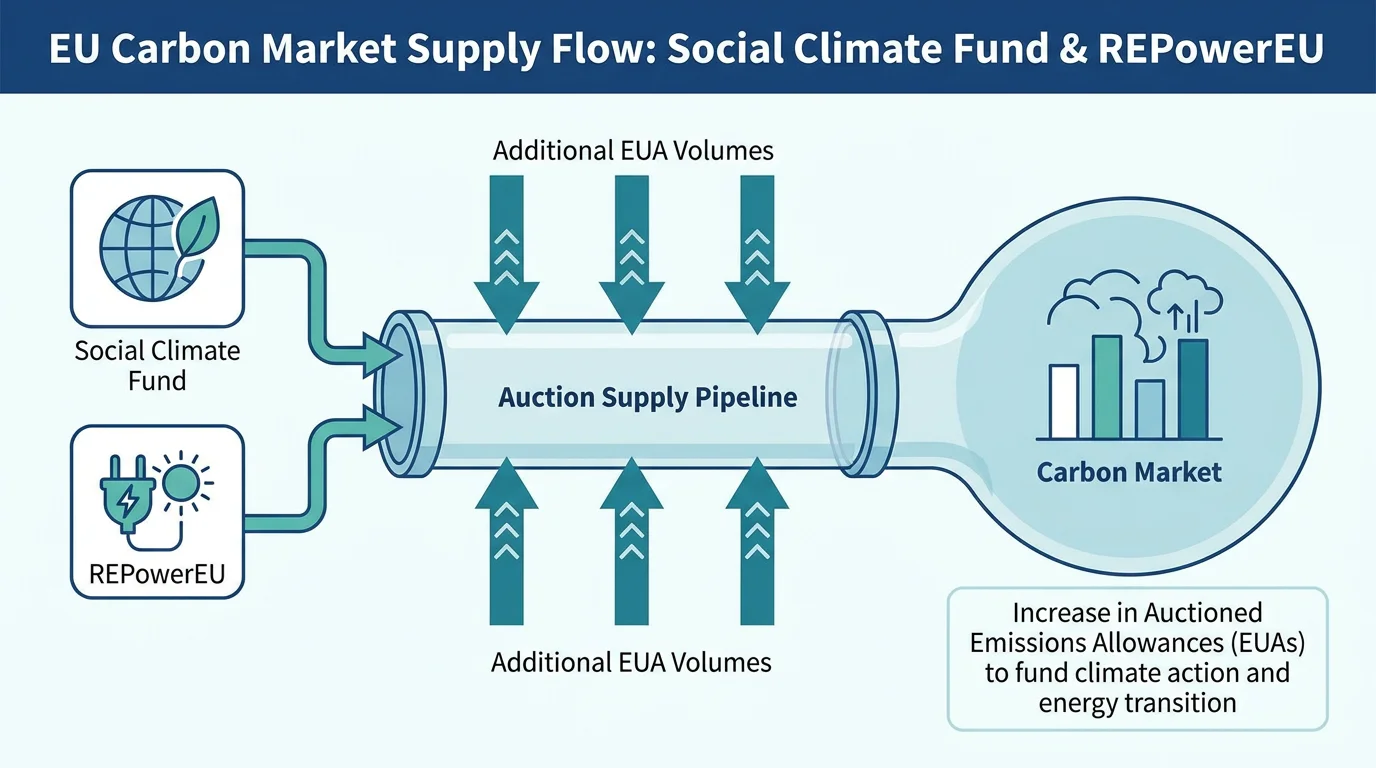
Second, the Recovery and Resilience Facility (RRF) under the REPowerEU programme continues to draw on auction proceeds. The REPowerEU volume in 2026 was adjusted to 93,280,000 allowances, principally through transfer of allowances that would have otherwise been auctioned for the Innovation Fund, while 14 million additional allowances allocated to Member States in the years 2027 to 2030 will be auctioned. Auctioning of allowances allocated to the Recovery and Resilience Facility will stop once the revenue targets for this Facility are reached, at the latest on 31 August 2026.
Northern Ireland and the Windsor Framework
Since 1 January 2021, the EU ETS Directive has continued to apply to and in the UK with respect to the generation of electricity in Northern Ireland, and in accordance with the Protocol on Ireland/Northern Ireland (the "Windsor Framework"), the UK will auction a volume of allowances corresponding to its share in the Union-wide cap.
One auction for Northern Ireland will take place on 7 October 2026. While the volume is modest at 782,000 EUA, the existence of this separate auction track is a regulatory detail that compliance teams should note in their planning.
Maritime Adjustments Still Pending
Maritime transport was included in the EU ETS from 2024, with shipping companies required to surrender allowances for a share of their verified emissions. The auction volumes for 2026 do not yet include any adjustments for the cancellation of maritime allowances provided for in Article 3gb and 12(3-e) of the ETS Directive; as the cancellation will be based on the difference between reported emissions and surrendered allowances, these numbers will be calculated after surrendering has taken place, and the cancellation of auction volumes for maritime will be deducted from the 2026 auction volume through an amendment to the auction calendars.
This pending adjustment introduces a degree of uncertainty into the volumes from September onward. Participants who rely on precise supply forecasts for their trading or hedging strategies should monitor the revised calendars expected around July 2026.
How to Access EU ETS Auctions
Participation in EUA primary auctions requires meeting eligibility and admission criteria set out in Articles 18 and 19 of the Auctioning Regulation. The EU Auctioning Regulation defines the categories of participants who are eligible to apply to bid in the auctions and requires certain admission criteria to be fulfilled. Direct access through EEX involves exchange membership and a clearing arrangement with European Commodity Clearing (ECC).
For many participants, however, the primary auction channel is only one piece of the puzzle. The secondary market, where EUAs trade continuously on spot and derivatives platforms, often provides more flexibility in terms of trade sizing and execution timing. Platforms that allow you to trade from as little as 1 EUA, rather than the traditional 1,000 EUA lot, open the door to more precise position management. Our programmable exchange for EU carbon allowances is designed to offer exactly this kind of granular access with real-time pricing and API-enabled automation.
Turning Calendar Intelligence into Trading Advantage
Auction days often generate predictable patterns in the secondary market. Supply arriving on the primary market can create short-term price pressure, while weeks with fewer auctions (such as holiday periods or the gap between the last CAP3 auction and end-of-year compliance deadlines) may see tighter liquidity.
Sophisticated participants use auction calendar data to time their procurement or hedging activity. For example, monitoring the weekly volumes and comparing them to secondary market depth can reveal when the market is absorbing supply smoothly and when price dislocations may arise. Our configurable alerts and pre-trade risk controls help you automate these signals so you do not need to monitor calendars manually.
Additionally, the MSR-driven volume reductions from September onward could tighten supply just as compliance demand picks up in the final quarter. Understanding this seasonal dynamic is critical for anyone managing a compliance portfolio or a speculative carbon position.
Conclusion
The EU ETS auction calendars for 2026 reflect a market in transition. With 190 million allowances set to enter the Market Stability Reserve from September 2026 to August 2027, supply tightening remains a dominant theme. The addition of Social Climate Fund volumes and the expiry of REPowerEU auctioning by August 2026 create a shifting supply profile that demands close attention. Maritime adjustments, still pending, add a further variable. For any participant operating in the European carbon market, whether for compliance or financial returns, staying ahead of these calendar revisions is not optional.
A platform that combines transparent pricing, flexible trade sizes starting from 1 EUA, and automated monitoring tools can transform how you respond to auction-driven market dynamics. Explore our programmable exchange for EU carbon allowances and gain the execution edge that calendar intelligence demands.
Frequently Asked Questions
When are EU ETS auctions held in 2026?
CAP3 auctions take place on Mondays, Tuesdays, and Thursdays; German auctions are held on Fridays; and Polish auctions occur bi-weekly on Wednesdays. All bidding windows run from 9:00 to 11:00 a.m. CE(S)T. A single Northern Ireland auction is scheduled for 7 October 2026.
How does the Market Stability Reserve affect auction volumes?
The MSR automatically reduces auction supply when the total number of allowances in circulation exceeds a defined threshold. For the September 2026 to August 2027 period, approximately 190 million allowances will be placed in the reserve, reducing the volumes available on the primary market during the final quarter of 2026.
Can smaller participants access EU carbon allowances without bidding in auctions?
Yes. The secondary market provides continuous access to EUAs without the regulatory and operational requirements of primary auction participation. Our exchange allows trading from just 1 EUA with real-time pricing and API integration, making it accessible to participants of all sizes.




Let’s connect
Do you want more information about what we do?