


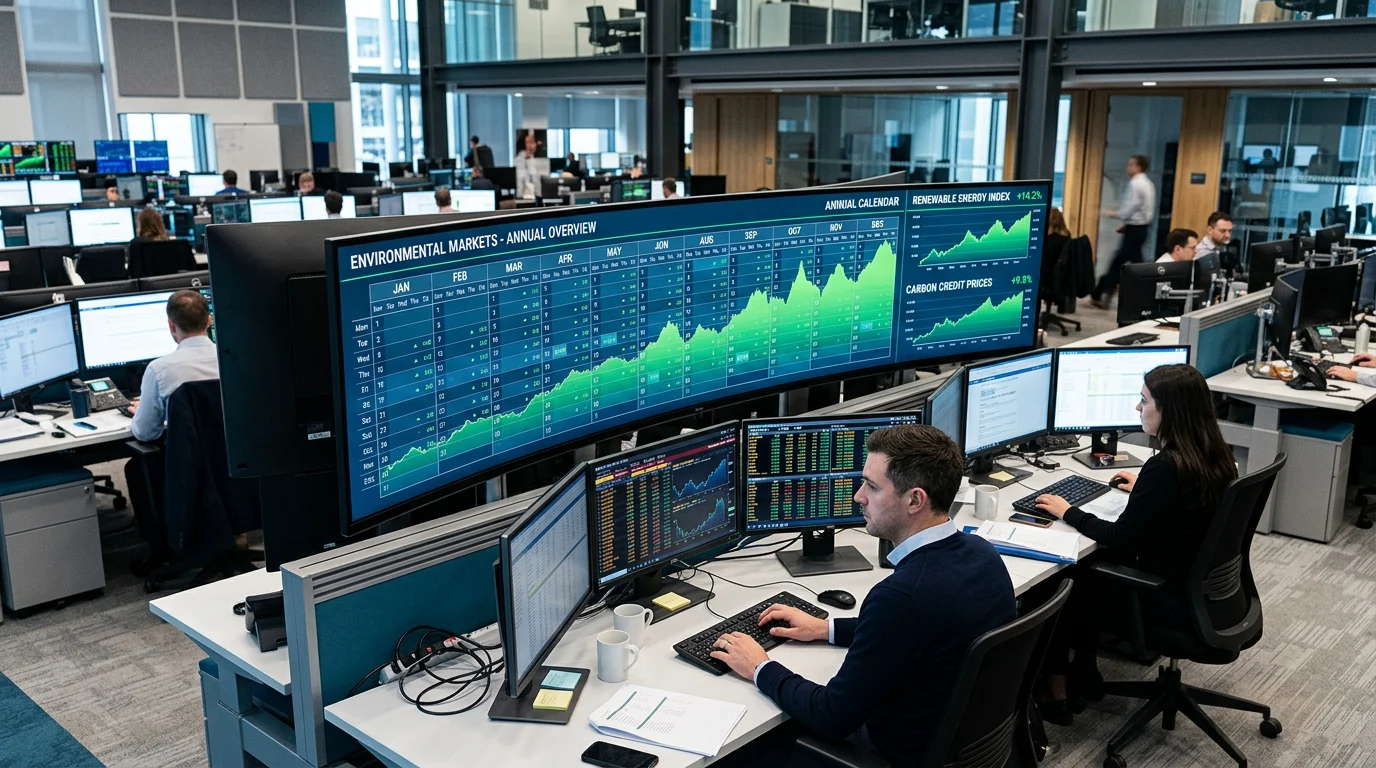

In 2024 alone, the European carbon market generated tens of billions of euros in auction revenues, a scale that makes every scheduling decision consequential. For anyone buying, selling, or hedging carbon exposure, the auction calendars for eu ets are the primary reference for supply timing. If you plan positions without them, you plan blind. For a practical primer on scheduling mechanics, you may consult our EU ETS auction calendars resource.
The timetable is not static. It fixes auction days, bidding windows, and yearly volumes, yet it is revised during the year to reflect policy and market triggers. According to the European Commission, since 2013 the EU ETS generated over €230 billion in auction revenues, and in 2024 alone the system generated a total of €38.8 billion. Understanding how the calendar governs that flow is essential for informed participation.
What the auction calendar is and who publishes it
At its core, the EU ETS auction schedule is the published list of primary auctions for EU Allowances across a calendar year. Each entry specifies the auction date, the platform, the volume offered, and the bidding window. Together, these entries determine how much fresh supply reaches the market and when. An EU Allowance represents the right to emit one tonne of carbon dioxide equivalent.
The calendar does not appear by chance. The European Energy Exchange prepares and publishes it in coordination with the European Commission, EU Member States, and the EEA EFTA States that auction on the common auction platform. National authorities in Germany and Poland coordinate their own sales. The rules that frame these auctions are set out in the EU Auctioning Regulation, which covers timing, administration, and eligibility. For the participation requirements that sit alongside the timetable, you may review our overview of the EU ETS rules for auctions.
How the 2026 auction days are structured

The weekly rhythm is the backbone of the schedule. In 2026, auctions by the common auction platform continue to take place on Mondays, Tuesdays and Thursdays, Germany holds weekly auctions on Fridays, and auctions on behalf of Poland are scheduled bi-weekly on Wednesdays. This structure spreads supply across the trading week rather than concentrating it.
Bidding is time-limited. Each EU Allowance auction conducted by the exchange opens its bidding window in the morning, typically from 9:00 to 11:00 CE(S)T. There are also rare, one-off entries. For example, under the Windsor Framework, the United Kingdom will auction a volume of allowances corresponding to its share in the Union-wide cap, with one auction for Northern Ireland scheduled for 7 October 2026. If you want the underlying mechanics explained in plain language, see our explainer on what the EU ETS calendar is.
- Common auction platform: Mondays, Tuesdays, and Thursdays.
- Germany: weekly auctions on Fridays.
- Poland: bi-weekly auctions on Wednesdays.
- Northern Ireland: one auction on 7 October 2026.
Why the 2026 calendar was revised mid-year
The most important point to grasp is that the timetable changes. The 2026 calendar was revised, and each revision reflects a specific policy or market trigger. According to the European Commission, the published calendars reflect the auctioning of 50 million allowances for the Social Climate Fund, of which 10 million were originally allocated to Member States, following the amended European Climate Law that also postponed ETS2 operations by one year.
These adjustments cascade to national volumes. As reported by the German authority DEHSt, the calendar was adjusted for June to December 2026 to incorporate the amended European Climate Law, and the auction volume reduction for Germany over this period amounts to about 2.2 million EU Allowances compared with the calendar published in December 2025. This is why relying on an outdated version of the schedule carries real risk. When volumes are revised mid-year, the ability to reposition quickly matters, which is where our EU ETS trading platform for traders and corporates is discussed further below.
How volume changes move supply and price

Volume adjustments have a direct market effect. When a European recovery facility reached its revenue target, the exchange cut auction supply for the remainder of the year. According to S&P Global, EU daily auction volumes were adjusted downward to 2.8175 million allowances for the period leading up to 31 August 2026, from 3.1985 million for June 1-22.
The scale of these revisions is significant. Auction volumes for the 2026 period were set to total 559.884 million allowances, down from 571.288 million previously, a reduction of 11.4 million allowances. A further source of change is the Market Stability Reserve. The 2026 auction calendars can be subject to further adjustments for the period September to December to reflect the operations of the Market Stability Reserve. Volumes for that window are therefore preliminary and subject to intra-year revision.
Comparing access to auction-driven supply
The calendar tells you when supply arrives, but acting on it depends on your trade infrastructure. Traditional venues often require large minimum lots, which limits smaller participants. Many participants also trade on the secondary market rather than bidding directly at auction. The table below contrasts a conventional exchange approach with our design.
| Criterion | Traditional exchange | Initiativ |
|---|---|---|
| Minimum trade size | Typically 1,000 EUAs per lot | From 1 EUA (1 tonne of CO₂) |
| Pricing visibility | Variable transparency | Transparent live pricing |
| Automation | Limited | API access and configurable alerts |
| Risk controls | Post-trade focus | Pre-trade risk controls |
Smaller trade sizes and real-time monitoring let you respond to calendar-driven supply changes without committing to oversized positions. This flexibility is valuable when volumes are revised during the year, precisely the pattern seen across 2026.
Final perspective
In short, the auction schedule for EU Allowances is the public timetable that governs when carbon supply is sold, in what quantity, and on which platform. It follows a stable weekly rhythm, yet it is revised during the year to reflect the Social Climate Fund, facility closures, and the Market Stability Reserve. Treat it as a living reference. Always confirm the latest published version before planning any auction participation or hedging decision, because supply timing directly shapes market conditions and price movements.
Take action with Initiativ
Following the auction calendar is only useful if you can act on it. When volumes are revised or supply tightens, you need to enter and exit positions quickly, at a size that fits your strategy rather than a rigid lot requirement. That is the gap we set out to close for both compliance operators and financial participants.
We provide an EU ETS trading platform for traders and corporates, an exchange for EU Allowances in spot and derivatives form. You can trade from a single allowance, monitor transparent live prices, set configurable alerts, and apply pre-trade risk controls, with API access for automation. Onboarding is straightforward, and access is available to members meeting KYC and KYB requirements. You are welcome to request access to our demo environment to explore the platform.
Frequently Asked Questions
Where can I find the official EU ETS auction calendar?
The primary auction calendar is published by the European Energy Exchange in coordination with the European Commission. It is available as downloadable PDF and spreadsheet files that list every auction date and volume for the year. You should always confirm you are viewing the most recent version.
How often does the auction calendar change?
It can change several times within a single year. Revisions reflect events such as Social Climate Fund provisions, facility closures, and Market Stability Reserve adjustments. For this reason, you should verify the latest published version before planning.
On which days do EU ETS auctions take place in 2026?
The common auction platform holds auctions on Mondays, Tuesdays, and Thursdays. Germany auctions on Fridays, while Poland auctions bi-weekly on Wednesdays. Bidding windows for exchange auctions typically run from 9:00 to 11:00 CE(S)T.
Why were the 2026 auction volumes reduced mid-year?
Volumes were cut after a Member States recovery facility reached its revenue target, which tightened supply. Additional adjustments stem from the Market Stability Reserve and preliminary volumes for the September to December period. These changes take effect through revised calendar publications.
Do I need to participate in primary auctions to trade EU Allowances?
No. Many participants trade allowances on the secondary market rather than bidding directly at auction. Through our EU ETS trading platform, you may buy and sell EU Allowances from a single allowance with transparent live pricing.



Let’s connect
Do you want more information about what we do?