


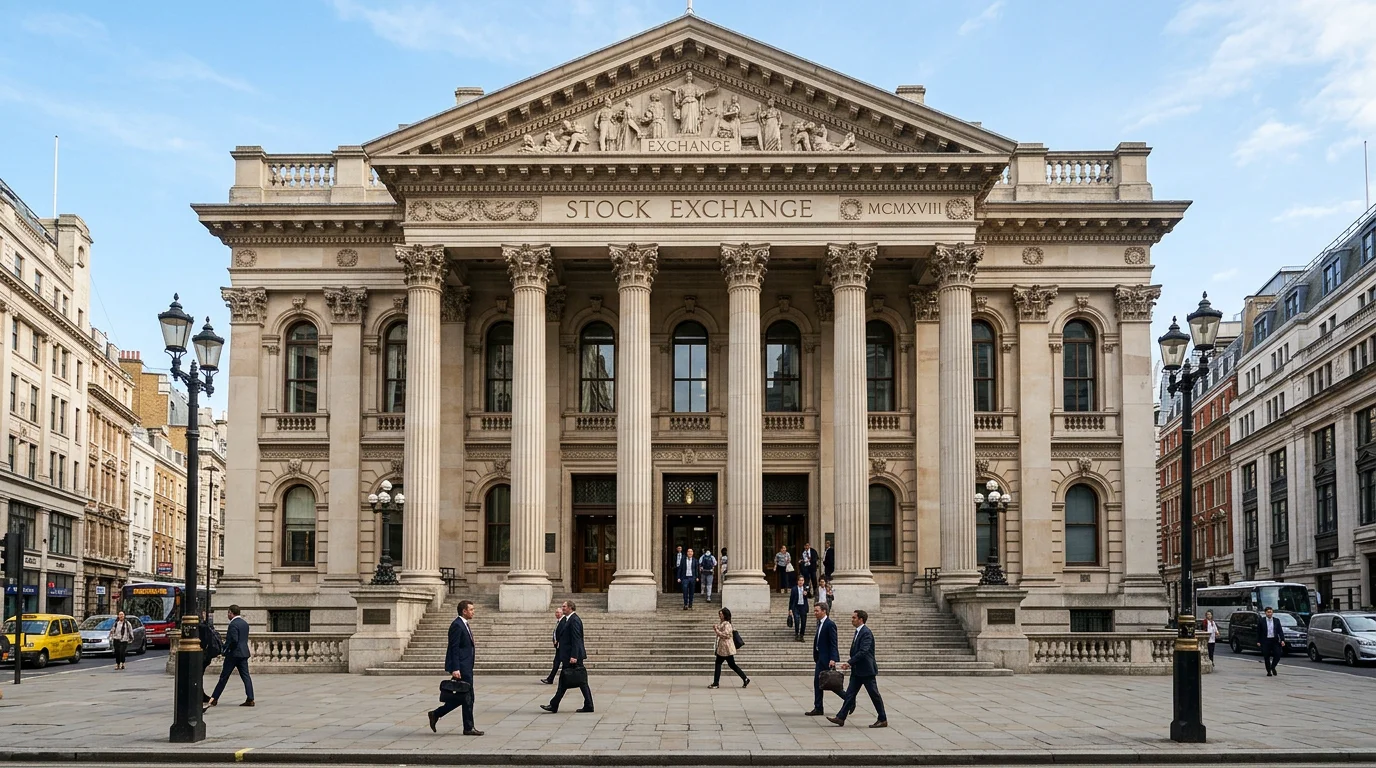

Every trading day, millions of orders flow through the New York Stock Exchange, yet the companies whose shares change hands rarely receive a single dollar from those transactions. That distinction sits at the heart of one of the most frequently misunderstood ideas in finance. Understanding whether the NYSE operates as a secondary market clarifies how capital, liquidity, and price discovery truly work. If you would like a plain-language reference, our guide to the NYSE as a secondary market lays out the essentials.
The stakes are considerable. In 2025, the U.S. stock market recorded a total of 347 IPOs including SPACs, each one creating fresh securities that would later trade among investors. Those first sales happen in the primary market. Everything that follows, the daily buying and selling you associate with the stock ticker, belongs to a different arena entirely.
The short answer: the NYSE is a secondary market
A common question among newer investors is this: is the nyse a secondary market? The answer is a straightforward yes. The NYSE is a venue where investors trade previously issued securities with one another, not with the company that issued them. When you purchase 100 shares of a listed company on the exchange, your money goes to the seller on the other side of the trade, not to the corporation.
This is the defining characteristic of any aftermarket. The initial sale of a security by the issuer, who receives the proceeds, is the primary market. Every sale after that first transaction occurs in the secondary market. For a fuller treatment of the concept, our explanation of the secondary market definition is a useful companion.
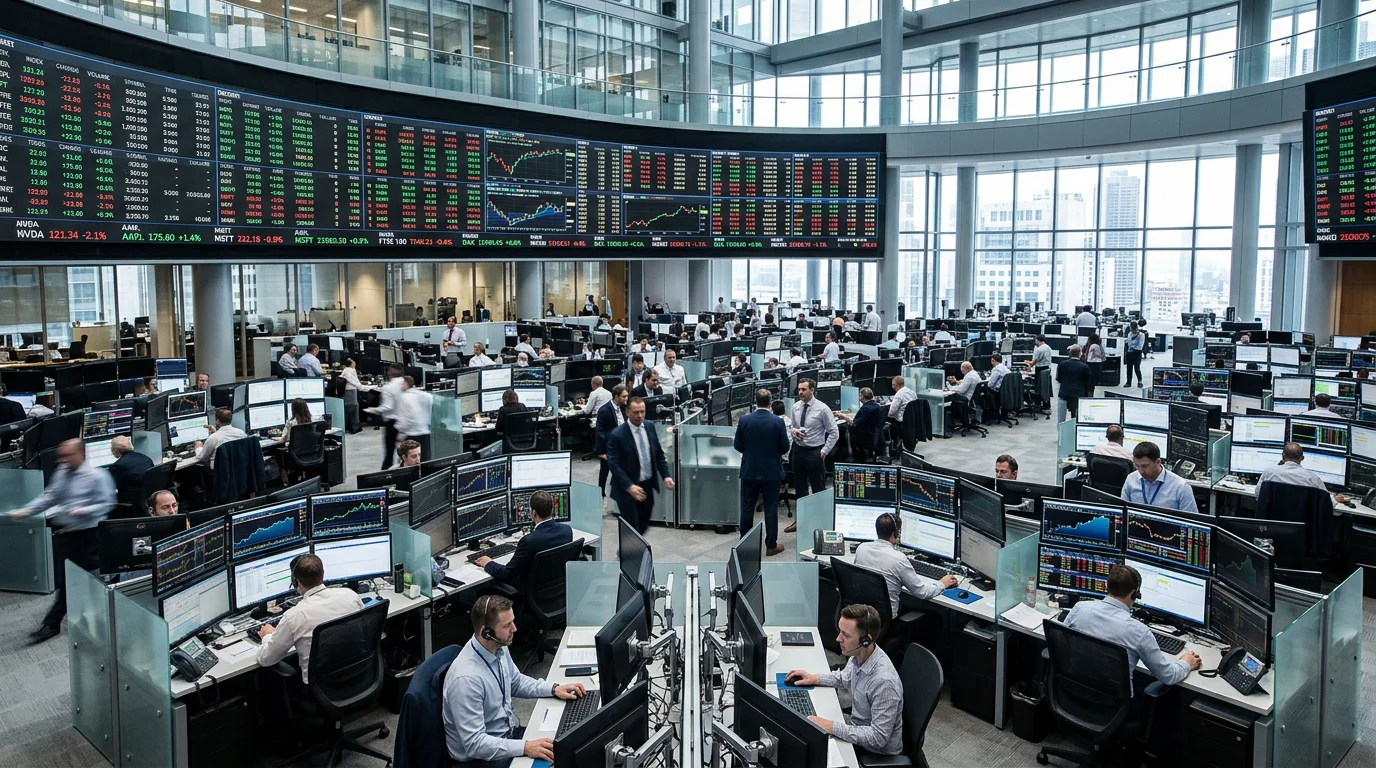
Primary versus secondary markets: the core difference
The separation is simpler than the terminology suggests. Primary markets involve the first-time issuance of securities, when companies sell them directly to investors and collect the capital. Secondary markets involve every transaction between investors that follows.
Consider how proceeds flow. In a primary offering, the issuer receives the money and uses it to hire staff, buy equipment, or fund expansion. In a secondary transaction, any gain or loss belongs to the selling investor, not to the issuing company. The activity remains brisk on both sides: according to the SEC market statistics, there were 99 IPOs raising over $22 billion in the first quarter of 2026, alongside 264 follow-on registered offerings that raised more than $44.2 billion.
| Criterion | Primary market | Secondary market (NYSE) |
|---|---|---|
| Who receives proceeds | The issuing company | The selling investor |
| Typical event | IPO or private placement | Daily buying and selling |
| Price setting | Often predetermined | Supply and demand |
| Main function | Raise new capital | Provide liquidity and price discovery |
How trading works on the exchange
Why do investors trust the NYSE to reflect fair value? Because it operates as an auction market, where buyers and sellers post the prices at which they are willing to trade. Prices move in response to investor sentiment and company performance: rising demand lifts a share price, while falling demand pushes it lower.
This mechanism produces two benefits that a well-functioning economy depends on. First, liquidity: you can convert holdings into cash by selling to another investor whenever the market is open. Second, continuous valuation: the exchange assigns an up-to-date price to each security as conditions change. For readers who want the economic reasoning behind this, our overview of secondary market economics goes further.
The four subsections of the secondary market
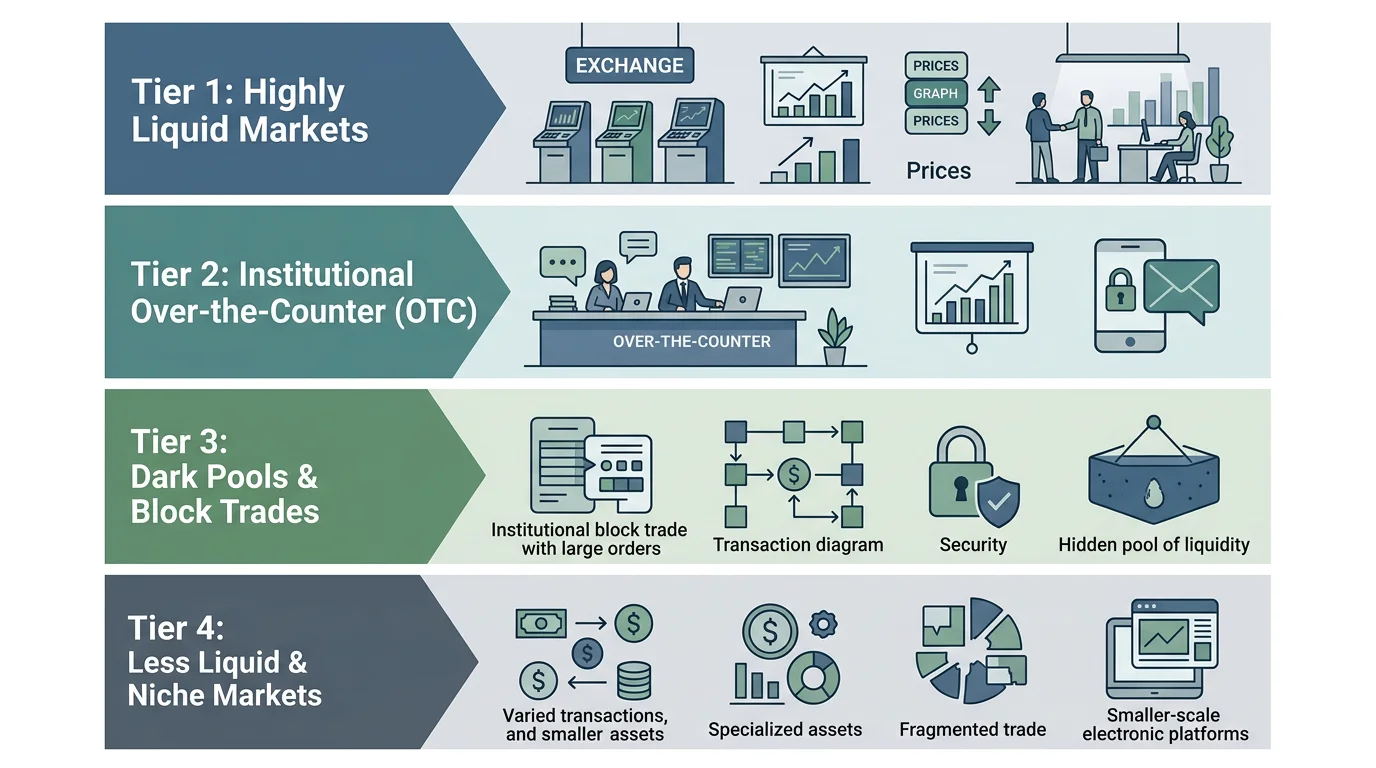
The secondary market is not a single room. It is conventionally divided into four submarkets, and a security can trade in any of them depending on the transaction.
- First market: listed securities trading on an exchange such as the NYSE or Nasdaq.
- Second market: unlisted securities trading over the counter (OTC).
- Third market: listed securities trading OTC through market makers.
- Fourth market: large institutional block trades executed directly, often through electronic communication networks or dark pools.
A frequent point of confusion is the label "first market". It sounds like the primary market, but it is not. The first market is simply the subsection of the secondary market where listed shares change hands on an exchange. If you and a friend exchanged cash for listed shares away from any exchange, that would be an OTC trade instead. The mechanics of routing orders across these venues are examined in our comparison of DMA versus exchanges.
Why secondary markets matter beyond equities
The secondary market concept reaches far past company shares. Bonds, options, futures, mortgages, and even intellectual property rights all trade in aftermarkets. Wherever an owner can resell an issued instrument to another party, a secondary market exists.
Private assets illustrate the scale of this shift. According to Carta data, total venture-capital secondary transaction value reached an estimated $61.1 billion in the twelve months ending June 2025, surpassing the combined value of all VC-backed IPOs over the same period. Meanwhile, public listings remain the preferred route for scale, and analysts note that aftermarket strength in 2025 delivered median first-day returns above 20% for that year's IPOs. The same logic underpins environmental markets, where instruments such as EU carbon allowances are bought and sold repeatedly after their issuance. If you participate in emissions markets, we provide a trading venue built precisely for that kind of secondary activity, with trade sizes starting from a single allowance rather than the traditional 1,000-unit lot.
Bringing it together
So the NYSE functions squarely as a secondary market, the arena where issued securities are resold among investors and where prices are continuously discovered through supply and demand. Keep the distinction clear: the primary market creates securities and funds the issuer, while the secondary market delivers liquidity and valuation. Whether you trade equities, bonds, or emissions rights, recognizing which market you are operating in will sharpen every decision you make about timing, pricing, and risk.
Take action with Initiativ
Understanding secondary markets is one thing; participating in one with the right tools is another. If your work touches the EU Emissions Trading System, whether you are an industrial operator, a bank, an asset manager, or a carbon broker, you need execution that is fast, transparent, and controllable.
We built a programmable exchange for trading EU carbon allowances in spot and derivatives form, designed for professional participants. You can trade from a single allowance, monitor live pricing in real time, configure alerts, and apply pre-trade risk controls before every order, with API access for automation. Explore what our carbon trading platform for traders and corporates can do for your desk.
Frequently Asked Questions
Is the NYSE a primary or secondary market?
The NYSE is a secondary market. Investors trade previously issued shares with one another, and the proceeds go to the selling investor rather than to the company that issued the securities.
Where does the primary market fit in relation to the NYSE?
The primary market is where securities are first issued, typically through an IPO or a private placement. A company often applies to list on the NYSE in conjunction with its IPO, after which the shares trade in the secondary market.
Does a company earn money when its stock trades on the NYSE?
No. Once shares have been issued, daily trading on the exchange transfers money between investors. The issuing company does not receive proceeds from these secondary transactions unless it conducts a new offering.
Are there secondary markets for assets other than stocks?
Yes. Bonds, options, futures, mortgages, and carbon allowances all trade in secondary markets. Our platform, for example, supports secondary trading of EU carbon allowances with transparent live pricing and professional-grade risk controls.
What makes the secondary market important for investors?
It provides liquidity and continuous price discovery. You can convert holdings into cash by selling to another investor, and the constant flow of trades keeps valuations aligned with current market conditions.

Let’s connect
Do you want more information about what we do?