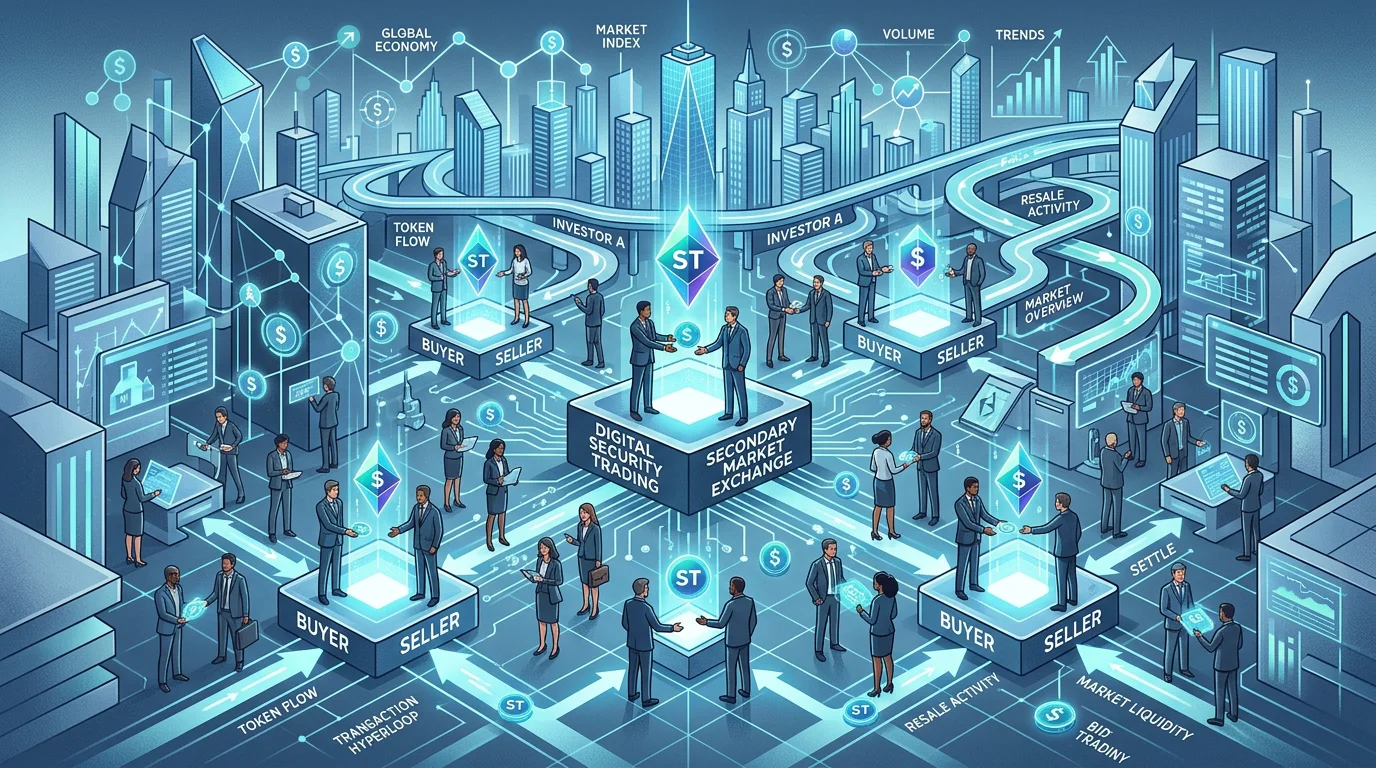

Summary: A secondary market is where investors trade securities that have already been issued, buying and selling from one another rather than from the original issuer. In economics, it matters because it supplies liquidity, sets prices through supply and demand, and allocates capital efficiently. Stocks, bonds, commodities, and even carbon allowances all trade in these aftermarkets.
In 2025, United States venture secondaries alone reached a scale that rivalled traditional public offerings, a sign of how central aftermarkets have become to modern finance. Yet many readers still confuse where a share is first sold with where it changes hands every day afterwards. Understanding the economic role of the secondary market clears up that confusion and explains why prices move the way they do. If you want a concise reference, our primer on the secondary market definition complements the analysis below.
The distinction is not academic. According to PitchBook data, US venture secondary transaction value reached 106.3 billion dollars in 2025. That figure shows how trading previously issued assets has grown into core market infrastructure, not a niche activity reserved for specialists.
What the secondary market means in economics
The concept is simpler than the jargon suggests. Anyone searching for a clear secondary market definition economics resource is really asking one question: where do securities go after they are first sold? The answer is the aftermarket, the financial arena in which previously issued instruments such as shares, bonds, options, and futures are bought and sold among investors.
The defining feature is the absence of the issuer. When you buy a share through a brokerage app, the company that issued that stock receives nothing; the money goes to the investor who sold it. Ownership simply transfers from one holder to another. This is what separates the aftermarket from the primary market, where new securities are created and the proceeds flow directly to the issuer to fund growth or operations.
Economists value this structure because it turns long-term commitments into tradable positions. A bond with a ten-year maturity does not lock an investor in for a decade; it can be sold tomorrow to another buyer. That flexibility underpins much of how capital markets function.
How secondary markets work in practice
Picture placing an order on a trading platform. Electronic systems instantly scan for a matching offer, and the price you pay is driven by supply and demand. If more investors want to buy an asset than to sell it, the price rises; if selling pressure dominates, the price falls. This continuous matching is the engine of price discovery.
Behind each trade sits a chain of intermediaries. Brokers, dealers, and clearinghouses ensure that orders execute smoothly and that ownership is legally transferred, with settlement typically finalising within one or two business days. The distinction between the parties who arrange trades and the venues where they occur often confuses newcomers, which is why our comparison of brokers and exchanges is worth reading alongside this section.
The most common instructions are market orders, executed at the current price, and limit orders, filled only if a specified price is met. Together they let participants control cost and timing, adding to overall market liquidity.
Primary market versus secondary market
A useful analogy is the difference between buying a new car and a used one. In the primary market, securities are created and sold for the first time, and the money flows to the manufacturer, meaning the issuer. An initial public offering is the classic example. In the secondary market, those same securities are resold, and the proceeds go to the selling investor rather than the original company.
The two are interdependent. Investors are willing to fund new issues in the primary market precisely because they know a liquid aftermarket exists to sell into later. Without a credible exit, primary fundraising would be far more expensive. The secondary market, in short, makes the primary market possible.
The main types of secondary markets
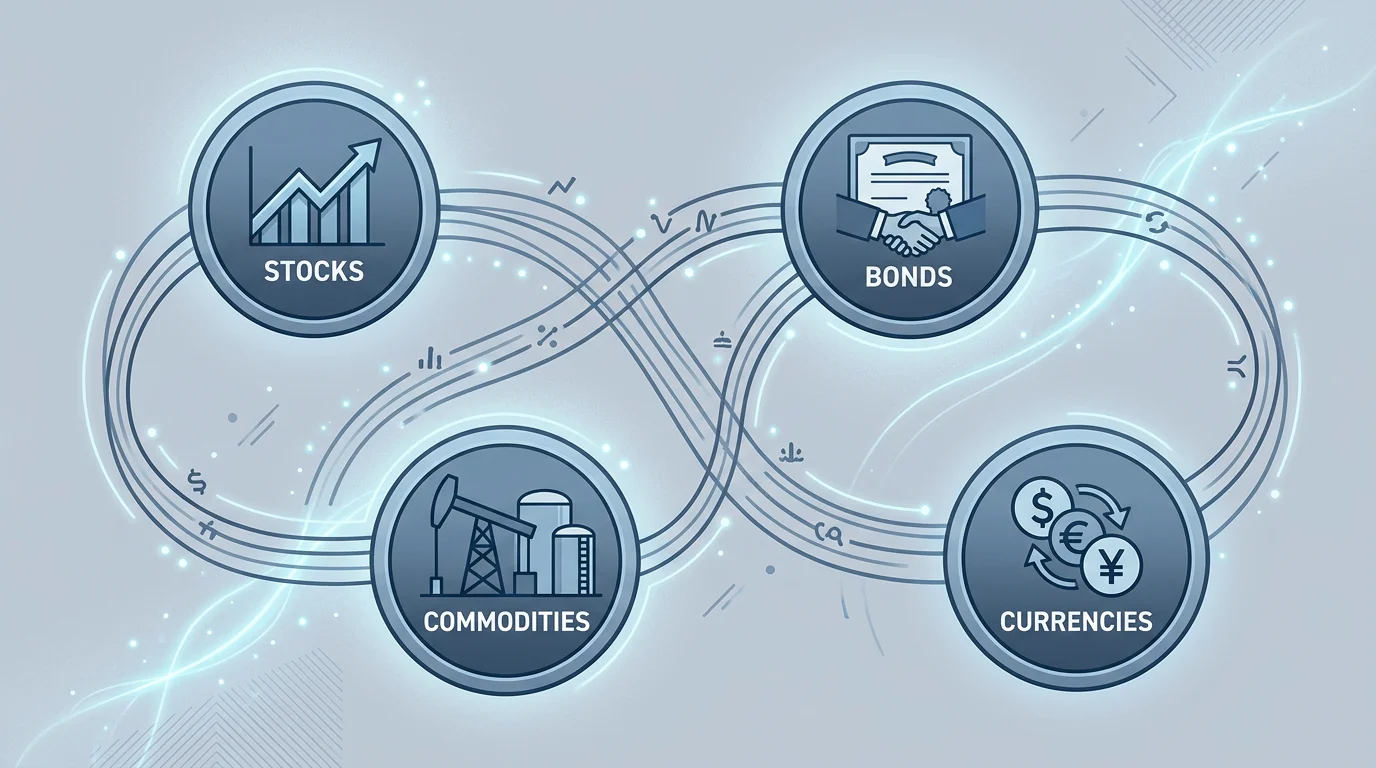
Secondary markets are not a single place but a family of venues, each catering to a class of assets:
- Stock markets, where previously issued shares of public companies trade on exchanges such as the New York Stock Exchange and Nasdaq.
- Bond markets, covering government, municipal, and corporate debt, much of which trades over the counter.
- Commodity markets, where gold, oil, and agricultural products change hands on exchanges and off them.
- Derivatives markets, dealing in options, futures, and swaps whose value derives from an underlying asset.
- Over-the-counter markets, decentralised networks where dealers trade directly rather than through a central exchange.
Exchanges and OTC venues behave differently. On an exchange, orders are routed to a central location to find the best available price. In OTC trading, dealers quote prices as market makers. If you want to understand why a regulated exchange sits at the heart of public equities, our breakdown of the NYSE as a secondary market walks through a concrete case.
Why secondary markets matter economically
Three functions explain why economists treat the secondary market as essential infrastructure rather than a sideshow.
First, liquidity. The ability to convert an asset into cash quickly, without moving its price much, gives investors the confidence to commit capital in the first place. The scale involved is significant: the NYSE reported an average daily trading volume of roughly 1.54 billion shares valued at around 80.6 billion dollars in mid-November 2025.
Second, price discovery. Continuous trading incorporates new information into prices in real time, producing valuations that help allocate scarce capital toward its most productive uses. Fixed income shows the depth of this activity clearly. According to SIFMA statistics, US Treasury securities traded at an average daily volume of 1,228.9 billion dollars through June 2026, up 11.1 percent year over year.
Third, the secondary market acts as an economic barometer. Rising prices tend to signal optimism about profits and growth, while falling prices can foreshadow concern or recession. Watching these venues therefore tells you something about the wider economy, not just individual assets.
Beyond stocks: private and emerging secondary markets
The aftermarket concept extends well past listed equities. Private secondary markets let shareholders of private companies sell stakes before an IPO, and they have expanded rapidly. The global secondary market reached a record 220 billion dollars in transaction volume in 2025, a 42 percent annual increase, with respondents projecting 250 billion dollars in 2026.
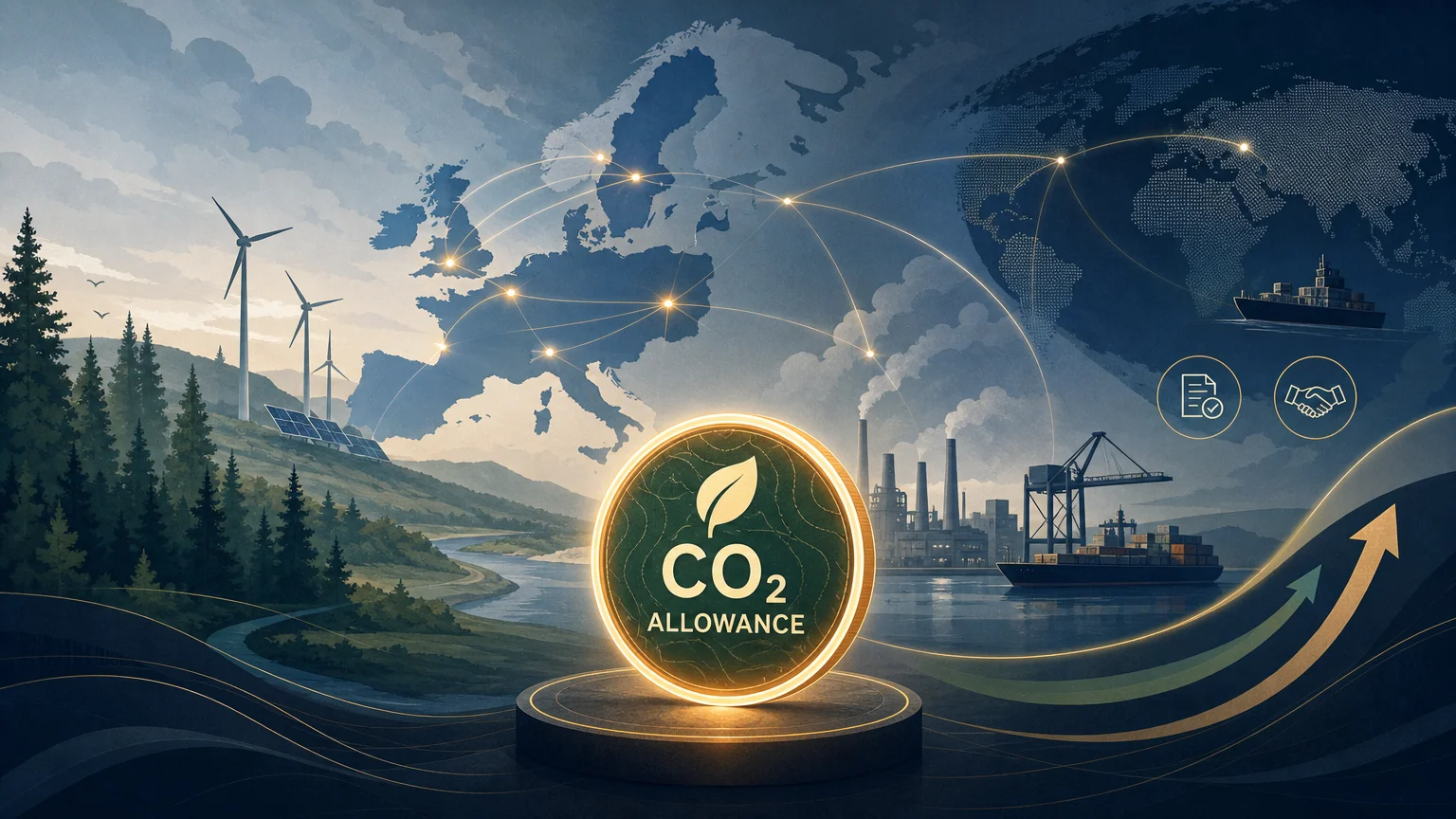
Environmental markets are a newer frontier. Carbon allowances issued under the EU Emissions Trading System trade actively among industrial operators and financial participants, functioning as a genuine secondary market for compliance instruments. These venues share the same economic logic as equities: liquidity, transparent pricing, and efficient allocation. The way orders reach an exchange also shapes execution quality, a topic covered in our overview of direct market access.
Because carbon aftermarkets have historically favoured very large participants, minimum trade size matters. The table below contrasts a conventional approach with the model we operate.
| Feature | Traditional carbon exchange | Our Initiativ platform |
|---|---|---|
| Minimum trade size | Standard lot of 1,000 EUAs | From 1 EUA, equal to 1 tonne of CO₂ |
| Fee positioning | Standard exchange fees | Competitive, lower-cost access |
| Live price transparency | Often limited | Transparent real-time pricing |
| Trading hours | Standard sessions | Longer hours with overnight yield |
Key takeaways on secondary markets
Understanding the secondary market and its economic role comes down to one idea: it is where already-issued assets trade among investors, without the issuer, and where liquidity and price discovery are created. Whether the instrument is a share, a bond, a private stake, or a carbon allowance, the mechanics rhyme. Start by identifying which venue governs the asset you care about, then watch how supply and demand set its price. That single habit will sharpen how you read markets and evaluate opportunities.
Take action with Initiativ
If you participate in emissions markets, the theory above becomes a daily practical concern: you need fast execution, transparent live prices, and trade sizes that fit your actual exposure rather than rigid institutional lots. That is precisely the gap we address for compliance entities and financial participants across the EU ETS.

We operate a programmable exchange where you can trade EU Allowances in spot and derivatives form, starting from a single EUA, with competitive fees, configurable alerts, pre-trade risk controls, and API-enabled automation. Cash is held in a segregated account with clearing support and protected up to 100 k€ by the FGDR. Explore our EUA trading platform for traders and corporates and request access to the demo environment.
Frequently Asked Questions
What is the simplest definition of a secondary market?
A secondary market is any venue where investors buy and sell securities from one another rather than from the issuing company. The original issuer is not involved, and the money changes hands between investors. Stock exchanges are the most familiar example.
How does the secondary market differ from the primary market?
In the primary market, new securities are created and sold for the first time, with proceeds going to the issuer. In the secondary market, those securities are resold, and the proceeds go to the selling investor. The primary market raises capital; the secondary market provides liquidity.
Why is the secondary market important for the economy?
It supplies liquidity, enabling investors to convert holdings into cash quickly, and it performs price discovery, setting fair values through supply and demand. These functions help allocate capital efficiently and act as a barometer of economic health.
Can carbon allowances trade on a secondary market?
Yes. EU Allowances trade actively among industrial operators and financial participants after their initial allocation, functioning as a genuine secondary market. On our Initiativ platform, you can trade them from a single EUA with transparent real-time pricing.
What are the main types of secondary markets?
The principal categories are stock markets, bond markets, commodity markets, and derivatives markets. These operate either through centralised exchanges or through decentralised over-the-counter networks of dealers, depending on the asset traded.