

Summary: A secondary market is where investors trade previously issued securities among themselves, not with the issuer. In 2025, global secondary volume hit a record $220 billion.
Most headlines celebrate the moment a company first sells its shares, yet the vast majority of daily financial activity happens afterward, when investors trade with one another. That arena is the secondary market, and understanding it is essential for anyone allocating capital, whether in equities, bonds, or carbon allowances. If you want a practical illustration, our secondary market definition resource walks through how a major exchange operates in real conditions.
The scale is striking. According to William Blair’s 2026 report, the global secondary market reached a record $220 billion in transaction volume in 2025, a 42% year-over-year increase, with volume projected to hit $250 billion in 2026. That growth reflects a simple truth: liquidity is the lifeblood of every functioning financial system, and the secondary market is where it lives.
What the Definition of Secondary Market Really Means
The definition of secondary market is straightforward: it is the financial marketplace where previously issued securities, such as shares, bonds, options, and futures, are bought and sold between investors rather than purchased directly from the issuing entity. The original company or government that created the security is not a party to these later transactions.
Consider the difference through ownership. When you buy shares of a listed company through a brokerage app, the company that issued that stock does not receive your money. Instead, the investor who sold the shares does. This transfer of ownership between third parties is precisely what makes the market "secondary" rather than primary. The security was already born in the primary market; it now simply changes hands.
This distinction matters across every asset class, from equities to emission allowances. On our platform, participants trade EU Allowances in both spot and derivatives form, and the same principle applies: existing rights move between buyers and sellers at prices set by supply and demand.

Primary Market Versus Secondary Market
The cleanest way to grasp the relationship is the car analogy. The primary market resembles buying a brand new vehicle directly from the manufacturer, where the proceeds go to the maker. The secondary market resembles the entire ecosystem of resale, where existing owners sell to other buyers and the money passes between them.
In the primary market, securities are created and sold for the very first time, most often through an initial public offering (IPO), a bond issuance, or a priced funding round. The capital raised flows directly into the issuer's treasury to fund growth. In the secondary market, no new securities are created; existing holders sell to new buyers, and the trading activity is independent of the original capital raise.
| Criterion | Primary Market | Secondary Market |
|---|---|---|
| Securities | Newly created | Previously issued |
| Seller | The issuer | An existing investor |
| Where money flows | To the issuer | To the selling investor |
| Typical transaction | IPO, bond issuance | Stock, bond, derivatives trading |
The Core Functions of Secondary Markets
Why does the secondary market matter so much? Because it performs several functions that support the broader economy, and each one reinforces investor confidence.
- Liquidity: The ability to convert an asset into cash quickly without significantly affecting its price. Investors participate in the primary market partly because they know they can exit later through the secondary market.
- Price discovery: Continuous trading establishes the fair market value of assets, as the collective actions of buyers and sellers incorporate new information into prices in real time.
- Portfolio diversification: Investors can reallocate holdings and reduce exposure to a single asset class based on their objectives and risk appetite.
- Economic barometer: Rising prices often signal optimism about corporate profits, while falling prices may indicate concern or recession.
The depth of these markets is considerable. According to BestBrokers data, the New York Stock Exchange reported an average daily trading volume of roughly 1.54 billion shares valued at around $80.6 billion in mid-November 2025. That constant flow is what allows a seller to find a buyer within seconds.
The Main Types of Secondary Markets
Secondary markets are not monolithic. They are generally divided by how trading occurs, and each structure suits a specific type of instrument.
Exchanges
Stock exchanges such as the NYSE and Nasdaq are centralized, highly regulated venues where trading is typically auction-based and orders are routed to a central location to find the best available price. These platforms enforce strict listing requirements. If you want to understand the distinction between trading through an intermediary and trading on a venue, our comparison of secondary trading vs exchange trading clarifies the mechanics.
Over-the-Counter Markets
The over-the-counter (OTC) market is a decentralized network of dealers who trade directly with one another rather than through a central exchange. Most bonds and structured products trade this way. Dealers quote prices at which they are willing to buy or sell, acting as market makers. Fixed income is a prime example: the SIFMA research tracks the enormous average daily trading volumes in U.S. Treasury securities, most of which change hands off-exchange.
Derivatives Markets
The derivatives market involves instruments whose value is derived from an underlying asset, including options, futures, and swaps. To explore this segment in depth, see our explainer on how futures markets work. On our own exchange, EU Allowances trade in both spot and derivative form, giving compliance entities and financial participants flexible tools for hedging and speculation.
Public and Private Secondary Markets
A further distinction separates public and private venues. The public secondary market is what most people picture when they hear "the stock market": organized, transparent exchanges where the latest purchase price per share is visible and almost anyone can open a brokerage account.
The private secondary market, by contrast, handles shares of companies that have not gone public. It operates through specialized platforms and privately negotiated deals, tends to be more opaque and less liquid, and is commonly restricted to accredited or institutional investors. Yet it has expanded dramatically. Institutional demand is intense: one dataset recorded a record 971 institutional-level contributions and a peak monthly bid-and-ask volume of $38.11 billion in January 2026, nearly double the prior peak. This surge reflects how long companies now stay private and how strongly early stakeholders seek liquidity.

How Secondary Markets Are Evolving in 2026
The mechanics of the secondary market are stable, but the infrastructure is shifting rapidly toward automation and electronic execution. That transformation is measurable. Tradeweb reported total trading volume of $62.3 trillion for May 2026, with average daily volume up 18.3% year over year, signaling that institutional participants are leaning further into electronic, transparent execution.
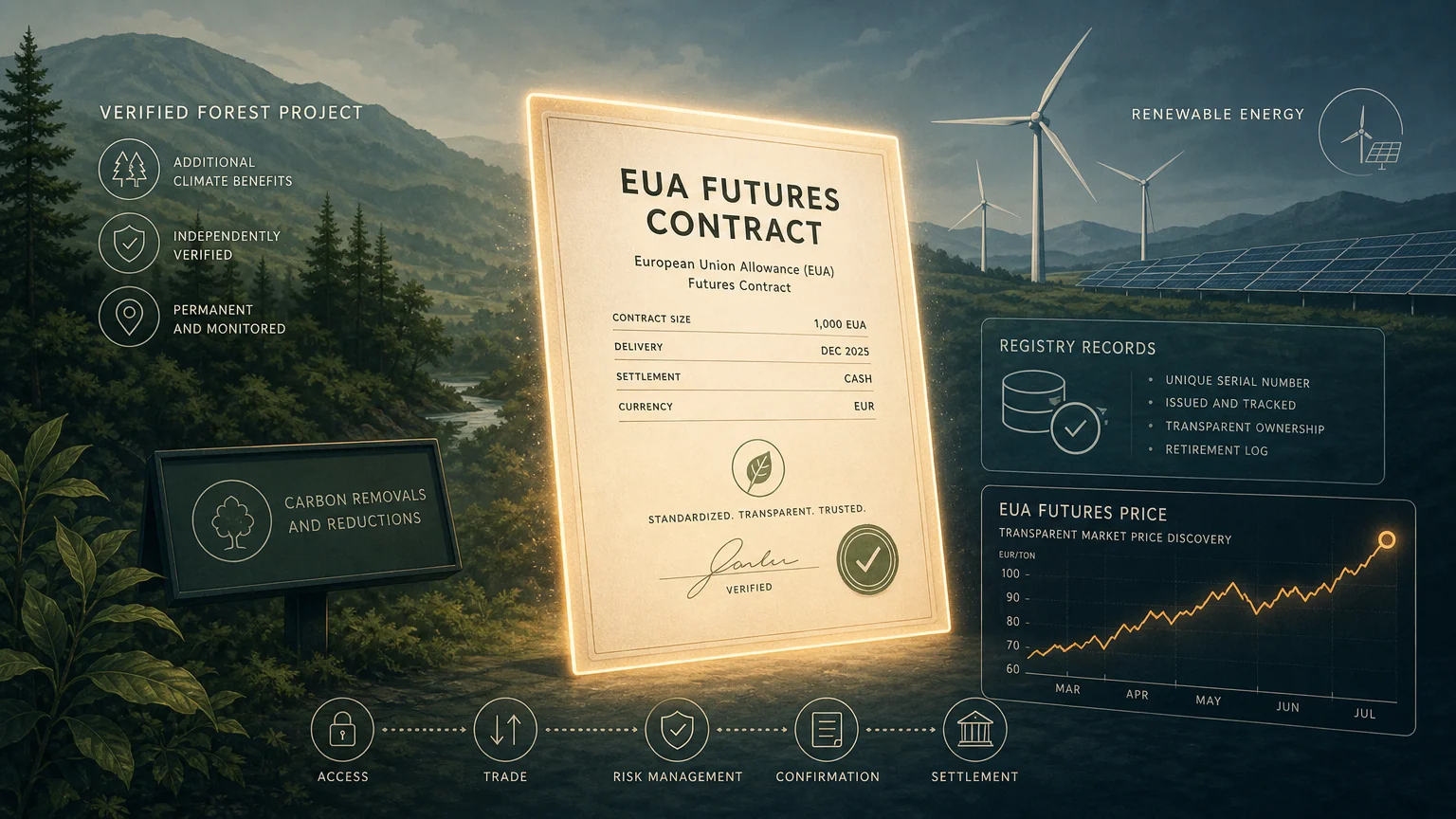
Carbon markets sit at the frontier of this evolution. Traditional carbon exchanges have long imposed high minimum trade sizes and offered limited transparency on live prices. We address these constraints directly: our platform lets you trade from a single EU Allowance, equivalent to one tonne of CO₂, rather than the standard 1,000-allowance lot, with transparent live pricing and pre-trade risk controls. For teams that need programmable access, our secondary market access for traders and corporates integrates real-time monitoring, configurable alerts, and API-enabled automation.
Conclusion
The secondary market is the engine of modern finance: it converts long-term investments into liquid cash, establishes the real-time value of assets, and gives investors the confidence to commit capital in the first place. With global secondary volume reaching a record $220 billion in 2025 and projected to climb further this year, the importance of efficient, transparent trading venues has never been clearer. For carbon market participants, that efficiency now depends on smaller trade sizes, live pricing, and automation that legacy exchanges rarely provide. To experience professional-grade execution with transparent pricing and configurable risk controls, get access to our demo environment today.
Frequently Asked Questions
What is the simplest definition of a secondary market?
It is a marketplace where investors buy and sell securities that were already issued, trading with one another rather than with the original issuer. The money flows to the selling investor, not the company.
How does the secondary market differ from the primary market?
In the primary market, securities are created and sold for the first time, and the proceeds go to the issuer. In the secondary market, existing securities change hands between investors, independent of any new capital raise.
Can carbon allowances be traded on a secondary market?
Yes. EU Allowances are actively traded between participants in spot and derivative form. On our exchange, you can trade from a single allowance with transparent live pricing, rather than being limited to large traditional lots.