




How does a single tonne of carbon dioxide acquire a market price? The answer lies in carbon market price discovery, the mechanism through which participants agree on the value of an emission allowance. For anyone tracking ETS trading price drivers and outlook, understanding how this reference price forms is the foundation of every trading and compliance decision.
The scale involved is considerable. According to ESMA data, the total monetary value of EU Allowances exchanged reached EUR 777 billion in 2025, a 9% rise on the previous year driven by higher prices. When markets of this size depend on a shared reference price, the quality of the pricing mechanism matters to industry, finance, and policy alike.
What price discovery means for carbon allowances
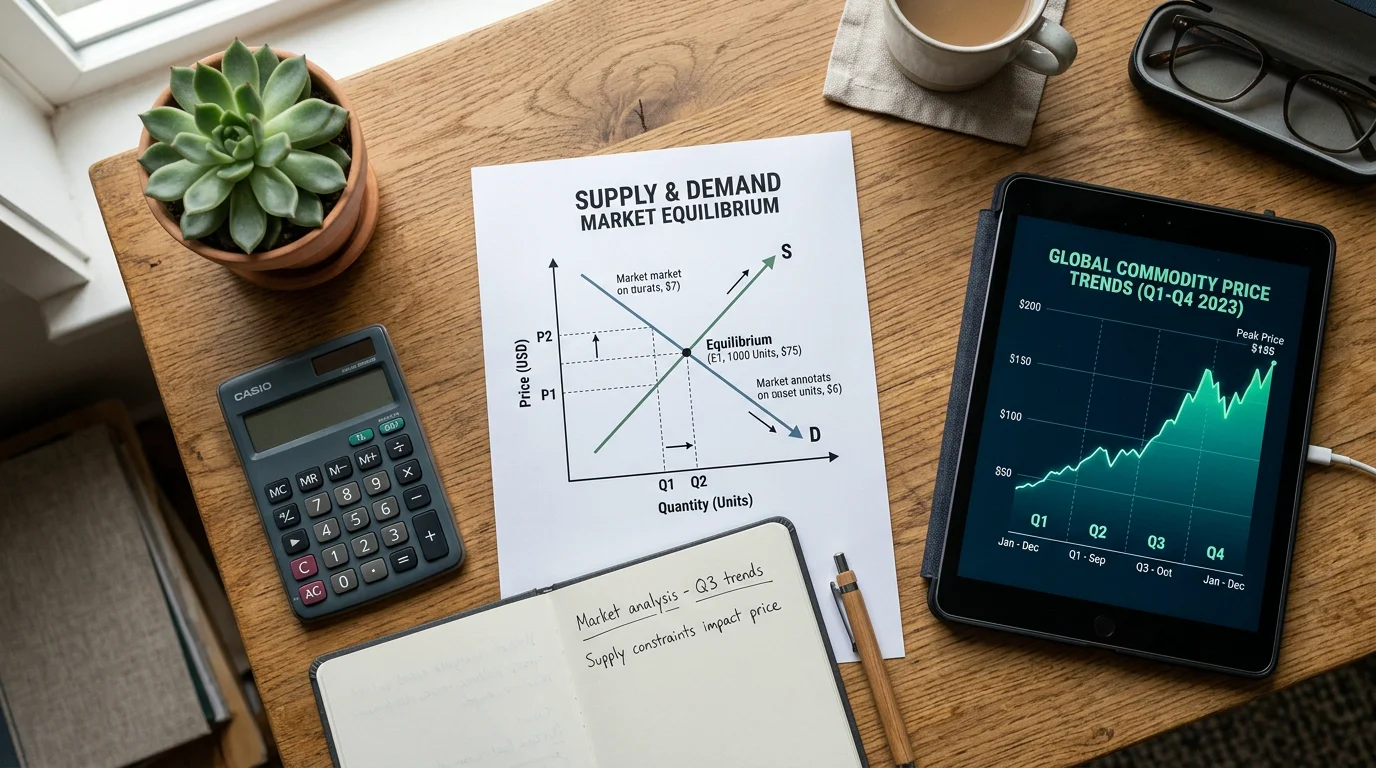
Price discovery is the continuous process through which the market translates supply, demand, and expectations into a single observable price. In a carbon market, that price expresses the marginal cost of emitting one tonne of carbon dioxide. Every auction bid, spot trade, and futures order feeds new information into it.
The result is a benchmark price that participants can trust. Without it, compliance entities would struggle to budget for their obligations, and financial firms would hesitate to provide liquidity. A credible reference price turns an abstract policy target into a concrete signal that shapes real investment.

How the EU ETS establishes a reference price
The EU Emissions Trading System is the anchor of European carbon pricing. Each weekday, member-state agencies auction allowances, and continuous secondary trading refines the resulting price throughout the session. This combination of primary auctions and active exchanges is what produces the headline EUA price.
Recent figures show where that price now sits. According to the European Commission, prices fluctuated between EUR 60 and EUR 80 during 2025, and futures markets signal only modest increases through 2027. Because the carbon price feeds directly into power costs, its movements ripple across the wider economy. For readers who want the mechanics, how EUA prices move and what to watch sets out the drivers in detail.
The role of spot and futures markets
Price discovery does not happen in one venue alone. Spot markets reflect immediate supply and demand, while futures markets embed expectations about future scarcity, policy, and energy prices. The two segments exchange information constantly, and each contributes to the emerging price.
Derivative instruments are central to this dynamic. They allow compliance entities to hedge future obligations and enable financial participants to express directional views. The interaction between spot and derivative markets deepens liquidity and sharpens the signal. Because carbon pricing is tightly bound to power and fuel markets, our overview of EU ETS prices and how they connect to energy markets is a useful companion to this section.
What drives allowance prices in 2026
Several forces shape the carbon price at any moment. The overall emissions cap sets the long-term trajectory, while short-term moves respond to weather, fuel switching, industrial output, and regulatory news. Expectations about upcoming reforms often move prices before any rule takes effect.
Supply management is decisive here. According to the 2026 State of the EU ETS report, liquidity, price discovery, and auction participation have remained broadly stable, with the Market Stability Reserve continuing to tighten supply and support the market. To understand this buffer in depth, review the market stability reserve impact on carbon pricing.
Price discovery in the voluntary carbon market
Beyond the regulated EU ETS lies the voluntary carbon market, where companies buy credits to offset emissions. Pricing here is far less uniform. Credit quality, project type, and vintage all influence the value of a single tonne of avoided or removed carbon.
The spread is wide. According to market data, average asking prices for many listed credits have ranged from a few dollars to more than twenty dollars per tonne, depending on the project. This fragmentation makes transparent pricing harder to achieve than in the compliance market, and it explains why standardised benchmarks remain a work in progress.
Why transparent access matters for participants
Robust price discovery depends on broad participation. When more firms can observe live prices and trade efficiently, the resulting benchmark becomes more reliable. Barriers such as large minimum lot sizes and opaque pricing reduce the number of participants and weaken the signal.
This is where market design shapes outcomes. We built our exchange to lower those barriers, and the table below contrasts our approach with the conventions of traditional venues.
| Feature | Traditional carbon exchanges | Our exchange at Initiativ |
|---|---|---|
| Minimum trade size | Standard lot of 1,000 EUAs | From 1 EUA (1 tonne of CO₂) |
| Live price transparency | Often limited or delayed | Real-time price monitoring |
| Automation | Varies by venue | API access and configurable alerts |
| Pre-trade risk controls | Not always integrated | Built-in exposure controls |
Bringing the pricing picture together
Effective carbon price formation is not an accident. It emerges from transparent auctions, liquid spot and derivative markets, and disciplined supply management through the Market Stability Reserve. For compliance entities and financial participants alike, the practical lesson is to monitor the reference price closely and to understand the structural forces behind it. As reforms continue through 2026, the venues and participants that widen access will strengthen the very signal on which every carbon decision depends.
Take action with Initiativ
If you need to act on live carbon prices with precision, the quality of your execution matters as much as your market view. Whether you manage a compliance obligation under the EU ETS or trade allowances professionally, transparent pricing and reliable access are the foundation of sound decisions.
We provide traders and corporates solutions for the carbon market, with trade sizes starting from a single EUA, real-time price monitoring, configurable alerts, pre-trade risk controls, and API access. Onboarding is straightforward, cash is protected up to EUR 100,000 by the FGDR, and you can request access to our demo environment to explore the platform before you commit.
Frequently Asked Questions
What is price discovery in a carbon market?
It is the process through which buyers and sellers converge on the value of an emission allowance. Auctions, spot trades, and futures orders continuously feed information into a single observable price. That price reflects the marginal cost of emitting one tonne of carbon dioxide.
Who sets the price of an EU Allowance?
No single body sets it. The price emerges from primary auctions run by member-state agencies and from continuous secondary trading on exchanges. Supply rules, such as the emissions cap and the Market Stability Reserve, frame the range within which the market prices allowances.
How do futures markets affect the carbon price?
Futures embed expectations about future scarcity, policy, and energy costs. They allow compliance entities to hedge and financial participants to take positions. This activity adds liquidity and helps the market form a forward-looking price alongside the spot benchmark.
Why do voluntary carbon credits vary so much in price?
Voluntary credits differ by project type, quality, vintage, and jurisdiction. These differences produce a wide price range rather than a single benchmark. Improving transparency and standardisation remains an ongoing challenge in that market.
How can smaller participants access carbon price discovery?
Lower barriers make participation easier. Our exchange at Initiativ allows trading from a single EUA rather than a 1,000-lot standard, with real-time pricing and API access. This helps a broader set of participants observe and act on live prices.
This may interest you


Let’s connect
Do you want more information about what we do?