
In climate discussions, everything today seems to come down to a single word: carbon. We hear about “carbon credits” “carbon offsetting” “carbon emissions” and even “carbon neutrality” but the nuances behind these terms are not always easy to grasp.
Behind these expressions lie two very different mechanisms that both play a role in the transition. The voluntary market, which channels private finance into climate-positive projects, and the regulated emissions market, which drives legally binding reductions within companies’ own operations.
Both markets contribute to climate action in their own way. But they are built on different logics, respond to different incentives and ultimately serve different goals. Understanding this distinction is essential to recognise what truly gives a tonne of CO2 its value and how each market supports, in complementary ways, the broader decarbonisation effort.
In this article, we explore these differences and what Initiativ is building within the regulated emissions market, a market designed to ensure traceable, measurable and mandatory reductions.
The voluntary carbon market comes from a simple idea: if a company can’t reduce yet all its emissions, it can finance projects elsewhere that remove or avoid CO2, (forests, renewable energy, regenerative agriculture etc). These projects then generate carbon credits that companies buy to “offset” part or the whole of their footprint.
This market operates without legal obligation: it relies on willingness, hence the name “voluntary”. Certification standards (Verra, Gold Standard, Plan Vivo, etc.) define the rules on how they can be generated, but there is no unified regulatory framework on how they are being utilised. The voluntary market has delivered substantial benefits to the transition, by channeling billions of dollars towards climate-positive activities that would not have been financed otherwise. Most importantly, it has enabled companies to take early climate action before regulation caught up.
Nevertheless, companies face increasing pressure to reduce their own emissions (from shareholders, customers, regulators and in Europe, through the EU ETS). The integrity of offsetting projects themselves is often questioned: methodologies vary widely, verification practices are inconsistent, and critics argue that offsetting can create the perception that continued fossil-fuel use is acceptable as long as credits are purchased.
The credit prices vary widely, from a few euros to more than €500 per tonnes of CO2 depending on the project, country and methodology.
Recent investigations have shed light on questionable practices: credits counted multiple times, overestimated benefits, or “protected” forests that already existed. These issues have undermined the confidence of both the public and investors.
In short: buying a voluntary credit means financing a useful project, but it does not mean that the company reduces its own emissions. It is a compensatory action, not a structural transformation. It does serve a strong purpose, as voluntary carbon markets give companies a real, tradable reference for the cost of emissions, helping translate climate impact into a financial metric. By buying credits, firms also internalize a carbon price in budgets and project decisions, steering capital toward lower-carbon operations even beyond regulation.
In contrast, the European regulated emissions market is built on legal constraints and a clear economic mechanism: the Emissions Trading System (ETS).
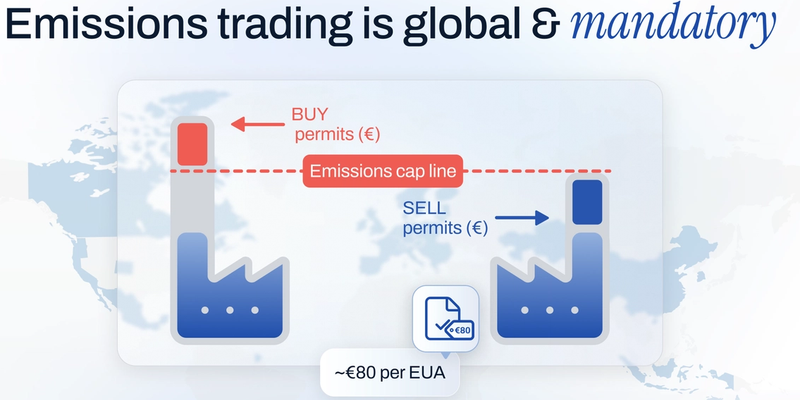
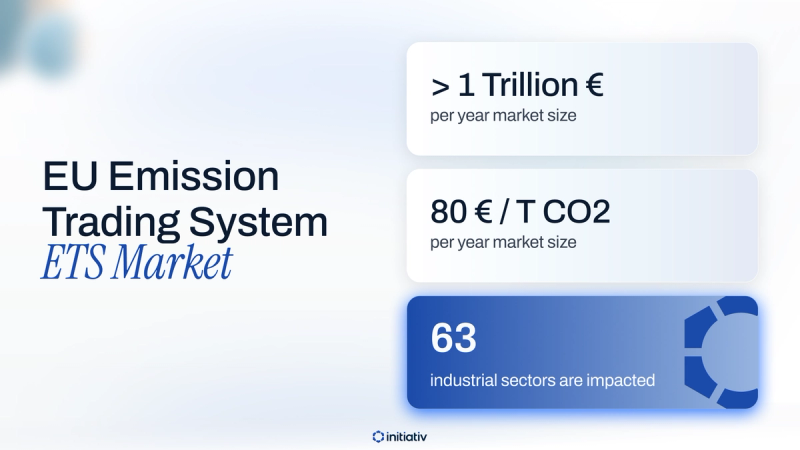
Each year, the EU sets a total cap on emissions from 63 sectors (energy, heavy industry, aviation, and soon maritime and road transport). This cap decreases over time to reach; 62% by 2030 compared with 2005. To date, this system has successfully decarbonized already by 30% (source: Science Direct). Companies receive or purchase emission allowances (EUAs), and each grants the right to emit 1 tonne of CO2. If companies emit more than their allocation, they must buy more allowances. If they emit less, they can sell the surplus. This is the “cap and trade” logic.
This mechanism creates a strong price signal: the more expensive it becomes to emit, the more companies are encouraged to innovate and cut their footprint.
Unlike the voluntary market, this system is strictly supervised by European regulators (ESMA, the European Commission and national authorities) and integrated into audited carbon accounting each year.According to the World Bank State and Trends of Carbon Pricing 2024, emissions trading systems account for the vast majority of the economic value generated by carbon pricing worldwide, with more than USD 100 billion in annual revenues coming from ETSs and carbon taxes. (source : Worldbank’s press release - Global Carbon Pricing Revenues Top a Record $100 Billion)
In other words: this market rewards measurable reductions, not goodwill and relies on traceability, not trust.
The confusion between credits and emissions slows down the transition because it blends moral and economic signals.
When a company claims “carbon neutrality” thanks to voluntary credits, it can give the perception of action without reducing its own emissions. However, it is still a positive step: by purchasing credits, companies are effectively imposing a carbon price on themselves, which can provide an internal incentive to reduce emissions over time. Yet this mechanism remains complementary, it does not replace the need for measurable, direct reductions within the company’s own operations.
Meanwhile, companies under the EU ETS must reduce or pay, with no workaround. Their climate performance is measured in tonnes of CO2 avoided, not in financed projects.
For investors, regulators and citizens, this distinction is essential: the value of a tonne of CO2 must reflect a real and verified reduction.
Today, 63 business sectors are covered by EU regulation that requires them to buy emissions rights: over 1 trillion euros traded each year on exchanges.
But there are currently only two exchanges that exist, serving mainly the top 5% of the market : about 500 of the largest actors. While market liquidity on these exchanges is high, it benefits mainly financial institutions and specialised traders.
Companies with compliance obligations, on the other hand, rarely access this liquidity directly and remain largely dependent on intermediaries to execute their transactions.
For the remaining 95% of companies, transactions go through a chain of intermediaries. Regulated carbon markets remain complex, fragmented and largely undigitalised for them.
Clients often highlight slow, manual processes, with no real-time price visibility or ability to react.
This is the barrier Initiativ’s exchange aims to remove.
We are building modern technology that helps small and medium-sized companies buy, sell and optimise their emissions-allowance portfolios in real time and at the best price on our exchange, InEx.
Initiativ opens direct, fair and transparent access to the exchange for everyone with no brokers, no clearers, no minimums, and complete visibility on every transaction and fully aligned with European law.

The carbon emissions trading market is fragmented, with participants accessing it via market platforms, OTC, or exchanges. This fragmentation leads to inefficiencies, high intermediation costs, and limited transparency. To achieve the necessary scale and credibility for climate policies by 2030, the market requires a structural and technological transition. Digitalization, which is transforming other financial markets, is essential to unify access, enhance transparency, and reduce risk for all industrial companies subject to the EU ETS.

French fintech Initiativ has raised €650,000 to build a next-generation digital exchange for emission allowances, giving industrial companies direct, transparent, and cost-effective access to the European carbon market. Backed by investors including Holmarcom, U-Investors, and members of the FrenchFounders network, Initiativ aims to democratise access to carbon trading and strengthen Europe’s industrial competitiveness.


Do you want more information about what we do?