
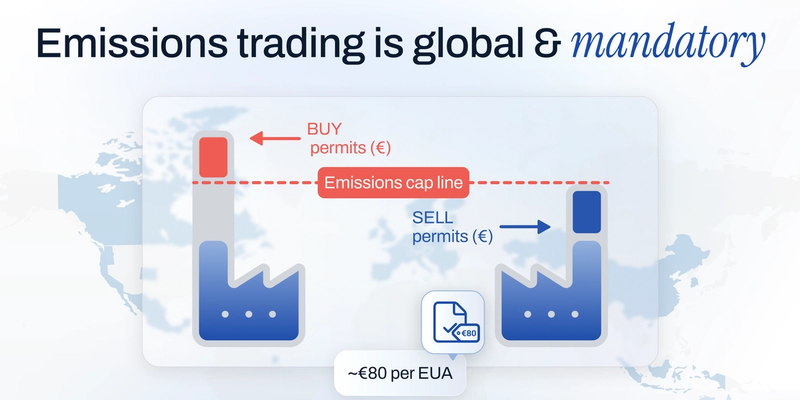
This article clarifies the difference between voluntary carbon credits and the EU ETS regulated emissions market. It explains how each mechanism works, the limits of offsetting, why emissions trading drives measurable reductions, and how Initiativ improves market access for companies.
Read
The carbon emissions trading market is fragmented, with participants accessing it via market platforms, OTC, or exchanges. This fragmentation leads to inefficiencies, high intermediation costs, and limited transparency. To achieve the necessary scale and credibility for climate policies by 2030, the market requires a structural and technological transition. Digitalization, which is transforming other financial markets, is essential to unify access, enhance transparency, and reduce risk for all industrial companies subject to the EU ETS.
Read
The European carbon market has proven to be one of the most effective tools for driving industrial decarbonisation. Yet for many companies, direct access remains limited. This article explores how Initiativ aims to simplify participation, reduce execution costs, and give every industrial actor the ability to manage their carbon exposure directly.
Read
An exchange is a marketplace. A broker is your way in. That simple distinction explains most of the confusion when people ask whether “the exchange” gave them a bad price or whether “the broker” sets the market. Prices are made where orders meet; accounts, routing, and custody live with the firms that serve you.
Read
French fintech Initiativ has raised €650,000 to build a next-generation digital exchange for emission allowances, giving industrial companies direct, transparent, and cost-effective access to the European carbon market. Backed by investors including Holmarcom, U-Investors, and members of the FrenchFounders network, Initiativ aims to democratise access to carbon trading and strengthen Europe’s industrial competitiveness.

A commodity market is a marketplace where raw materials or primary products—such as energy resources, metals, and agricultural goods—are traded.
In financial markets, exchanges and Direct Market Access (DMA) platforms are closely related but serve different purposes. Exchanges provide the marketplace where trades occur, while DMA platforms provide the technology that connects traders directly to those exchanges. Understanding the distinction is important for grasping how modern trading infrastructure works.
The actual difference between carbon credits and emission allowances


Do you want more information about what we do?