
A strategic market that remains hard to access
The carbon market is one of the main pillars of the European Union’s climate strategy. By assigning a market price per tonne of CO₂ emissions, the EU encourages companies to reduce their carbon footprint and direct their investments toward cleaner technologies.
While the carbon market operates efficiently and has proven its ability to reduce emissions over time, the real challenge today lies in accessibility. Existing exchanges remain open to a very limited number of participants, creating fragmentation and reinforcing dependence on intermediaries.
Mid-sized industrial companies, though central to European production, face high entry thresholds, complex execution processes, and heavy administrative requirements. Without direct access, they must rely on brokers or banks that apply their own margins and extend transaction timelines. As a result, the market drifts away from its original purpose: instead of promoting efficiency and decarbonisation, it sustains opacity and rent in favour of a few privileged actors.
Toward a market without free allocations: a new challenge for industrials
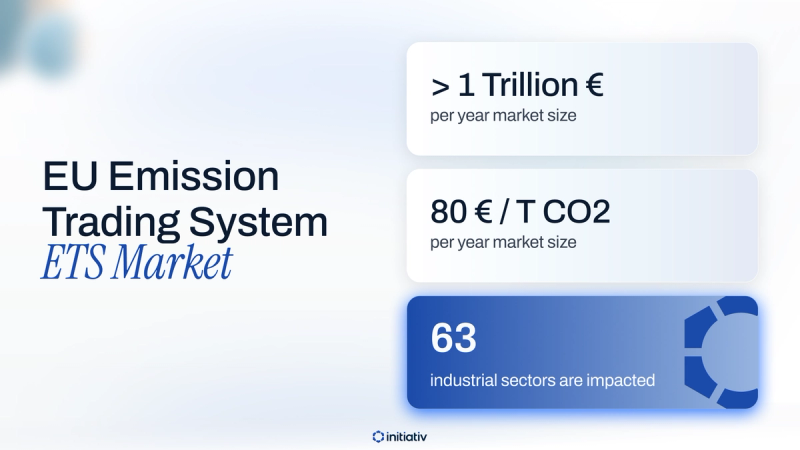
The gradual reduction of free allocations, already effective in some sectors such as electricity and underway in others including steel, aviation, and fertilisers, is progressively transforming market dynamics. More and more industrials now have to purchase an increasing share of their allowances, which naturally raises traded volumes and heightens sensitivity to access costs.
In this context, the ability to buy efficiently, at the right price and without excessive intermediation, has become a key factor of competitiveness. Yet not all market participants have the tools or visibility required to operate in such conditions.
This paradox captures one of the major challenges of the transition: a market designed to bring actors together but still too difficult to access for most of them.
Initiativ’s conviction: democratising access to carbon markets
At Initiativ, we start from a simple observation: the transition can only succeed if every industrial actor has the power to act directly on its carbon exposure.
We aim to make the market more accessible, allowing each industrial company to manage its carbon allowances directly, without relying on intermediaries or facing the system’s current complexity. By simplifying access and reducing execution costs, our approach helps companies regain valuable budgetary control and free up resources that can be reinvested in their decarbonisation projects.
Our ambition is to simplify and rebalance how this market operates, offering industrial companies the same conditions of access, transparency, and efficiency that major financial actors benefit from today.
Initiativ’s approach: a regulated, transparent, and European platform
We are building a regulated infrastructure designed for compliance and security, but also for simplicity of use. Through the use of latest technologies, each transaction is traceable and every price visible in real time. This transparency restores fair value, the true market price accessible to all and free from hidden costs.
Initiativ brings the concept of a short supply chain to the carbon market. By directly connecting all market participants to liquidity, the platform reduces existing fragmentation and greatly simplifies execution processes. It also enables clients to adopt a more agile buy-and-sell strategy through an intuitive interface and the ability to complete transactions in just one click.
Users will be able to manage inventory on-platform that allows them to hold and manage their carbon units (EUA, UKA) directly on the platform, without interacting with their carbon registry. All operations take place within a single, automated, and secure environment, right up to the annual delivery of quotas to the European Union when members can re-deliver the units needed to their registry accounts before compliance deadline. Finally, the platform allows the cash held on account to generate daily interest, a first in the world of carbon exchanges.

This article clarifies the difference between voluntary carbon credits and the EU ETS regulated emissions market. It explains how each mechanism works, the limits of offsetting, why emissions trading drives measurable reductions, and how Initiativ improves market access for companies.

The carbon emissions trading market is fragmented, with participants accessing it via market platforms, OTC, or exchanges. This fragmentation leads to inefficiencies, high intermediation costs, and limited transparency. To achieve the necessary scale and credibility for climate policies by 2030, the market requires a structural and technological transition. Digitalization, which is transforming other financial markets, is essential to unify access, enhance transparency, and reduce risk for all industrial companies subject to the EU ETS.


Do you want more information about what we do?