
French fintech Initiativ announces that it has raised €650,000 to launch a digital trading platform for emission allowances. This upcoming exchange for industrial companies democratizes access to a market that is strategic for the competitiveness and compliance of European businesses.
Initiativ, a young French company founded by Isaure Courcenet, Nicolas Negrilic, and Nicolas Bigotte, announces that it has raised €650,000 from a major Moroccan group, Holmarcom, the venture capital fund U-Investors, and several private business angels from the Frenchfounders network in the banking, trading, and climate sectors. In October 2025, Initiativ will compete in the Start-up World Cup in San Francisco after winning the French Aix edition in July, for a prize of $1 million. The start-up has also been accelerated by the Cambridge Institute for Sustainability Leadership (CISL) at the University of Cambridge and has joined the ZEBOX international innovation accelerator’s club.
The creation of this new market coincides with the global rollout of systems similar to the one in place in Europe, the EU-ETS, and with the arrival of the Carbon Border Adjustment Mechanism (CBAM), which will have a significant impact on international trade.
Unlike carbon credits, which are voluntary, emission allowances are financial instruments whose use is regulated by European regulation. They already apply to the energy, aviation, and maritime transport sectors and will be extended to the building and road transportation sectors starting in 2027.

The founding team combines expertise in commodity markets, financial regulation, and digital market infrastructure. Isaure Courcenet was a commodities broker at a scale-up backed by the World Bank and has led digital infrastructure projects for the public sector in Europe. Nicolas Negrilic, formerly with HSBC, led the approval process at Shares, France's first MiFID and PSAN authorized fintech company. Nicolas Bigotte was the head of low carbon trading with BP and has more than 15 years of experience in the energy and finance industries.
Today, buying or selling emission allowances involves a long chain of middlemen, not all of whom are visible: brokers, traders, and other large intermediaries. This opaque chain naturally brings prices that vary according to the size or bargaining power of companies.
Direct access: a digital marketplace where every industrial company can buy or sell their allowances, without barriers based on size or financial expertise Clear, public pricing: no more intermediation fees and transparent rates Security: simple, instant transactions and guaranteed delivery
By simplifying market access, Initiativ helps reduce procurement costs and ultimately minimizes the impact on prices for consumers (energy, transportation, construction).
“The future of capital markets is being written now. It is being written on stocks, bonds, and forex. It is time for it to be written on commodities that are essential to the proper functioning of our global economy.”
- Isaure Courcenet, Initiativ CEO
The European allowance emissions market already represents €1 trillion in annual transactions and generates €44 billion in public revenue per year in Europe alone.
Until now dominated by a duopoly (an American giant and a long-established German institution), this market remains deliberately confined to a handful of insiders and calibrated for seasoned, large-cap financial players. Faced with this impasse, Initiativ is positioning itself as a sovereign and accessible alternative, with clear rules of the game open to all, serving French and European industrial competitiveness.
Inspired by the wave of fintech companies that have been revolutionizing the banking world for the past decade, such as Revolut and Qonto, the Initiativ team aims to disrupt the conventions of the market through innovation and simplicity.
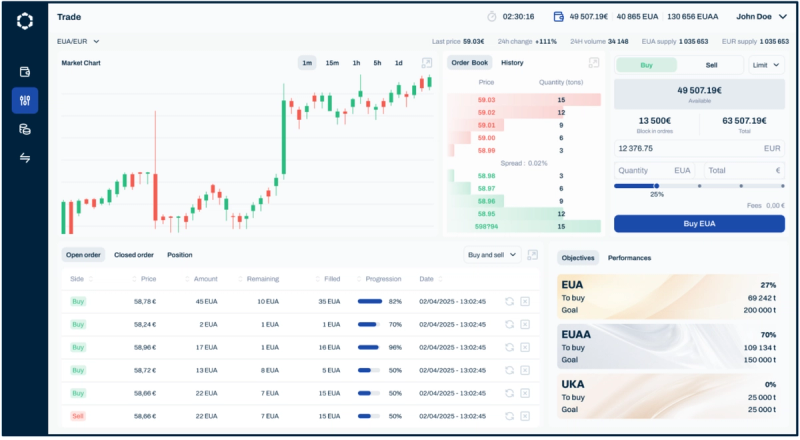
Behind an interface designed for the widest possible audience, Initiativ integrates the latest generation of technology at all levels, from the use of a decentralized infrastructure to the creation of artificial intelligence models applied to financial markets.
The actual launch will take place once the Investment Service Provider license has been obtained from the ACPR and AMF, but several future clients from the industrial and financial space are already pre-registered on the platform and will be able to trade as soon as it opens.
Among the organizations that have expressed interest are manufacturers in the maritime and aviation sectors and major European financial institutions with their own trading desks dedicated to emission allowances. Not to mention that Initiativ is being mentored by the Paris Chamber of Commerce (CCI) within its Growth startups program.
Isaure Courcenet (CEO) : is the founder of Initiativ. She was a commodities broker at a World Bank-backed scale-up and led infrastructure development consulting assignments for digital assets at a firm affiliated with the World Economic Forum. She has contributed to public sector work on digital infrastructure in several jurisdictions, including with the French Ministry of the Interior..
Nicolas Negrilic (COO) : has a 10+ year experience in financial services on regulatory and operational topics, as a consultant or head of compliance. He joined the Startup/Fintech ecosystem in 2022 with Shares, making them the first French startup to be authorized for both crypto and MiFID activities.
Nicolas Bigotte (CCO) : Nicolas Bigotte is a seasoned leader with more than 15 years of expertise in trading, derivatives, and commodity markets. He most recently served as Global Head of Sales at BP Low Carbon Trading, where he spearheaded growth across voluntary and compliance carbon markets. Renowned for his ability to structure impactful deals and partnerships, he has consistently delivered value to clients and stakeholders. Previously, Nicolas held senior origination roles at BP and Société Générale, developing innovative risk management and trading strategies.

This article clarifies the difference between voluntary carbon credits and the EU ETS regulated emissions market. It explains how each mechanism works, the limits of offsetting, why emissions trading drives measurable reductions, and how Initiativ improves market access for companies.

The carbon emissions trading market is fragmented, with participants accessing it via market platforms, OTC, or exchanges. This fragmentation leads to inefficiencies, high intermediation costs, and limited transparency. To achieve the necessary scale and credibility for climate policies by 2030, the market requires a structural and technological transition. Digitalization, which is transforming other financial markets, is essential to unify access, enhance transparency, and reduce risk for all industrial companies subject to the EU ETS.


Do you want more information about what we do?