


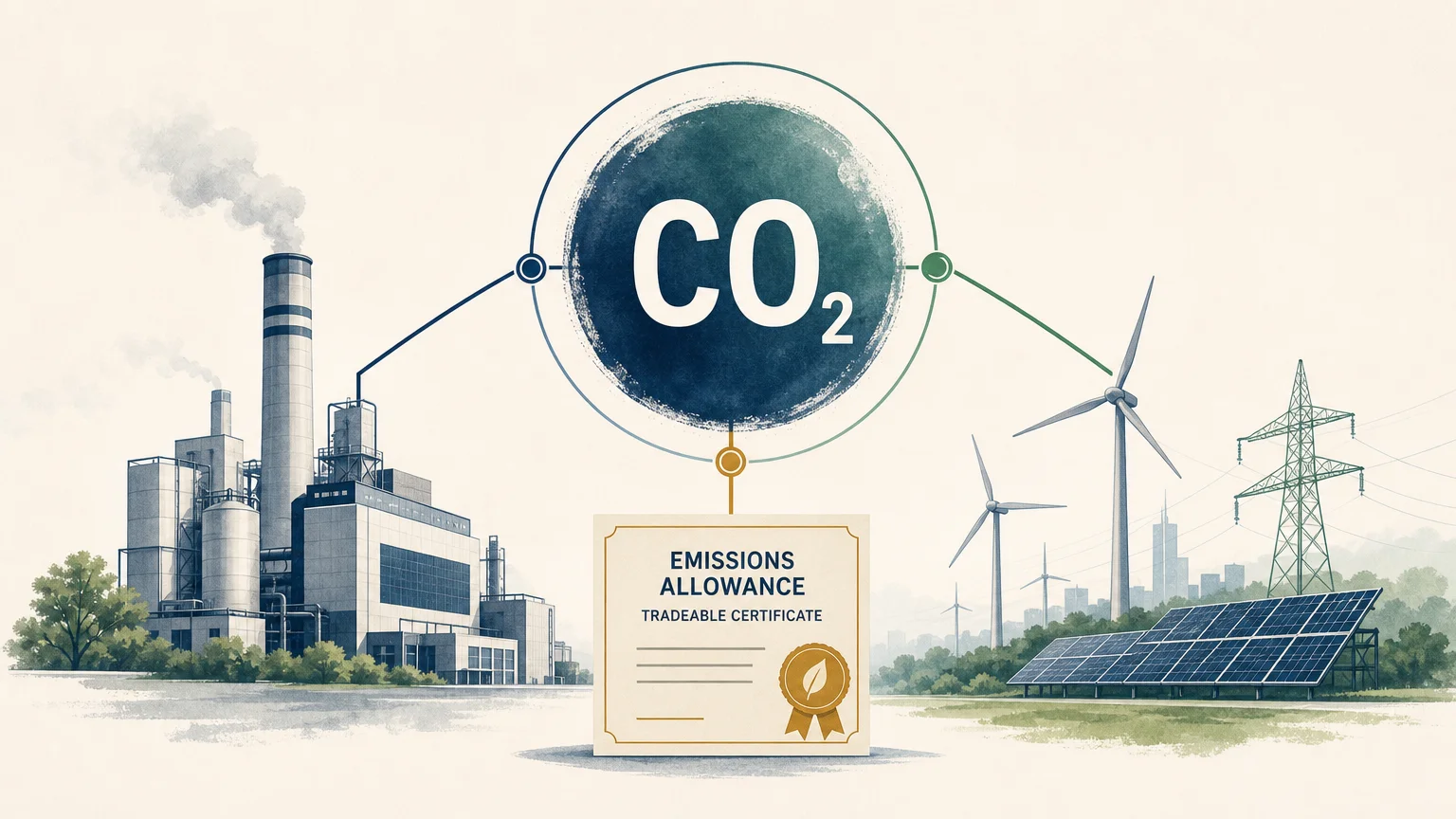

What happens when pollution becomes a measurable business cost? That question sits at the centre of carbon pricing, a policy approach that changes the economics of fuel use, industrial production, investment, and procurement. For readers following allowance markets, our guide to the EU ETS trading price provides a focused view of one of the most important compliance markets.
Carbon pricing does not describe one universal instrument. It includes fixed charges, tradable allowances, internal company benchmarks, and international mechanisms that influence how emissions are valued. The latest 2026 World Bank data shows that 87 implemented policies covered just over 29% of global greenhouse gas emissions, while carbon pricing mobilised more than $107 billion for public budgets in 2025.
What does carbon pricing mean in practice?
Carbon pricing means attaching a monetary value to greenhouse gas emissions. The charge may apply directly to carbon dioxide emissions, to the carbon content of fossil fuels, or to tradable allowances that permit covered entities to emit.
The policy objective is to reflect part of the social cost created by emissions. These costs can include climate damage, health impacts from air pollution, infrastructure losses, and risks to agricultural production. Without a price signal, many of these costs remain outside the transactions that determine fuel, electricity, and product prices.
A carbon price changes incentives rather than prescribing one technical solution. An industrial operator may reduce fuel consumption, switch energy sources, improve efficiency, invest in abatement equipment, or purchase allowances. The economically attractive response depends on the price, the available technology, the regulatory design, and the company’s production profile.
It is also important to separate direct carbon pricing from broader policies that make carbon-intensive activity more expensive. Fuel excise duties, efficiency standards, renewable energy requirements, and subsidy reforms may influence emissions without creating an explicit price per tonne. They can complement carbon pricing, but they are not the same instrument.
Carbon tax or ETS: who sets the price?
Consider two jurisdictions with the same emissions target. One may impose a fixed charge per tonne of carbon dioxide. The other may limit total emissions and allow covered companies to trade allowances. Both create a financial incentive to reduce emissions, but they provide different forms of certainty.
| Mechanism | How it works | Primary certainty | Main trade-off |
|---|---|---|---|
| Carbon tax | Government sets a charge per tonne or per unit of fuel carbon content. | Price certainty | Actual emissions reductions vary with behaviour and technology response. |
| Emissions trading system | Government limits covered emissions and issues tradable allowances. | Quantity certainty | Allowance prices can fluctuate with supply, demand, policy, and economic activity. |
| Internal carbon price | A company assigns a carbon value to guide investment and operational decisions. | Decision-making consistency | It may not create an external payment or directly reduce regulated emissions. |
A carbon tax is generally easier to understand in financial planning because the rate is stated in advance. A company can estimate its liability by multiplying the applicable rate by its taxable emissions or fuel use. Governments may still adjust the rate over time, provide exemptions, or apply different rates by sector.
An emissions trading system, also called cap and trade, takes the opposite approach. The regulator establishes a cap, distributes or auctions allowances, and requires covered entities to surrender enough units to match their verified emissions. The market then determines the allowance price.
That price can respond to economic growth, fuel switching, weather, industrial output, regulatory changes, allowance banking, and expectations about future scarcity. To understand how those forces interact in practice, our explanation of carbon market price discovery examines the role of supply, demand, information, and market structure.
Some systems combine elements of both approaches. A market may include a price floor, a cost containment reserve, or an upper price limit. A tax may also rise according to a published schedule. These hybrid designs attempt to balance emissions control with more predictable costs for businesses and households.
How are coverage, obligations, and revenue designed?
A carbon price only affects emissions that fall within its scope. Policymakers therefore make several design choices before an instrument becomes operational. They decide which gases, sectors, facilities, fuels, and emissions thresholds are covered, as well as where the obligation is imposed.
Some instruments regulate large industrial installations directly. Others apply upstream, placing the obligation on fuel producers, importers, or distributors. Upstream regulation can cover many users with fewer compliance points, while point-source regulation can provide more detailed control over facility-level emissions.
In an ETS, covered entities typically monitor and report emissions, surrender allowances, and maintain records that can be audited. A carbon tax also requires measurement and reporting where liability depends on actual emissions. Reliable monitoring, reporting, and verification are essential because an inaccurate emissions baseline can distort both compliance costs and environmental outcomes.
Allocation is another central issue. Allowances may be auctioned, distributed free of charge, or allocated through output-based benchmarks. Free allocation can reduce the risk of carbon leakage for trade-exposed industries, but it may reduce the immediate financial incentive to change production methods. Auctioning raises public revenue, while benchmarking can reward facilities that perform better than an industry standard.
Carbon pricing revenue can be used in several ways. Governments may fund clean energy, public transport, industrial innovation, climate adaptation, household compensation, or general public spending. In 2025, carbon pricing generated more than $107 billion for public budgets globally, according to the World Bank’s 2026 reporting. That figure represents public revenue from carbon taxes and allowance sales, not the total value of secondary carbon-market trading.
For companies, the headline rate is not always the same as the effective cost. Free allocation, exemptions, rebates, output-based rules, and partial sector coverage can materially change exposure. A market price of one allowance may therefore be useful for benchmarking, but insufficient for calculating the actual cost of a specific installation or product.
Why is carbon pricing expanding internationally?
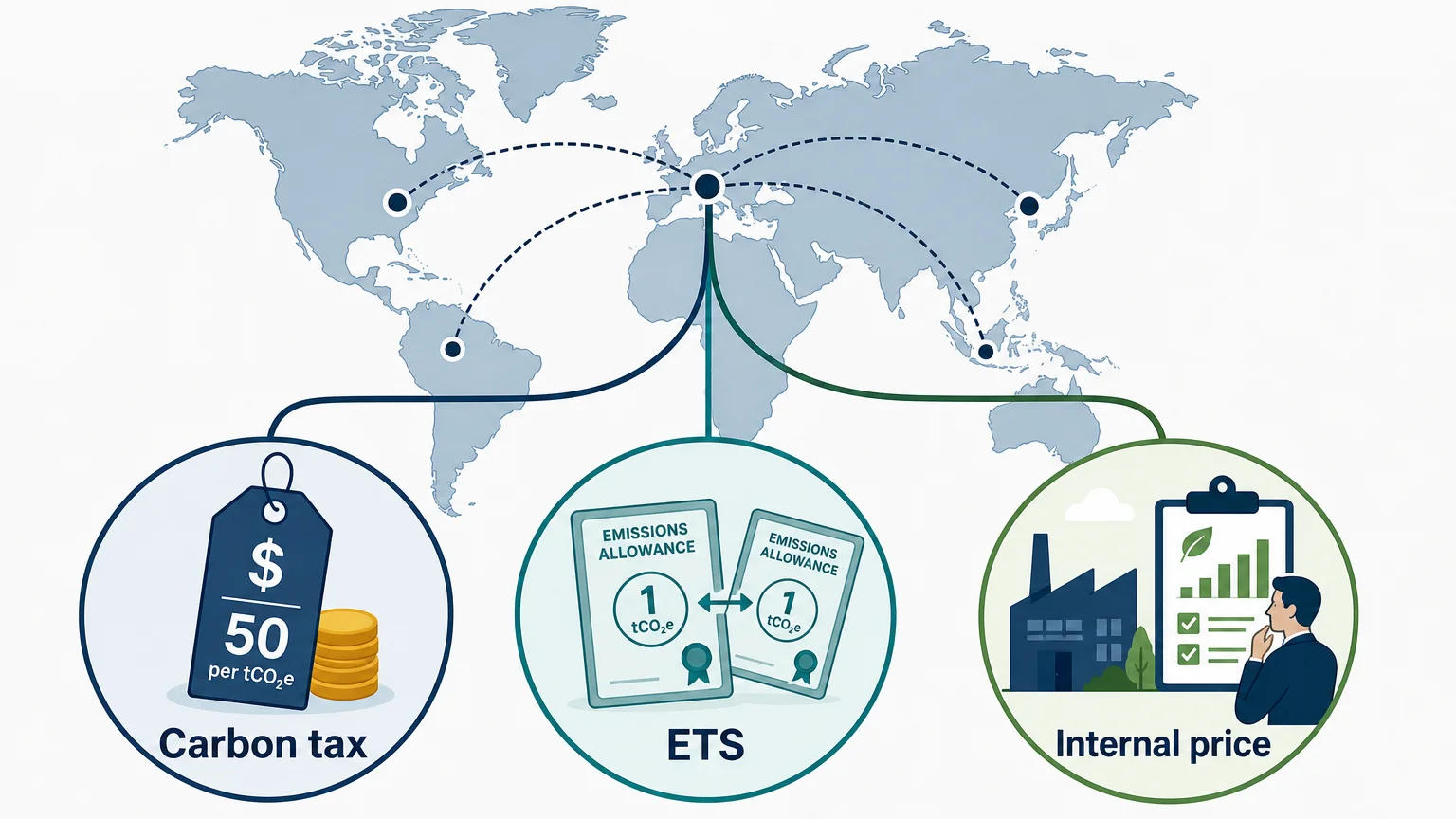
In 2026, carbon pricing is no longer limited to a small group of mature markets. The World Bank reports that all large middle-income economies have either implemented or are planning direct carbon pricing instruments. This expansion reflects several overlapping pressures, including climate commitments, industrial transition, public revenue needs, and the desire to reduce trade distortions between jurisdictions.
Different regions are choosing different paths. Some rely on long-established carbon taxes. Others are developing national or subnational ETSs. Several jurisdictions use more than one instrument, with an ETS covering large industry and power generation while a tax or fuel charge applies to transport, buildings, or smaller sources.
International trade is adding another layer of pressure. When one jurisdiction places a meaningful cost on emissions and another does not, producers may face different operating costs. This can create concerns about competitiveness and carbon leakage, particularly in sectors such as steel, cement, chemicals, fertilisers, and aluminium.
Border measures can address part of this problem by considering the carbon cost associated with imported goods. They also encourage exporters to improve emissions reporting and identify whether a carbon price has already been paid in the country of production. The result is a stronger connection between domestic climate policy, trade compliance, and supply-chain data.
International cooperation is also developing through carbon-market provisions under the Paris Agreement. In 2026, governments continued discussing mechanisms for transferring emissions reductions between countries and for avoiding double counting. These arrangements are distinct from domestic ETSs and carbon taxes, but they contribute to a wider architecture for cross-border climate cooperation.
What does carbon pricing change for business decisions?
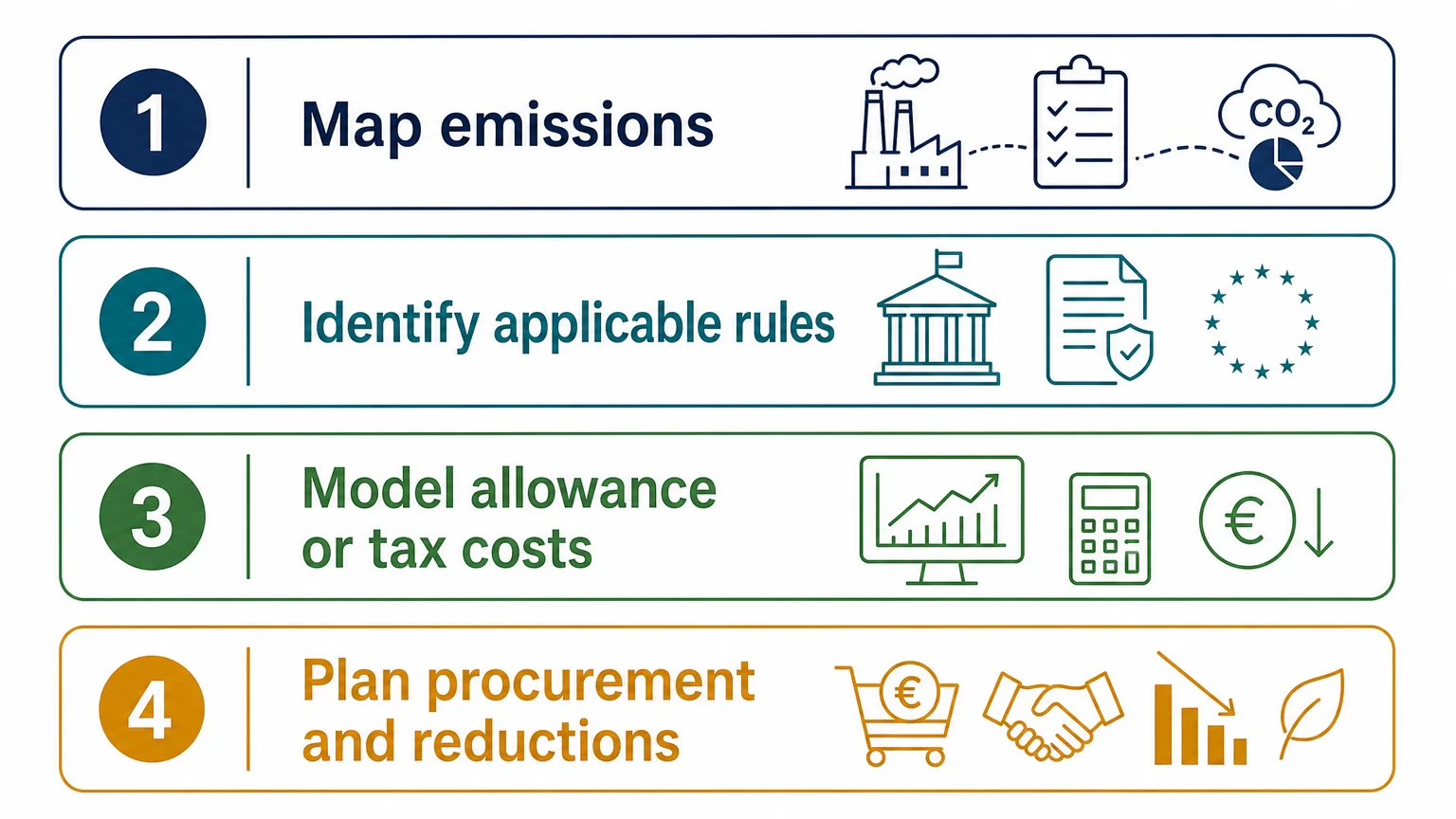
For a business, carbon pricing is not only a policy issue. It can affect procurement, investment appraisal, production planning, contract terms, treasury management, and risk reporting.
The first step is to identify the relevant obligation. A company may be directly covered by an ETS, indirectly exposed through electricity or fuel prices, or affected by a carbon cost embedded in purchased materials. A multinational may face several systems at once, each with different thresholds, gases, reporting periods, and allocation rules.
The second step is to distinguish current liability from future risk. A facility may receive free allowances today but face tighter benchmarks later. A carbon tax may begin at a modest rate but increase according to legislation. An internal scenario should therefore include both the present cost and plausible future price paths.
Companies also need to separate compliance procurement from speculative activity. Compliance teams generally seek sufficient allowances to meet surrender obligations. Trading desks may manage positions, liquidity, spreads, or derivatives exposure. These activities can involve different controls, mandates, reporting needs, and risk limits.
A robust internal carbon price can help connect these decisions. It may be a shadow price used in investment models, an internal fee charged to business units, or a benchmark used in scenario analysis. The internal value does not replace a legal obligation, but it can reveal how future carbon costs might affect capital allocation.
For professional participants managing allowance exposure, our carbon benchmark resource explains how EUA prices can be interpreted alongside market drivers and broader carbon-market conditions.
Does carbon pricing reduce emissions and support growth?
The environmental case depends on design and implementation. A price that is too low, covers too few emissions, or is weakened by exemptions may produce limited behavioural change. A credible system must provide a meaningful incentive while giving companies enough visibility to plan investments.
Carbon pricing can reduce emissions through several channels. It can make high-carbon fuel less competitive, improve the economics of efficiency projects, support fuel switching, and reward companies that reduce emissions below a benchmark. In an ETS, allowance scarcity can also create value for verified reductions that reduce future compliance needs.
Evidence is not uniform across every jurisdiction, because outcomes depend on the starting energy mix, economic cycle, technology costs, and accompanying policies. A 2024 study using data from 121 countries estimated that a $10 increase in carbon taxes was associated with a 1.3% short-run reduction and a 4.6% long-run reduction in per-capita carbon dioxide emissions, as reported in the study’s analysis.
These findings should not be interpreted as a universal forecast. They indicate that responses can strengthen over time as households and businesses replace equipment, redesign processes, and adjust investment plans. The long-term effect may therefore be more important than the first-year response.
Economic effects also depend on revenue use and distribution. A carbon price can raise energy and production costs, especially for carbon-intensive activities. Recycling revenue through household support, targeted industrial investment, tax reductions, or public infrastructure can reduce adverse effects and improve political durability.
Carbon pricing is therefore rarely sufficient on its own. It usually works alongside standards, public investment, research support, grid expansion, permitting reform, and measures that protect vulnerable households or trade-exposed industries. Its role is to make emissions visible in economic decisions, not to replace every other climate policy.
What should decision-makers monitor in 2026?
Carbon pricing is changing from a narrow compliance topic into a broader market and risk-management discipline. Decision-makers should monitor at least five areas: policy scope, price formation, emissions data, international trade, and market infrastructure.
Policy scope matters because a new sector can change demand for allowances or taxable fuels. The expansion of an ETS into additional industrial activities may increase compliance demand. Conversely, lower economic output or accelerated fuel switching may reduce demand and weaken prices.
Price formation deserves separate attention. An allowance price reflects current fundamentals, but it also reflects expectations about future caps, regulation, auction supply, banking, fuel spreads, weather, and industrial output. This is why companies often need more than a single spot-price reference when planning procurement.
Data quality is equally important. Emissions measurements, production volumes, allowance balances, and verified reports influence compliance calculations and financial forecasts. Better carbon market data can help teams distinguish market movement from changes in underlying exposure.
International trade rules may also influence corporate decisions. In May 2026, the Associated Press reported that maritime nations preserved plans to continue work on a potential global carbon fee for shipping, with further discussions expected later in the year. Although the proposal remained under development at that time, it illustrates how sector-specific international pricing could affect freight costs and supply-chain planning.
Finally, market infrastructure determines how efficiently participants can act. Professional users may require live pricing, order-book visibility, pre-trade controls, API access, block execution, position reporting, confirmation, settlement, and team permissions. These capabilities become more important when carbon costs are material to compliance, procurement, or trading performance.
Our carbon market data guide offers additional context for interpreting prices, volumes, and market trends when evaluating allowance exposure.
Carbon pricing is a framework, not a single price
Carbon pricing can mean a fixed tax, a fluctuating allowance price, or an internal value used to guide investment. The main distinction is between price certainty and quantity certainty, but real-world outcomes also depend on coverage, allocation, monitoring, revenue use, and international coordination. In 2026, adoption is expanding, yet most emissions remain outside direct pricing or face prices that vary significantly by jurisdiction.
For organisations, the practical task is to connect policy design with measurable exposure. That means mapping emissions, understanding compliance obligations, modelling different price scenarios, and separating legal procurement from market risk. A well-designed carbon price can support lower-emission decisions, but its effectiveness depends on credible rules and complementary measures.
Take action with Initiativ
Carbon pricing creates practical decisions for compliance teams, industrial operators, brokers, banks, asset managers, and professional trading desks. Those decisions require reliable market access, clear price visibility, and workflows that connect execution with risk management and reporting.
Initiativ provides carbon trading for traders and corporates, with access to EU Allowances in spot and derivatives form. Professional participants can monitor live prices, use alerts and pre-trade controls, connect through an API, manage positions and limits, and support confirmation and settlement workflows through a digital exchange infrastructure.
Frequently Asked Questions
What is carbon pricing?
Carbon pricing assigns a financial value to greenhouse gas emissions. It is commonly implemented through a carbon tax, an emissions trading system, or an internal company price used for planning.
What is the difference between a carbon tax and an ETS?
A carbon tax sets the price directly, while an ETS sets a limit on covered emissions and allows the market to determine the allowance price. A tax offers greater price predictability, whereas an ETS provides stronger certainty about the quantity of emissions covered by the cap.
Who pays a carbon price?
The liable party depends on the policy design. It may be a fuel supplier, an industrial installation, an electricity generator, an importer, or another regulated entity, while the cost can also flow through supply chains and consumer prices.
Can companies use an internal carbon price?
Yes. Companies may use a shadow price, internal fee, or scenario value to assess investments, identify transition risks, and compare projects with different emissions profiles. This internal price does not replace a legal tax or allowance surrender obligation.
How can professional participants manage carbon-market exposure?
Professional participants can combine emissions data, policy analysis, procurement planning, market monitoring, and risk controls. Initiativ supports professional EU Allowance participants with spot and derivatives access, live market information, API connectivity, position management, and post-trade workflows.
This may interest you



Let’s connect
Do you want more information about what we do?