




If you are tracking the EU ETS trading price, the first question is not only what the quote is, but which EUA contract, venue, and delivery date it represents. The market price reflects supply, compliance demand, energy economics, policy expectations, and liquidity. For historical context and scenario analysis, consult our EUA price forecasts.
As of September 7, 2026, official EU auction indicators showed a six-month average allowance price of €75.99 and a two-year reference average of €70.68. These are reference measures rather than a single live trading quote, which can vary by contract, venue, settlement date, and time of day, as shown by the September auction indicators.
What Does the EU ETS Trading Price Actually Measure?
An EU Allowance, or EUA, gives its holder the right to emit one tonne of carbon dioxide equivalent within the regulated system. The EU Allowance price therefore represents the cost of holding, acquiring, selling, or surrendering that compliance instrument.
The EU ETS is a cap and trade market. The total number of available allowances is constrained by the emissions cap, while regulated entities must surrender enough allowances to cover verified emissions. Companies with a short position need to buy allowances, while participants with surplus inventory may sell them.
That structure makes the market price an economic signal. It influences decisions about fuel switching, industrial production, abatement investment, hedging, and the timing of compliance procurement. It also explains why the price can move even when the physical emissions balance changes slowly.
There is no single price that serves every purpose. A spot EUA reflects near-term delivery, while a futures contract reflects delivery at a later date. A compliance buyer may focus on the cost of acquiring allowances, while a financial participant may focus on spreads, volatility, basis risk, or the shape of the forward curve.
The European Environment Agency provides historical emissions and allowance information through its EU ETS data viewer. That data helps users distinguish the allowance market from related carbon instruments, including the separate EU ETS 2 market planned for buildings, road transport, and additional sectors.
Why Does the EUA Price Move?
What causes a daily price change in the EU ETS? Usually, several forces interact rather than one isolated event. The most important inputs are allowance supply, emissions demand, energy prices, regulatory expectations, weather, industrial output, and the availability of market liquidity.
Energy switching is a central mechanism. When gas becomes more expensive than coal, power producers may require more allowances because coal generation is generally more carbon intensive. When gas prices fall or renewable generation rises, expected allowance demand can weaken.
Industrial production also matters. Lower output from sectors such as steel, cement, chemicals, and refining can reduce near-term demand. Stronger production can have the opposite effect, especially when companies need to cover emissions that exceed free allocations.
Policy expectations can move the market before a rule changes. Participants may adjust positions ahead of revisions to the emissions cap, the Market Stability Reserve, free allocation, aviation rules, maritime coverage, or the Carbon Border Adjustment Mechanism. The price may therefore respond to an expected future shortage or surplus before it appears in current compliance data.
Liquidity affects how strongly the market reacts. In early 2026, EU carbon prices fell 29% over three months, while volatility reached a two-year high. The same ESMA market report stated that financial intermediaries accounted for about 62% of overall trading volumes in 2025, showing why financial participation matters for price formation and access.

Market participants should also distinguish volatility from a change in long-term fundamentals. A sharp move may reflect positioning, options activity, auction timing, or a short-lived energy shock. A sustained trend usually requires a deeper change in expected allowance demand, supply, or policy credibility.
For a more detailed explanation of these forces, readers can review our price drivers analysis, which connects liquidity, execution conditions, and market participation.
Which EU ETS Price Should You Monitor?
Which quote is relevant depends on your objective. A compliance entity planning a purchase may monitor the spot market and nearby futures. A trading desk may compare several maturities, spreads, volatility measures, and order-book conditions before deciding how to execute.
Spot prices are useful when delivery is immediate or when a buyer wants to acquire allowances for an existing compliance obligation. They can be sensitive to short-term auction supply, immediate industrial demand, and the availability of sellers.
Futures prices provide a forward reference. They can help companies plan procurement over several months or years, but they introduce additional considerations such as margining, rollover, basis risk, and the relationship between the futures contract and eventual spot delivery.
Auction clearing prices are another important reference. They show the level at which allowances are allocated through official auctions, although they do not replace secondary-market prices. Auction results can influence expectations about supply and may affect nearby contracts when the market is thin.
When you compare prices, check at least five details:
- Whether the quote refers to spot, futures, or options.
- The delivery month or delivery year.
- The trading venue and settlement method.
- The currency and price unit, usually euros per tonne.
- The time stamp and liquidity available at the quoted level.
A quoted price without those details can create a misleading comparison. Two prices may appear different because they represent different delivery periods or contract specifications rather than a genuine market discrepancy.
How Can You Use EU ETS Price Data in Practice?
What should a professional participant do with the price information? The answer depends on whether the priority is compliance certainty, trading performance, cost control, or operational transparency.
For compliance procurement, a company may define a target inventory, establish purchase bands, and spread purchases over time. This approach can reduce dependence on one entry point, although it does not eliminate market risk or guarantee a lower average cost.
For trading activity, participants may use the forward curve to evaluate relative value, monitor changes in volatility, and compare execution costs across venues. They may also combine directional views with defined limits, collateral planning, and position monitoring.
Risk management should cover more than the headline price. You may need to monitor:
- Open EUA positions and expected compliance needs.
- Cash balances, margin requirements, and collateral availability.
- Price alerts and exposure limits.
- Order-book depth and potential market impact.
- Trade confirmations, reporting, and settlement status.
This is where execution infrastructure becomes important. A professional platform should make it easier to view live prices, submit appropriate order types, apply pre-trade controls, and maintain a reliable record of transactions.
We combine these needs through our EU ETS price discovery resources, which explain how orders, market information, and participant expectations interact to form a tradable reference.
What Could Change the EU ETS Trading Price in 2026 and Beyond?
Why does the 2026 outlook remain uncertain? The market is entering a period in which regulatory design, allowance scarcity, and industrial competitiveness are being reassessed together.
The European Commission proposed a targeted EU ETS revision on July 17, 2026. Possible changes relate to the system’s future ambition, scope, aviation and maritime treatment, and the operation of the Market Stability Reserve. Any confirmed reform could alter expectations about future supply and demand.
A 2026 European Parliament briefing notes that the review may consider the Market Stability Reserve intake rate, release thresholds, and invalidation rules. It also uses an EUA price assumption of €88.33 in revenue projections, which is a modelling input rather than a guaranteed market forecast.
CBAM is another important consideration. As free allocation phases down for relevant sectors, the relationship between domestic carbon costs and embedded emissions in imports becomes more significant. This can affect procurement strategies for industrial companies exposed to international trade and carbon leakage risks.
The introduction of maritime obligations and the continuing development of aviation coverage also broaden the compliance base. These changes may increase demand in some periods, but the effect depends on verified emissions, free allocation, fuel prices, economic activity, and the timing of surrender obligations.
The planned EU ETS 2 should be assessed separately. It is not the same allowance market as EU ETS 1, and its price should not be substituted for the EUA price used by current industrial, power, aviation, and maritime participants.
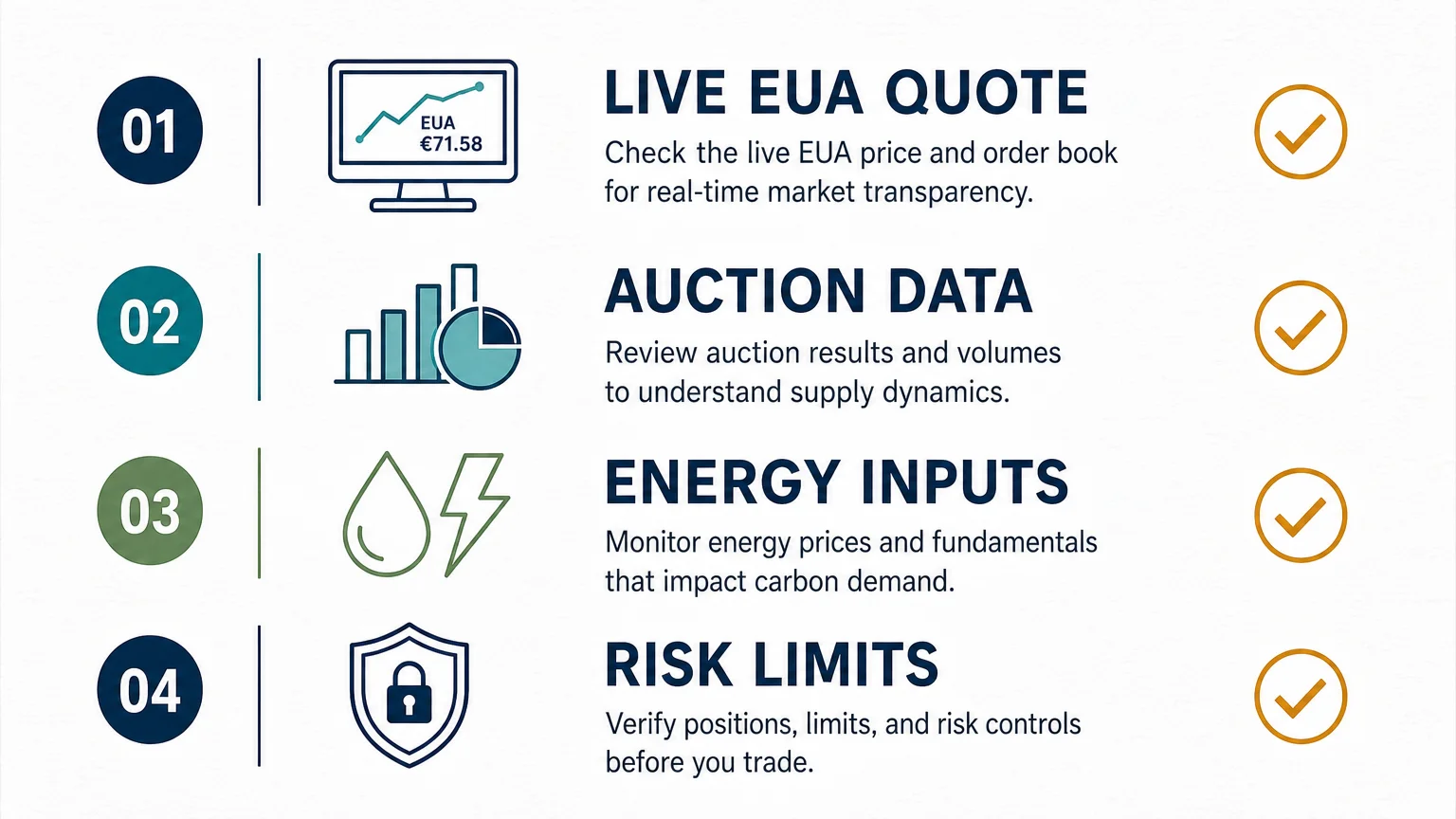
For that reason, a robust 2026 market view should use scenarios rather than one fixed prediction. Consider a stable-demand scenario, a tighter-supply scenario, and a policy-change scenario. For each, define the price range, procurement response, risk limit, and review point.
Making Sense of the EU ETS Trading Price
The EU ETS trading price is best understood as a changing market signal rather than a single permanent number. Spot prices, futures, auction results, energy costs, compliance demand, liquidity, and policy expectations all contribute to the quote you see. If you are making procurement or trading decisions in 2026, verify the contract, delivery period, source, and liquidity before acting. A disciplined process should combine current market data with position limits, scenario planning, and clear execution procedures.
Take action with Initiativ
When price information must support real procurement or trading decisions, access to reliable execution tools becomes as important as the market view itself. Professional participants need visibility into prices, positions, orders, risk, and post-trade workflows without creating unnecessary operational friction.
We provide access to EUA spot and derivatives trading, live market monitoring, configurable alerts, pre-trade risk controls, API connectivity, order-book tools, and reporting workflows. Teams can also manage positions, balances, limits, confirmations, and settlement processes through one institutional infrastructure. Learn more about EU ETS trading for traders and corporates.
Frequently Asked Questions
What is the EU ETS trading price?
The EU ETS trading price is the market value of an EU Allowance, which represents the right to emit one tonne of carbon dioxide equivalent. The relevant price depends on the instrument, delivery period, venue, and market conditions.
Is the EUA price the same as the EU ETS 2 price?
No. EU ETS 1 and EU ETS 2 are separate markets with different covered sectors, compliance structures, and allowance instruments. You should confirm which market a data provider or contract refers to before comparing prices.
What factors influence EUA prices?
Key factors include allowance supply, industrial emissions, power-sector fuel switching, renewable generation, energy prices, regulatory expectations, auctions, and market liquidity. Short-term positioning and volatility can also create price movements that do not immediately reflect long-term fundamentals.
Should a company buy EU Allowances at one time?
That depends on the company’s compliance needs, risk tolerance, cash position, and procurement policy. Some organizations spread purchases over time or use a structured hedging approach to reduce reliance on one market entry point.
Can Initiativ support professional EU ETS trading?
Initiativ supports professional participants with EUA spot and derivatives access, live price monitoring, order management, risk controls, API connectivity, and reporting workflows. Eligibility remains subject to onboarding, KYC or KYB requirements, and professional-client qualification where applicable.




Let’s connect
Do you want more information about what we do?