




A carbon allowance is not simply a compliance cost. It is also a forward-looking market signal that can influence investment, procurement timing, hedging, and industrial competitiveness. If you are searching for an EU ETS price forecast 2030, our EUA price trends and forecasts through 2030 can help you frame the wider market context.
The central challenge is uncertainty. The EU ETS is becoming structurally tighter, but the price response depends on emissions, energy spreads, policy implementation, allowance banking, and market expectations. The latest available EEA data combines 2024 market information with Member State projections from 2025 to 2030, creating a useful basis for scenario analysis rather than a guaranteed price path.
What does the EU ETS price forecast 2030 actually cover?
The phrase “EU ETS price” usually refers to EU ETS1, the established market for sectors such as power generation, industry, aviation, and maritime transport. However, the European Union is also developing ETS2 for buildings, road transport, and additional smaller sources. These schemes have different participants, supply mechanisms, compliance structures, and price risks.
For most industrial buyers, the primary question concerns the price of EU Allowances, or EUAs, in ETS1. The system is designed to reduce covered emissions by 62% from 2005 levels by 2030 for stationary installations. This declining cap creates long-term scarcity, but scarcity does not produce a smooth annual price increase.
Prices can weaken when industrial output falls, renewable generation displaces fossil power, or fuel switching reduces allowance demand. They can rise when coal replaces gas, hedging demand increases, or market participants anticipate tighter supply several years ahead. A forecast therefore needs to connect the carbon market with the energy system and the wider economy.
ETS2 should not be blended into an ETS1 forecast. Its compliance obligations fall mainly on fuel suppliers, while its purpose is to extend carbon pricing into sectors that have not historically purchased standard EUAs. A single headline forecast can therefore mislead buyers unless it clearly identifies the market being measured.
What is a reasonable ETS1 price range for 2030?

A useful planning figure should be treated as a range, not a prediction. One BCG scenario available before September 2026 places the 2030 EU ETS price near €125 per tonne of CO2. The BCG benchmark is best understood as one modelled reference point, not a market guarantee.
For internal stress testing, companies can build three illustrative cases around a central assumption. For example, a lower case near €90, a reference case near €125, and a higher case near €160 per tonne can show how procurement costs change under different market conditions. These figures are planning examples, not a published consensus or an official price target.
The lower case would be consistent with faster emissions reduction, stronger renewable generation, subdued industrial output, or additional compliance flexibility. The higher case would be consistent with persistent fossil fuel use, delayed abatement investment, stronger hedging demand, and a tighter interpretation of future policy.
The most important question is not whether the price reaches one exact number. It is whether your organisation can remain financially resilient if the allowance price moves materially above its base case. A procurement policy that only works at one price level is vulnerable to both market volatility and regulatory change.
Which forces will move EUA prices toward 2030?
Four forces deserve priority in any forecast: allowance supply, compliance demand, energy-market conditions, and policy expectations. Their effects interact, so analysing them separately is useful only as a first step.
Supply policy is the structural foundation. The emissions cap declines over time, auction volumes change, and free allocation is gradually affected by the transition to CBAM for covered imports. The Market Stability Reserve can also remove allowances when the market surplus is high, or release them when the surplus falls below defined thresholds.
Compliance demand depends on real emissions rather than policy ambition alone. Power generators may need more allowances when coal generation rises. Industrial companies may need fewer allowances when electrification, efficiency improvements, hydrogen, or carbon capture reduce emissions. The timing of these investments can create temporary price swings.
Forward hedging also matters. Industrial companies often buy allowances ahead of their surrender deadlines, while financial participants may respond to expected scarcity. This means the market can price future policy before the underlying emissions decline has occurred.
Energy prices remain an important transmission channel. The European Commission reported in its 2025 analysis that ETS1 prices had averaged around €80 during 2022 and 2023, before declining to €65 in 2024. It also noted that 2025 prices had fluctuated between €60 and €80 at the time of publication, illustrating how fuel markets and industrial demand can affect carbon prices before longer-term scarcity dominates.
For organisations monitoring these interactions, our EU ETS and energy market price drivers provides a focused framework for connecting allowance prices with power, gas, coal, demand, and policy conditions.
Why could the 2026 reform change the outlook?
Regulatory design is one of the largest uncertainties in any 2030 forecast. The legally defined cap and MSR settings may appear stable, but their longer-term consequences depend on how quickly emissions fall and how much flexibility remains in the market.
A 2026 European Commission working document stresses that its indexed EUA price curves illustrate directional trends and policy comparisons. They are not intended to provide precise market forecasts. The 2026 assessment also describes scenarios in which the current legal trajectory could create a sharply tighter system during the 2030s.
The reform debate can influence several price variables:
- Cap trajectory: the reduction path may need to align with the EU’s 2040 climate objective.
- MSR thresholds: lower thresholds could remove allowances sooner and increase short-term tightness.
- Intake and release rates: changes could alter how quickly the reserve responds to market surpluses or shortages.
- Scope: aviation, maritime activity, waste, carbon capture, and other sectors may affect future supply and demand.
- Carbon removals: eligible removals could create additional compliance options, depending on their rules and availability.
These variables create two different risks. A tighter framework could raise the long-term carbon price and accelerate investment. A sudden rule change could also create temporary dislocations, particularly if companies, traders, and compliance entities adjust their positions at the same time.
That is why a forecast should be updated when the legislative framework changes. A price model based on current rules can remain useful for comparison, but it should not be treated as a permanent estimate of the 2030 market.
How should industrial buyers and financial desks plan?
Consider an industrial operator with annual surrender obligations and uncertain production volumes. The organisation must decide how much to buy now, how much to reserve for later, and whether futures or options should complement spot purchases.
A robust policy normally combines several layers:
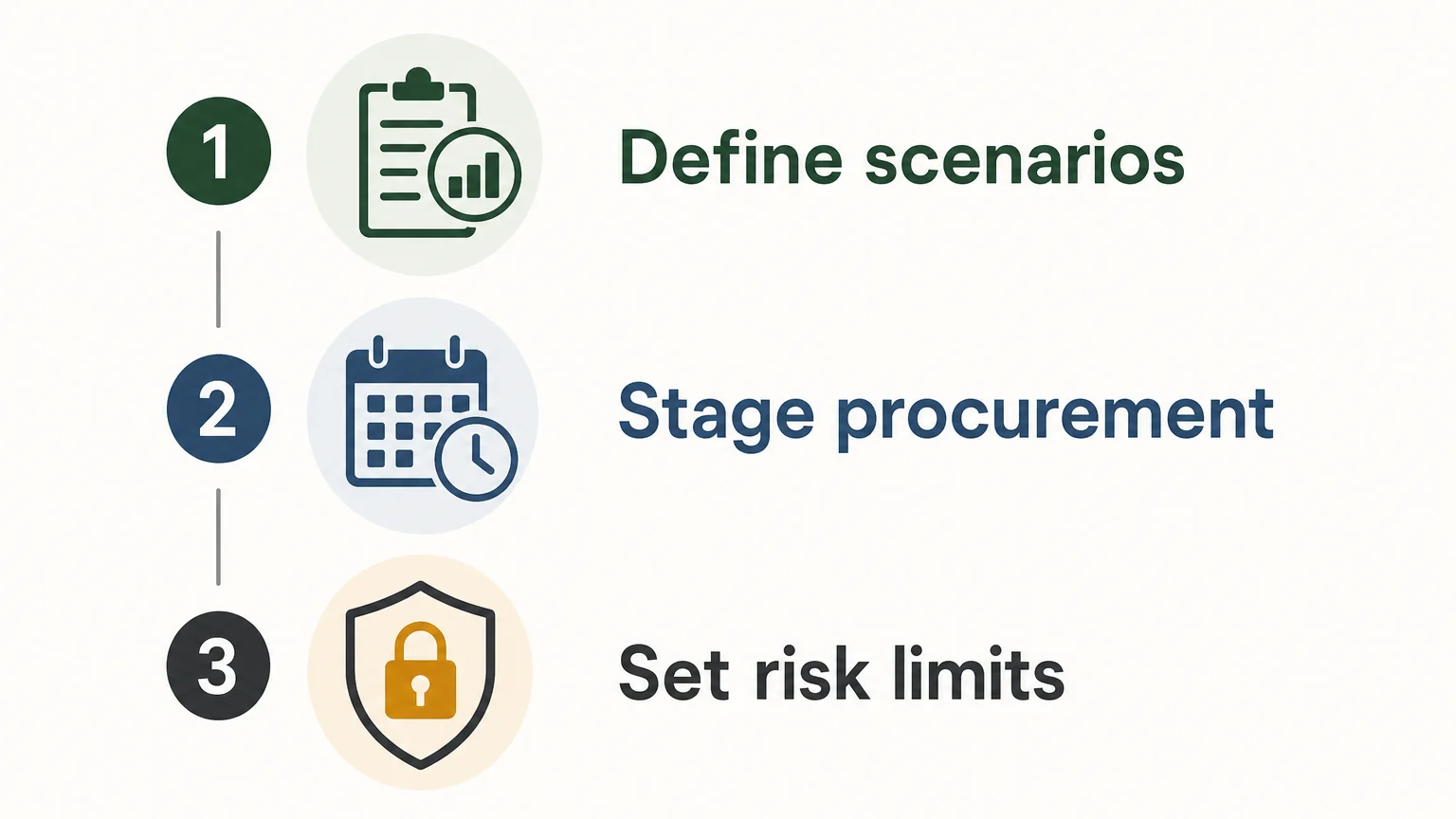
- Scenario planning: define lower, reference, and higher EUA price cases.
- Demand forecasting: connect allowance needs to production, emissions intensity, fuel mix, and planned abatement.
- Staged procurement: spread purchases across time instead of relying on one market entry point.
- Hedge governance: establish approved instruments, limits, collateral rules, and escalation procedures.
- Liquidity monitoring: assess order-book depth, contract availability, spreads, and execution conditions.
- Operational control: reconcile positions, balances, confirmations, settlement, and reporting.
Financial desks may use a different framework. They often focus on basis risk, volatility, curve structure, liquidity, margin, and the relationship between carbon and energy markets. Compliance teams usually prioritise delivery certainty and budget control, while trading firms may prioritise execution flexibility and position management.
To connect these requirements, our ETS trading price forecasts and key drivers can support a more structured review of price assumptions, market signals, and risk factors.
Market access is only one part of the process. Your infrastructure should also support live price monitoring, configurable alerts, pre-trade controls, position oversight, and clear post-trade workflows. These functions help convert a forecast into an operational procurement or trading policy.
What does ETS2 mean for a 2030 carbon price forecast?
ETS2 may attract attention because its price could affect transport and heating costs, but it should not be used as a substitute for an ETS1 forecast. The schemes have different starting conditions and different stabilisation mechanisms.
In its 2025 economic analysis, the European Commission referred to an ETS2 modelled price of €48 per tonne in 2015 prices for 2030. That corresponds to approximately €69 per tonne in 2030 prices. The Commission analysis presents this as a modelled assumption, not a guaranteed trading price.
ETS2 also has a stronger direct connection with household energy and transport costs. Fuel suppliers are expected to pass at least part of the allowance cost through their pricing structures, although the final effect depends on competition, taxes, fuel demand, and government support.
For companies exposed to both systems, the correct approach is to maintain separate forecasts. ETS1 should drive industrial compliance and carbon-market hedging analysis. ETS2 should be incorporated into transport, heating, energy procurement, and consumer-cost scenarios where relevant.
What should a 2030 EUA risk policy contain?
A forecast becomes useful only when it leads to decisions. Your policy should define who owns the price view, which assumptions are reviewed, and what action follows when the market moves outside the approved range.
The policy should include a written reference case, a stress case, and a clear review schedule. It should also distinguish between physical compliance needs, discretionary trading, and speculative exposure. Those activities may use the same market, but they should not use the same limits or approval process.
Public finances provide another reason to monitor the market carefully. The European Parliament reported €38.8 billion in EU ETS revenue for 2024 and described expected ETS1 revenue of €135.8 billion between 2026 and 2030. Its Parliament briefing also shows why allowance prices matter beyond individual compliance budgets.
Finally, distinguish a market view from a risk limit. You may believe that prices will rise, but that does not automatically justify buying the entire future requirement today. A staged approach can preserve flexibility, reduce timing risk, and create room to respond when policy or energy-market conditions change.
EU ETS price forecast 2030: the practical conclusion
The clearest conclusion is that the EU ETS price outlook for 2030 should be managed through scenarios, not a single headline number. A tighter cap and falling allowance supply create upward structural pressure, while faster decarbonisation, weaker industrial demand, and policy changes can moderate the path. Separate ETS1 from ETS2, connect carbon exposure with energy-market assumptions, and translate each price scenario into procurement, hedging, liquidity, and governance decisions.
Take action with Initiativ
If your 2030 planning depends on reliable EUA access, you need more than a forecast. You need a practical way to monitor prices, manage exposure, and execute transactions across changing market conditions.

With EU ETS trading solutions for traders and corporates, we provide professional access to EUA spot and derivatives markets, live price monitoring, configurable alerts, pre-trade risk controls, position visibility, API connectivity, and reporting workflows. Our platform supports compliance procurement, trading-desk oversight, block execution, confirmation, and settlement, subject to onboarding and professional-client qualification requirements.
Frequently Asked Questions
What is a reasonable EU ETS price for 2030?
There is no single official price target for 2030. A responsible approach is to use lower, reference, and higher scenarios that reflect different assumptions about emissions, energy markets, policy, and allowance supply.
Are EU ETS1 and ETS2 the same market?
No. ETS1 primarily covers established industrial, power, aviation, and maritime participants, while ETS2 addresses buildings, road transport, and additional sectors through fuel suppliers. Their price mechanisms and risk factors should be forecast separately.
What could push EUA prices higher by 2030?
Lower allowance supply, stronger industrial demand, higher fossil fuel use, delayed abatement, increased hedging, and tighter MSR settings could support higher prices. Regulatory changes can also affect expectations before their full market effects appear.
How should a compliance buyer prepare for higher EUA prices?
Start with an emissions forecast, then define price scenarios, procurement milestones, hedge limits, and approval rules. Staged purchases across spot and derivatives markets can reduce dependence on one entry point, although each instrument introduces its own liquidity and collateral considerations.
Can financial participants trade EU Allowances?
Financial participants can seek access where they meet the relevant onboarding and professional-client requirements. Our exchange supports professional users with EUA spot and derivatives trading, API access, risk controls, position monitoring, and operational reporting.



Let’s connect
Do you want more information about what we do?