


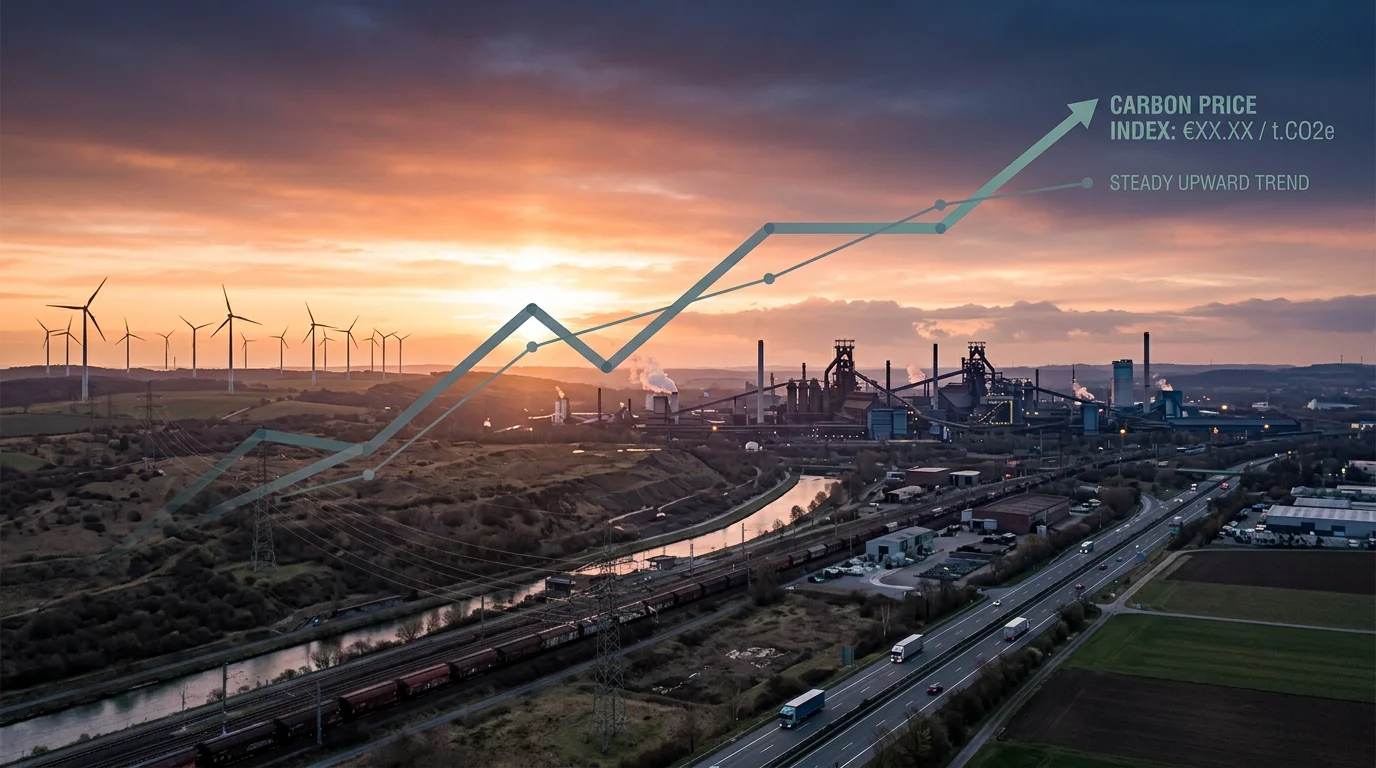

What happens when the right to pollute carries a price that climbs every year? In Europe, close to 40% of greenhouse gas emissions now sit inside a market that turns carbon into a scarce, tradable commodity. That single design choice reshapes electricity bills, industrial strategy and the pace of decarbonisation. To understand the mechanics behind this market, you may consult our analysis of emissions trading systems and the wider transition it drives.
The logic is deceptively simple. A hard ceiling on emissions creates scarcity, scarcity creates a price, and that price rewards whoever emits less. This is how a well-designed emissions trading system supports the low-carbon transition: it converts an environmental cost into a financial signal that every operator can read. The result is a market that has become the reference point for carbon pricing worldwide.
How a cap-and-trade market prices carbon
The mechanism rests on one rule: a firm limit on total emissions. Each allowance grants the right to emit one tonne of carbon dioxide equivalent. Companies must monitor their emissions and surrender enough allowances to cover them each year, or face heavy fines. If an installation cuts its output, it can sell surplus allowances or bank them for later.
When people search for how an "emissions trading system support low carbon transition", they are describing this exact feedback loop. The cap is reduced annually in line with the EU climate target, so the supply of allowances shrinks over time. As the ceiling tightens, the carbon price signal strengthens, steering investment toward cleaner electricity, steel and transport. The market, not a regulator, sets the daily clearing price. For a step-by-step breakdown, you may read our guide to how cap-and-trade works.
The EU ETS as the world's benchmark carbon market
Launched in 2005, the EU Emissions Trading System was the first large-scale carbon market of its kind. It now covers power plants, heavy industry, intra-EU aviation and, since 2024, maritime transport, accounting for around 40% of the bloc's greenhouse gas emissions. The scale explains why the scheme functions as a global reference for carbon pricing policy.
The system is currently in its fourth phase, running from 2021 to 2030. Free allocation still shields energy-intensive sectors exposed to carbon leakage, yet it is being scaled down and made conditional on decarbonisation efforts. According to updated Commission benchmarks, industry will on average continue receiving free allocations covering around 75% of its emissions for the 2026-2030 period. This gradual withdrawal is designed to sharpen the price signal precisely where emissions are highest.
Proven results: emissions down, revenue reinvested
Does putting a price on carbon actually reduce emissions? Two decades of data suggest it does. According to the European Parliament think tank, the original scheme cut the greenhouse gas emissions of its covered sectors by half in 2024 compared with 2005. The tightened cap now targets a 62% reduction by 2030 against the same baseline.
The pace has moderated more recently. The 2026 State of the EU ETS report found that covered emissions declined by approximately 1.3% in 2025, with more than half of the system's 2030 target already achieved. The slower reduction appears linked to energy system dynamics, such as higher gas generation balancing rising renewables, rather than a weakness in the framework itself.
The financial dimension matters just as much. Since 2013, the system has raised over 175 billion euros, and Member States are committed to channelling this revenue toward renewable energy, energy efficiency and a just transition. A carbon market does more than cap pollution; it converts the cost of emitting into a stream of public investment for the technologies that make emitting unnecessary.
Expanding the frontier: ETS2, CBAM and wider coverage
The system is not standing still. A second scheme, known as ETS2, will cap emissions from fuels used in buildings, road transport and smaller industrial installations, and is set to start operating in 2028. It applies upstream to fuel distributors rather than to households or drivers directly. To cushion the social impact, the Social Climate Fund will mobilise 86.7 billion euros from ETS2 revenue over the 2026-2032 period.
Alongside this expansion, the Carbon Border Adjustment Mechanism is phasing in from 2026. It extends the carbon price to imports of goods such as steel, cement, aluminium and fertilisers, levelling the field between EU and non-EU producers while free allocation is gradually withdrawn. Together, these reforms move the system toward genuine allowance scarcity. If your organisation must prepare for these obligations, you may consult our EU ETS readiness guide.
What the 2026 reform means for market participants
On 17 July 2026, the European Commission proposed a targeted revision of the system to prepare for the years after 2030. According to reporting on the overhaul, the proposal slows the Linear Reduction Factor to 3.7% a year for 2031-2035 and 1.7% for 2036-2040, down from the 4.3% rate applied since 2024, and pairs a looser cap with a proposed 100 billion euro Industrial Decarbonisation Bank.
For compliance operators and financial participants, this signals a decade of continued but recalibrated scarcity. Prices remain volatile, trading between roughly 79 and 82 euros per tonne in mid-2026, which means carbon exposure now behaves like any other financial variable. Access, however, has traditionally carried friction: standard exchanges require large lot sizes and live pricing is not always transparent. This is where the design of the trading venue becomes decisive.
We built our platform to remove those barriers for industrial operators, banks, trading firms and carbon brokers. The table below compares our approach with the conventions of traditional exchanges on the criteria that matter most for EU Allowance trading.
| Criterion | Our platform | Traditional exchanges |
|---|---|---|
| Minimum trade size | From 1 EUA (1 tonne CO₂) | Standard lot of 1,000 EUAs |
| Pricing | Transparent live pricing | Limited live transparency |
| Automation | API access and configurable alerts | Varies by venue |
| Risk controls | Pre-trade risk controls | Varies by venue |
| Cash protection | Guaranteed up to 100 k€ by the FGDR | Varies by venue |
Smaller trade sizes and real-time monitoring lower the threshold for participation, whether you manage a compliance obligation or a trading strategy. Pre-trade risk controls let you manage exposure before execution, and API access supports integration with existing risk systems.
The direction of travel for carbon markets
The lesson of two decades is unambiguous: a well-designed emissions trading system that supports the low-carbon transition can halve emissions in its covered sectors while funding the technologies that replace fossil fuels. As ETS2 and the border mechanism widen the net across the economy, carbon pricing shifts from a sectoral tool to a structural feature of European industry. The practical takeaway is to treat carbon exposure as a core financial variable, not a compliance afterthought, and to build the monitoring and execution capacity needed to manage it through a volatile but steadily tightening market.
Take action with Initiativ
Understanding the mechanism is one thing; acting on it with confidence is another. If your organisation faces carbon exposure, whether as a compliance operator or a financial participant, you need transparent pricing, small trade sizes and professional-grade risk controls to translate that exposure into a managed position.
We provide an exchange platform for trading EU Allowances in spot and derivatives form, with trading from a single EUA, competitive fees, real-time price monitoring, configurable alerts and pre-trade risk controls. To take the next step, explore our trading access for traders and corporates and request access to our demo environment.
Frequently Asked Questions
What is the difference between the EU ETS and ETS2?
The EU ETS covers power, industry, aviation and maritime transport. ETS2 is a separate scheme for fuels used in buildings, road transport and smaller installations, applying to fuel distributors rather than households. It is set to start operating in 2028.
How is the carbon price determined?
The price is set by supply and demand in the market, not by a regulator. A declining annual cap reduces the supply of allowances, while auctions and secondary trading establish the daily clearing price. This price rewards companies that emit less.
How does a carbon price actually reduce emissions?
By making pollution costly, the price gives every operator a financial reason to invest in cleaner processes. Companies that cut emissions can sell surplus allowances or bank them, turning decarbonisation into a source of value rather than pure cost.
Can smaller participants trade carbon allowances?
Yes. Traditional exchanges often require lots of 1,000 allowances, which raises the barrier to entry. Our platform allows trading from a single EUA, equivalent to one tonne of CO₂, with transparent live pricing and pre-trade risk controls.
What changed with the 2026 reform proposal?
The Commission proposed a slower emissions cap reduction after 2030 and extended free allocation for certain industries, paired with new decarbonisation funding. The direction remains one of tightening scarcity, though the pace is being recalibrated to protect competitiveness.

Let’s connect
Do you want more information about what we do?