


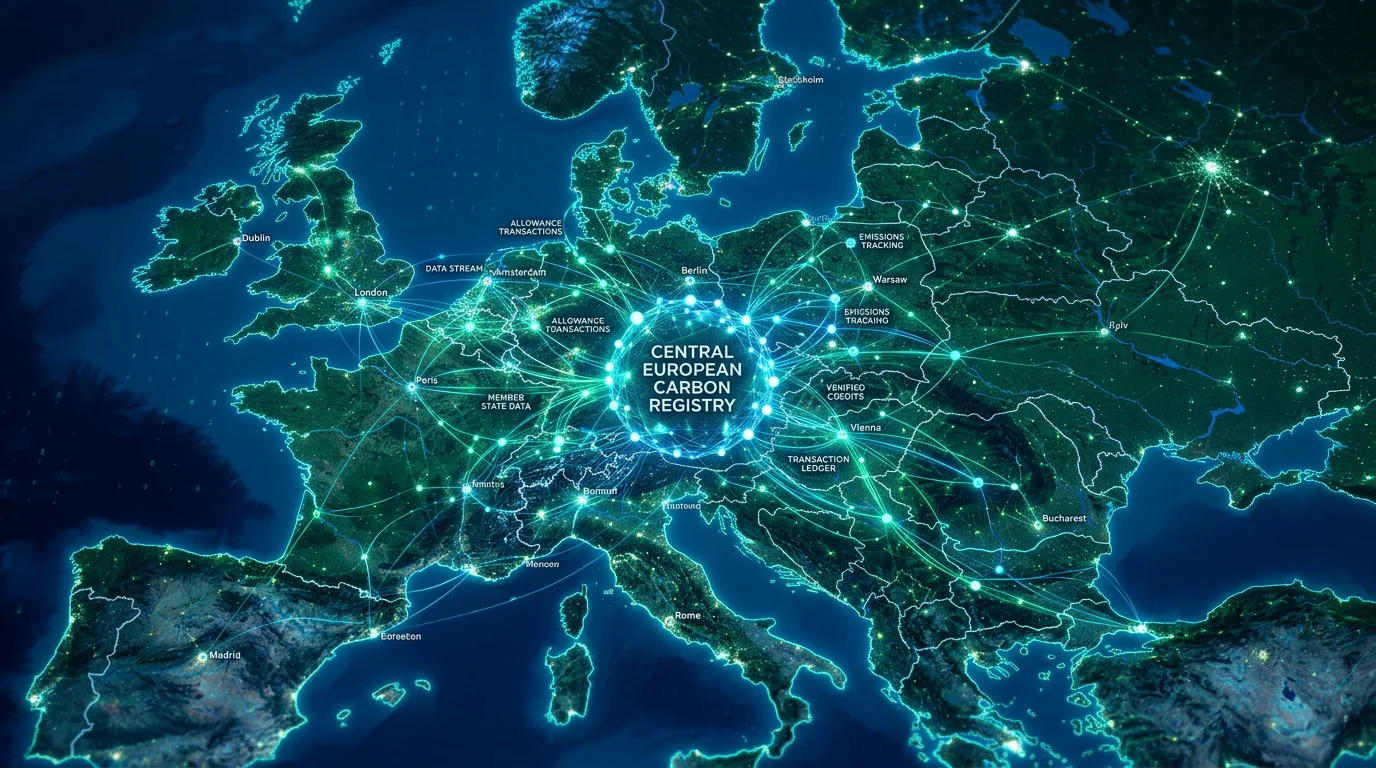

Every tonne of carbon priced under Europe's flagship climate policy leaves a digital trail, and that trail lives in one place. The Union Registry within the EU ETS functions much like a bank ledger for carbon, recording ownership of allowances rather than money. If you operate an installation, fly aircraft, run ships, or trade allowances professionally, your presence in this system is not optional. To place it in context, our EU ETS overview explains how the wider market fits together.
The stakes are considerable. According to an ESMA report, roughly 599 million allowances were auctioned on the Common Platform in 2024, worth around 39 billion euros. Behind those transactions sits the registry that authenticates ownership, executes transfers, and reconciles emissions against surrendered allowances each year.
What the union registry eu ets actually is
The Union Registry is an online database that guarantees precise accounting of all allowances issued across the system. It keeps track of the ownership of allowances held in electronic accounts, records transfers known as transactions, and stores annual verified emissions from operators. In short, it is the authoritative record of who holds what.
It is important to understand what the registry is not. It is not a trading venue. Supply and demand are matched elsewhere, on exchanges and over-the-counter markets, while the registry simply settles the resulting movements of allowances between accounts. If you are new to the instruments themselves, our guide to EU allowances and registry-related basics covers the fundamentals.

From national registries to one central system
The system was not always unified. In 2012, EU ETS operations were centralised into a single registry operated by the European Commission, replacing the patchwork of national registries used before that point. This consolidation covers all participating countries, with each Member State operating its own national section under a national administrator.
Coverage has widened steadily over time. Stationary installations were transferred at centralisation, aircraft operators joined in January 2012, and maritime operators were added in January 2024. Each expansion brought a new category of account holder into the same ledger, tightening the link between industrial activity and carbon accountability across sectors.
The account types you can hold
Which account you need depends on why you are participating. Compliance entities hold operator accounts, while financial participants and other organisations hold trading accounts. The main types available include the following.
- Operator holding account (OHA): for operators of stationary installations subject to the system.
- Aircraft operator holding account (AOHA): for airlines attributed to a Member State.
- Maritime operator holding account (MOHA): for shipping companies within scope since 2024.
- Regulated entity holding account (REHA): introduced for the second trading system from 2026 and 2027 onwards.
- Trading account: a voluntary account for legal or natural persons, from which allowances cannot be surrendered for compliance.
- Verifier account: used only by accredited verifiers, which cannot hold allowances.
A structural distinction now matters for anyone planning ahead. Allowances for the first system (EUA) and the second system (EUA2) are kept strictly separate. An EUA cannot be held in a regulated entity account, and an EUA2 cannot be held in a first-system account. If you require professional-grade access to these instruments, our EU allowances auction calendars help you plan around issuance and auction timing.
How to open an account, step by step
To participate in the system, whether for compliance or for trading, you must open an account in the registry. You cannot do so anonymously or instantly. The process runs through your national administrator, who collects and verifies your supporting documentation before access is granted.
The practical sequence typically follows a clear order. First, each authorised representative registers on the European Commission's EU Login service and configures the EU Login mobile application together with an additional authentication method. Next, each representative generates a national user identification number, which is specific to each Member State. You then submit the online account application with the required documents, and once identity checks succeed, you receive an enrolment key by post to activate access.
Two safeguards deserve attention. At least two authorised representatives are normally required so that processes needing a second approval can be executed, and account holders must confirm annually, by 30 June, that all account information remains complete, up to date, accurate, and true. A missing confirmation can lead to the account being blocked.

Security, transfers, and the rules that protect you
Because allowances have real monetary value, the registry builds friction into transfers on purpose. Movements to accounts on your trusted account list execute quickly during business hours, while transfers to accounts outside that list carry a deliberate delay, generally at least 24 hours, so that suspicious activity can be caught in time.
That delay is a protective feature, not an inconvenience. Under the Finnish national administrator's guidance, for example, an account holder may request abortion of a transfer up to two hours before the delay ends if fraud is suspected. The four-eyes principle, requiring one representative to initiate and another to approve, further reduces the risk of unauthorised movements. For the full compliance framework, our summary of the rules in the EU ETS is a useful companion.
The consequences of failing to surrender enough allowances are financial and public. According to the European Commission, the penalty of 100 euros per tonne of excess emissions rises each year in line with EU inflation, and it does not remove the obligation to surrender the missing allowances.
The compliance calendar that governs your year
The registry does not operate on a rolling basis; it follows a fixed annual rhythm. Emission reports are verified by independent accredited verifiers before the end of March of the following year. Once verified, operators must surrender the equivalent number of allowances, with the surrender deadline falling by the end of September.
This cadence shapes market behaviour. According to the ICAP profile, maritime operators entered a phased obligation, surrendering allowances equal to 40% of verified 2024 emissions and 70% for 2025, while free allocation for aviation fell to 50% in 2025 and is fully phased out from 2026. Each of these steps is executed and reconciled inside the registry.
What changes in 2026 and why it matters
This year marks a genuine structural shift. The registry now contains sections for the first system and, from 2026 and 2027 onwards, for the second system covering fuel combustion in buildings and road transport. New regulated entity accounts and a distinct allowance type, EUA2, are being integrated alongside existing infrastructure.
The market backdrop adds urgency. According to Trading Economics, carbon permit prices moved above 85 euros per tonne in mid-2026 as the European Commission unveiled a broad overhaul of the system. For anyone holding accounts, staying current with account confirmations, allowance segregation, and surrender deadlines is now more consequential than ever.
Bringing it together
The Union Registry under the EU ETS is the backbone of European carbon accounting, quietly recording ownership, transfers, and surrenders that keep the market honest. Treat your registry obligations as an operational discipline rather than an afterthought: appoint your representatives carefully, respect the four-eyes principle, complete your annual account confirmation by 30 June, and align transfers with the September surrender deadline. As the second trading system comes online this year, keeping your accounts and allowance types cleanly separated will spare you avoidable risk and preserve your standing in a market where compliance and value are inseparable.
Take action with Initiativ
Managing accounts in the registry is only half the picture; you also need reliable, transparent access to the market where allowances change hands. If you are an industrial operator, bank, trading firm, asset manager, or carbon broker, the friction of large minimum lots and opaque pricing can slow your response to fast-moving conditions.
We built a programmable exchange that lets you trade from a single EUA rather than a traditional 1,000 EUA lot, with transparent live pricing, configurable alerts, pre-trade risk controls, and API-enabled automation. Cash is held in a segregated account with clearing support and protected up to 100,000 euros by the FGDR. Explore our EU ETS trading solutions for traders and corporates and request access to our demo environment today.
Frequently Asked Questions
Is the Union Registry a place where I can buy allowances?
No. The registry is an accounting database that records ownership and settles transfers, not a trading venue. You buy and sell allowances on exchanges or over the counter, and the resulting movements are then recorded in your registry account.
Do I need an account if I only trade rather than comply?
Yes, if you wish to hold allowances directly. Voluntary trading accounts are available to eligible organisations and, with limitations, private persons. Note that allowances cannot be surrendered for compliance from a trading account, as that function belongs to operator accounts.
How many authorised representatives do I need?
Operator and trading accounts generally require at least two authorised representatives so that the four-eyes principle can apply. One must be able to initiate transactions and another to approve them. Verifier accounts are an exception and may operate with a single representative.
What happens if I miss the annual account confirmation?
Account holders must confirm by 30 June that their account information is complete, up to date, accurate, and true. A missing confirmation can lead to your account being blocked, which prevents transfers and surrenders. It is wise to treat this deadline as a fixed operational task.
How does the 2026 second trading system affect my existing account?
The registry now includes sections for both systems, with a new regulated entity account type and a separate allowance called EUA2. First-system allowances and second-system allowances cannot be mixed across account types. If you need faster market access alongside these obligations, our trading platform supports professional participation from a single allowance.
This may interest you


Let’s connect
Do you want more information about what we do?