


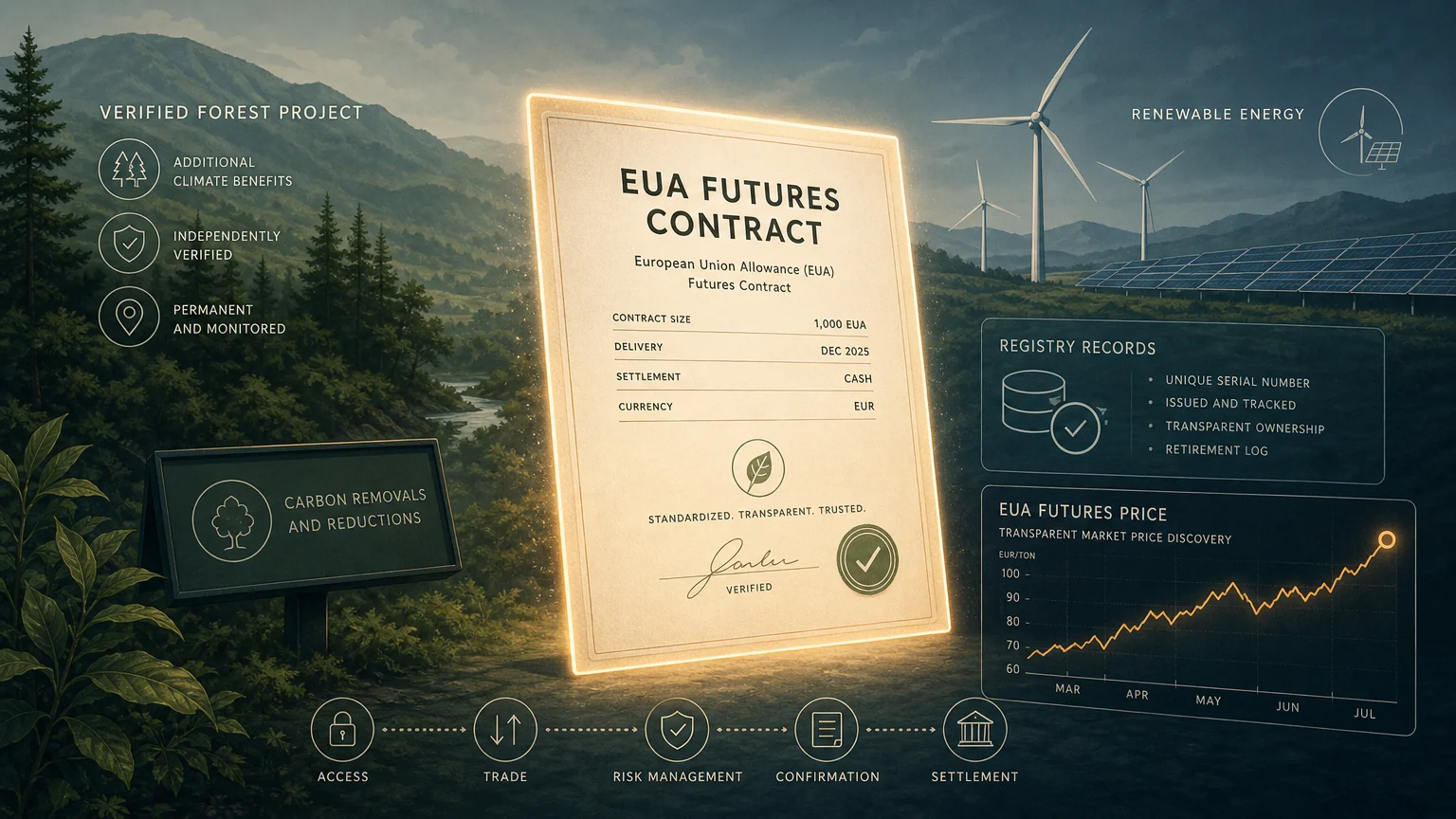

Can a climate claim become a standardized market instrument without losing the attributes that give it meaning? A carbon offset futures contract attempts to do that by defining eligible credits, contract size, delivery terms, and settlement procedures. For professional participants, our carbon offset trading platform can support the wider process of monitoring prices, managing positions, and evaluating execution.
The market remains comparatively young and structurally complex. In 2024, the CFTC guidance addressed how designated contract markets should consider quality, delivery, and contract design when listing voluntary carbon credit derivatives. That context matters because standardization can improve tradability, but it cannot eliminate the need to assess the underlying credits.
What is a carbon offset futures contract?
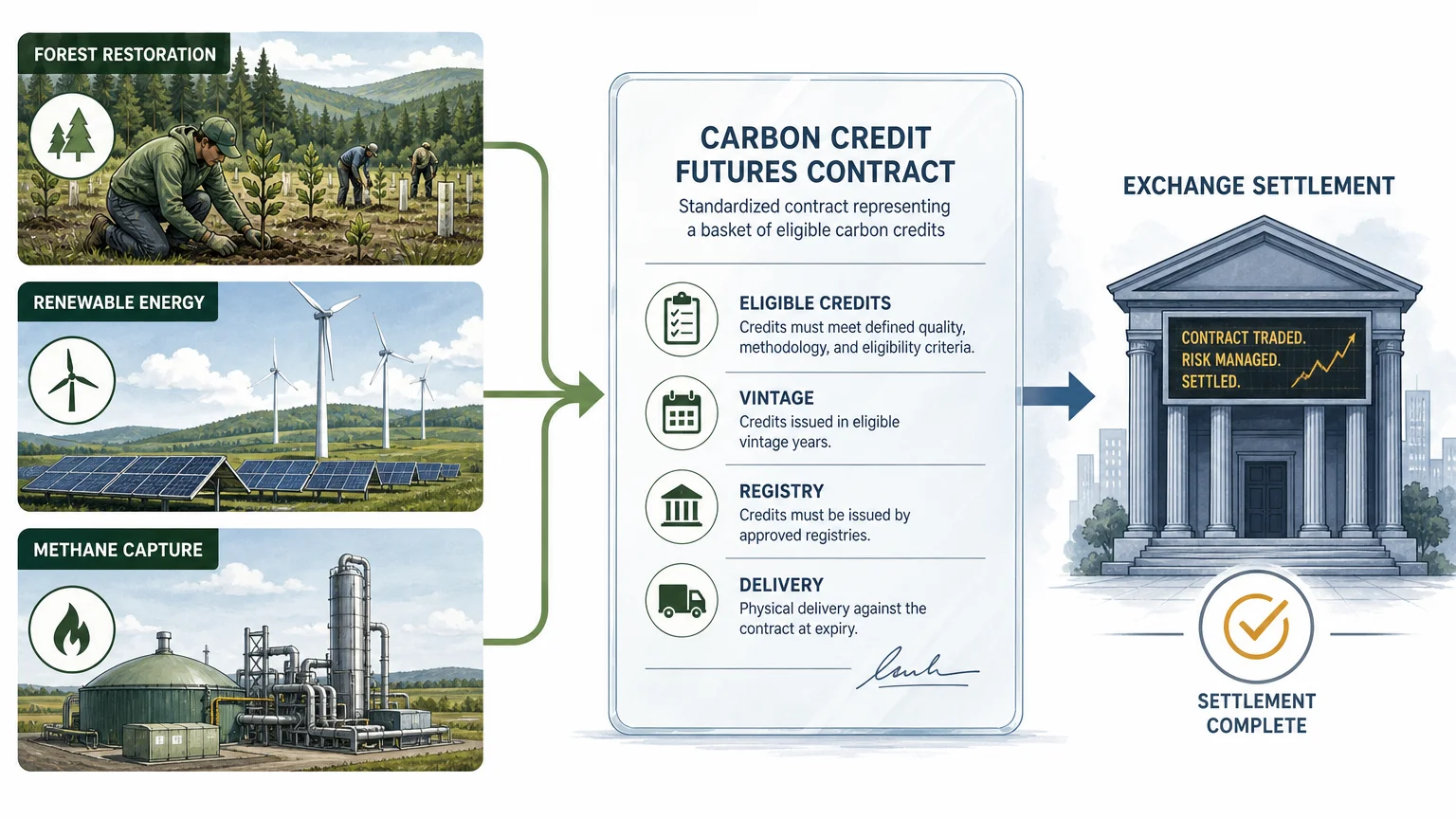
A carbon offset futures contract is a legally standardized agreement to buy or sell a defined quantity of eligible carbon credits at a specified future date. The contract normally states the underlying credit category, qualifying standards, registry, delivery process, minimum price movement, expiry dates, and settlement method.
The underlying asset is usually a carbon offset, also called a voluntary carbon credit in many market contexts. One credit commonly represents one metric tonne of carbon dioxide equivalent reduced, avoided, or removed. However, the contract does not accept every credit available in the voluntary market. Eligibility rules determine which methodologies, registries, vintages, and project attributes qualify.
This distinction separates the futures contract from the underlying offset. The offset represents an environmental claim connected to a project. The futures contract represents a financial obligation linked to a standardized pool of eligible offsets. A buyer can use it to obtain future delivery, hedge expected procurement needs, or take a position on changing carbon prices.
Unlike a customized forward agreement, an exchange-traded futures contract generally uses uniform terms and clearing arrangements. The buyer and seller do not need to negotiate every contractual detail. They trade a defined product through a market structure designed to support price publication, margining, position management, and, where applicable, physical delivery.
What does one contract represent?
Consider a nature-based contract as an example. It may restrict delivery to credits from forestry, land-use, or other approved activities. A broader global emissions offset contract may accept a wider group of eligible project types, subject to its own standard and registry requirements.
Some listed GEO and N-GEO examples have represented 1,000 environmental offsets per contract, with each offset linked to one metric tonne of carbon dioxide equivalent. That figure is product-specific rather than universal. Contract sizes, tick values, eligible standards, delivery windows, and final settlement references can differ between exchanges and products.
Contract specifications therefore deserve close attention. You should confirm:
- the number of credits or allowances represented by one contract;
- the accepted registry and eligible project standards;
- the permitted credit vintage and project type;
- whether delivery is physical or financial;
- the delivery location, account, or registry process;
- the expiry months and final trading date; and
- the margin, position limit, and block trade requirements.
These details affect both the economic value and the practical usefulness of the instrument. A contract may appear to provide exposure to carbon offsets, but its actual exposure can be narrower because of delivery restrictions, eligibility filters, or the limited availability of credits that satisfy every condition.
How do trading, clearing, and settlement work?
At expiry, the contract must be settled according to its rules. In a physically settled structure, the seller delivers eligible credits through the specified registry or delivery mechanism. The buyer receives the credits and may hold, transfer, or retire them, subject to the applicable registry and program rules.
Financial settlement works differently. Instead of transferring credits, the parties settle the difference between the contract price and a designated reference price. This approach can simplify exposure to price movements, but it does not provide the buyer with credits for compliance, voluntary claims, or future retirement.
Before expiry, many participants close or roll their positions. A trader who bought a contract can sell an offsetting contract rather than take delivery. A trader who sold a contract can buy it back. This secondary trading requires sufficient liquidity, transparent pricing, and reliable reporting.
Clearing adds another layer. A central counterparty can stand between buyers and sellers, collect initial margin, and calculate variation margin as prices change. This structure can reduce direct bilateral counterparty exposure, but it does not remove market risk. A participant can still face margin calls, forced liquidation, or losses when prices move against the position.
Academic research describes exchange-traded carbon derivatives as tools that can support standardization, transparency, and price discovery in developing voluntary markets. An academic review also emphasizes that the market infrastructure around these contracts remains important to their usefulness.
How do voluntary offset futures differ from EUA futures?
The key distinction is the underlying environmental instrument. A voluntary carbon offset is generally linked to a project that reduces, avoids, or removes emissions. An EU Allowance, or EUA, is an emissions permit within the European Union Emissions Trading System. It gives the holder authority to emit a defined amount under that compliance framework.
Both instruments can be expressed in tonnes of carbon dioxide equivalent, but they do not serve the same purpose. A compliance entity may need EUAs to meet a legal surrender obligation. A company may purchase voluntary offsets to support a voluntary climate claim or a specific emissions strategy. The eligibility, legal status, market participants, and price drivers are different.
EUA futures are influenced by compliance demand, allowance supply, industrial output, power generation, fuel switching, policy changes, and auction design. Voluntary offset futures are influenced by credit quality, project supply, corporate demand, retirement preferences, registry rules, and confidence in the underlying methodologies.
That difference creates basis risk. A participant may use EUA futures as a broad carbon hedge, but the EUA price may not move in line with the price of a nature-based offset or a removal credit. Similarly, a voluntary offset futures contract may not hedge the cost of EUAs needed for a regulated installation.
For a practical overview of the instruments and market mechanics involved, you can also consult our guide to carbon futures trading. The important principle is to match the futures product to the obligation, credit type, or price exposure you actually need to manage.
Why use carbon offset futures?
Why would a professional participant use a derivative instead of purchasing credits immediately? The first reason is timing. A corporate buyer may expect to need eligible offsets later, but may want to establish a price before procurement takes place.
A futures position can also support hedging. An offset supplier, project developer, broker, or corporate buyer may face uncertainty about future prices. A futures contract can create a financial position that offsets some of that price exposure, although the hedge will only work well if the contract closely matches the credits ultimately required.
Standardized futures can also contribute to price discovery. A visible traded price gives buyers and sellers a reference point for negotiations. It can make market conditions easier to compare than a series of private over-the-counter quotes, particularly when the contract has enough volume and open interest.
Traders may use these contracts for directional exposure, spreads, or relative-value strategies. For example, a participant could compare a broad offset contract with a nature-based contract, or assess the difference between voluntary offset exposure and compliance allowance exposure. Those strategies require careful analysis because the underlying commodities can respond differently to policy, credit-quality concerns, and changing demand.
Operational efficiency is another consideration. A professional carbon trading platform can bring live prices, order management, risk controls, position monitoring, and reporting into a more coordinated workflow. That does not remove the need for due diligence, but it can help a trading or procurement team manage the process more consistently.
What are the main risks?
The largest risk is not simply that the market price moves lower. It is that the contract does not provide the type of environmental asset or price exposure that the buyer expected.
- Credit quality risk: A contract may accept a defined class of credits, but questions can remain about additionality, permanence, leakage, measurement, and double counting.
- Basis risk: The futures price may diverge from the price of the specific credits a company ultimately wants to buy or retire.
- Liquidity risk: A thin market can produce wider spreads, greater slippage, and difficulty closing a position near expiry.
- Margin risk: Futures are leveraged instruments. A relatively small price movement can create a substantial variation margin requirement.
- Delivery risk: Eligible credits may be unavailable, delayed, invalidated, or unsuitable for the buyer's intended use.
- Regulatory risk: Rules affecting voluntary claims, aviation programs, derivatives, registries, or market access can change.
- Roll risk: A participant who extends exposure from one expiry to another can gain or lose value because of the shape of the futures curve.
A 2026 working paper examining voluntary offset futures from 2021 through 2026 argues that commodity-like behavior depends heavily on the credibility of the eligibility threshold. Its 2026 research highlights how quality uncertainty can affect price discovery, term structure, and the relationship between voluntary and compliance markets.
Curve structure deserves particular attention. If later contracts trade above nearby contracts, the market is in contango. Rolling a position forward can then create a negative roll effect, even if the underlying reference price remains broadly stable. Our explanation of futures contango and roll yield provides additional context for evaluating that cost.
How should you evaluate a contract before trading?
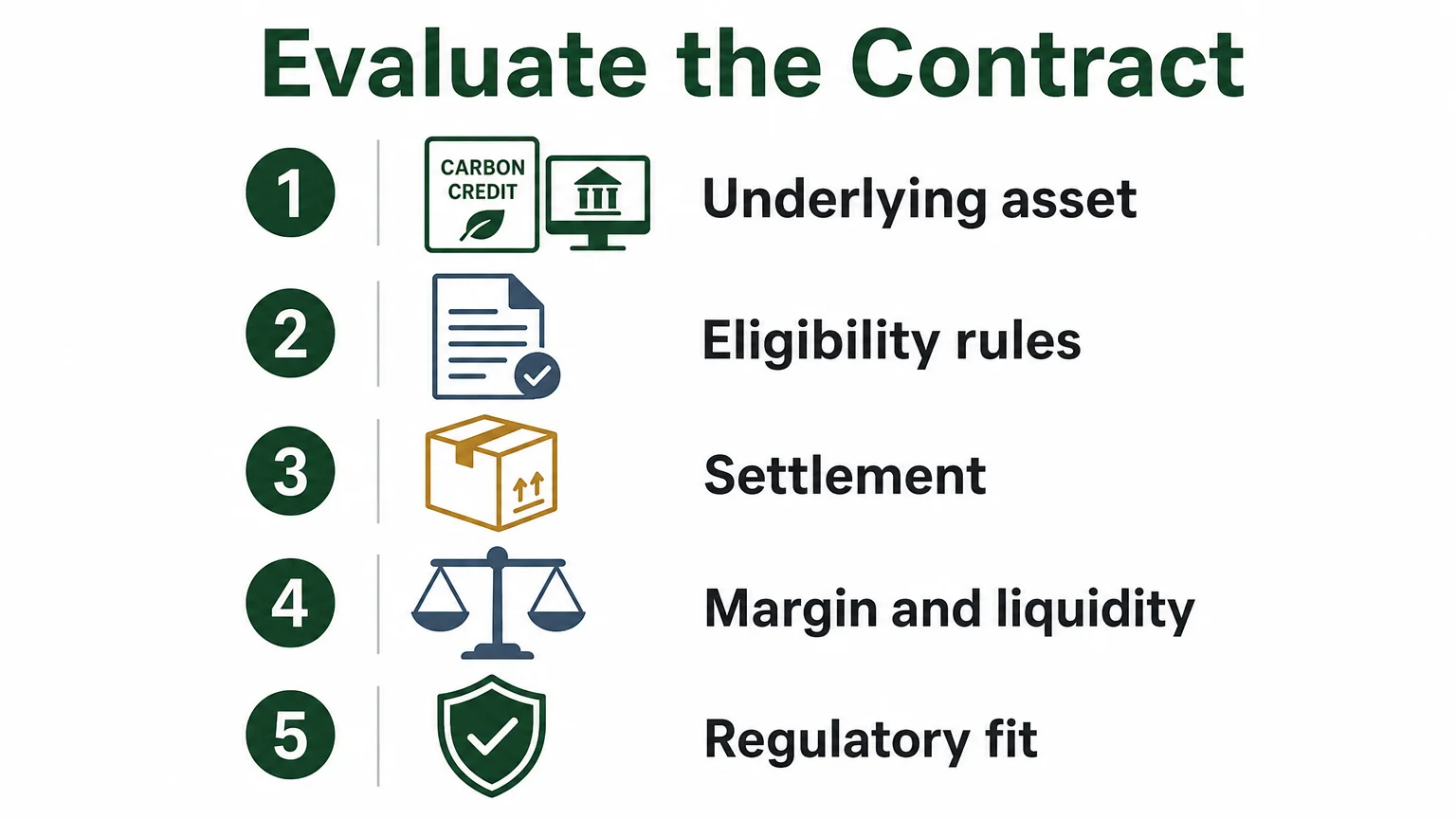
Before placing an order, begin with the underlying asset rather than the price chart. Confirm what the contract represents, which credits qualify, and whether those credits match your organization’s future procurement or retirement needs.
- Review the contract specification. Check size, tick value, expiry, delivery terms, accepted registries, eligible methodologies, and settlement reference.
- Test the hedge relationship. Compare the futures exposure with the credits, allowances, or obligations you actually need to manage.
- Assess liquidity. Review bid and offer depth, trading volume, open interest, block trade rules, and the likely cost of closing or rolling a position.
- Model margin requirements. Stress the position against sharp price moves, currency changes, and possible margin calls.
- Check operational readiness. Confirm registry access, custody arrangements, delivery capability, reporting requirements, and internal approval procedures.
- Confirm legal eligibility. Determine whether your entity qualifies to trade, clear, hold, receive, or retire the underlying credits.
The international context also matters. Carbon markets differ in their legal basis, coverage, allowance design, credit standards, and maturity. The World Bank report published in 2026 is a useful reference for comparing carbon pricing systems and understanding why a voluntary offset future should not be treated as interchangeable with every other carbon instrument.
Finally, define the purpose of the trade in advance. A compliance hedge, a procurement strategy, a market-making position, and a speculative trade require different limits, monitoring routines, and exit plans.
What to remember about carbon offset futures
A carbon offset futures contract combines a financial derivative with a defined pool of eligible environmental credits. Its usefulness depends on more than the quoted price. You must understand the credit standard, registry, vintage, contract size, delivery method, clearing structure, liquidity, margin, and relationship to the exposure you are managing. Voluntary offset futures can support procurement, hedging, and price discovery, but they remain exposed to quality uncertainty, basis risk, regulatory change, and roll costs. Treat the contract specification and the underlying credit as equally important parts of the analysis.
Take action with Initiativ
Once you have defined the credit attributes, delivery objective, and risk limits, the next challenge is operational. You need a place to monitor prices, manage orders, and coordinate procurement without separating execution from oversight.
At Initiativ, we provide professional access to EUA spot and derivatives, including futures and options, with live market data, pre-trade controls, API connectivity, position views, reporting, confirmation, and settlement workflows. If your organization is assessing market access or structured procurement, explore carbon trading for traders and corporates to understand how our infrastructure can fit your process.
Frequently Asked Questions
What is the difference between a carbon offset and a carbon allowance?
A carbon offset is generally linked to a project that reduces, avoids, or removes emissions. A carbon allowance is a permit issued within a compliance system that authorizes the holder to emit a defined amount.
Are carbon offset futures physically settled?
Some contracts are physically settled, meaning eligible credits are delivered through a defined registry or account process. Other contracts may use financial settlement, so you should review the product specification before trading.
Can a carbon offset futures contract guarantee credit quality?
No. Eligibility rules can restrict the accepted credit pool and improve consistency, but they do not remove every concern about additionality, permanence, measurement, or double counting. Buyers should conduct separate due diligence on the standard and intended use.
Who uses carbon offset futures?
Potential users include corporate procurement teams, project developers, brokers, market makers, financial institutions, and professional traders. Their objectives may include hedging future purchases, managing inventory exposure, supporting price discovery, or taking a view on market prices.
Can Initiativ support professional carbon-market workflows?
Yes. Our platform is designed for eligible professional participants that need EUA spot and derivatives access, live price monitoring, risk controls, API connectivity, position management, reporting, and settlement-related workflows.
This may interest you

Let’s connect
Do you want more information about what we do?