



A futures contract can trade above the spot market without guaranteeing that the underlying asset will rise. That distinction makes futures contango essential for anyone assessing a hedge, rolling a position, or comparing immediate delivery with future exposure. If you work with EU allowances, our explanation of EUA futures versus EUA spot provides a useful carbon-market comparison.
Contango describes a relationship between prices at different delivery dates. The curve may reflect the cost of holding an asset, expectations about supply and demand, interest rates, or the value of having the physical asset available immediately. Understanding those forces helps you interpret the curve without treating it as a simple bullish or bearish signal.
What does futures contango mean?
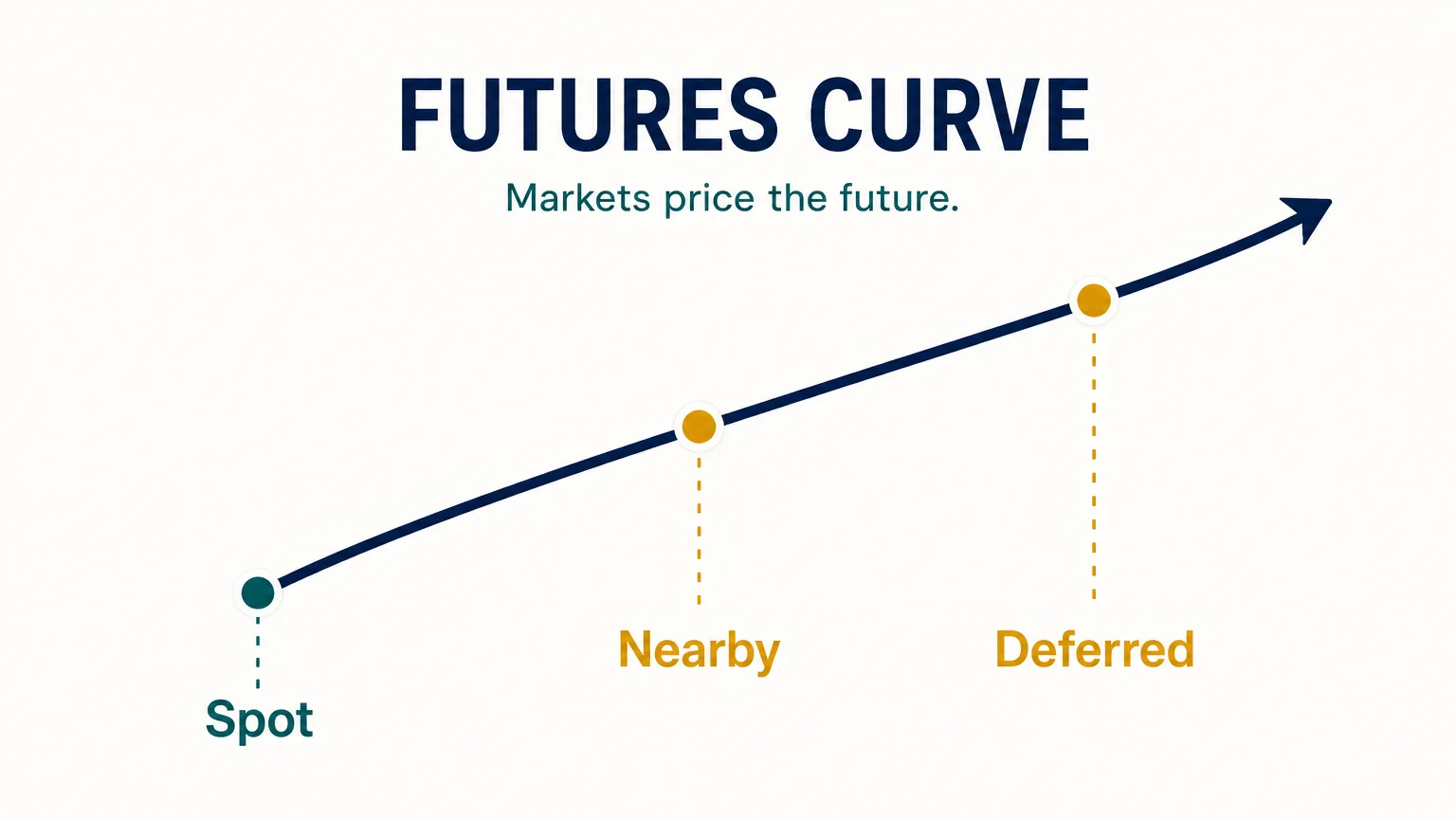
Suppose an asset has a spot price of $80, while a futures contract for delivery in six months trades at $83. The market is in contango relative to that delivery date because the future price exceeds the current spot price.
Contango can also describe the shape of the futures curve. If September contracts trade below October contracts, and October contracts trade below November contracts, the curve slopes upward as maturity extends. This is sometimes called a normal or carrying-cost market.
The comparison must use contracts for the same underlying asset and compatible specifications. Contract quality, delivery location, settlement method, interest rates, and time to maturity can all affect the price relationship. A futures price above spot therefore provides information about market structure, not a complete forecast of the future spot price.
A 2026 study in the Journal of Futures Markets examined term-structure data across agricultural, metals, and energy markets from January 2003 through December 2024. Its findings show that contango and backwardation can move together across markets, particularly during periods of financial stress and geopolitical risk, as described in a 2026 futures study.
Why does the futures curve enter contango?
For a storable physical commodity, the basic explanation is the cost of carry. A market participant who buys the asset today and holds it until a future delivery date may incur financing, storage, insurance, transport, and handling costs.
Those expenses can create a rational difference between the spot and futures prices. In simplified terms, the futures price reflects the spot price plus the net cost of carrying the asset until delivery. Any income from holding the asset, or any benefit from immediate ownership, reduces that adjustment.
The benefit of holding inventory is known as the convenience yield. It may include the ability to keep a factory operating, meet an urgent customer order, or avoid a supply interruption. When inventories are abundant, immediate ownership may provide less operational value. A lower convenience yield can therefore support contango.
Supply and demand can reinforce the structure. Near-term oversupply may depress spot prices, while expectations of stronger demand later can keep deferred futures prices higher. Conversely, a sudden shortage can lift near-term prices and push the market toward backwardation.

How is contango different from backwardation?
Contango and backwardation describe opposite curve structures. In contango, later-dated futures are generally more expensive than nearby contracts. In backwardation, nearby contracts trade above later-dated contracts.
Consider a crude oil market where immediate supply is tight. Refineries may pay a premium for prompt delivery, raising the front-month price above contracts further along the curve. That structure is backwardation and may indicate a high convenience yield.
Now consider a market with ample inventory and weak immediate demand. Sellers may need to discount spot cargoes, while deferred prices include financing and storage costs. The resulting upward-sloping curve is contango.
Neither structure should be treated as an automatic directional signal. Contango does not mean that the spot price must rise, and backwardation does not guarantee that the spot price will fall. The curve can change as inventories, interest rates, expectations, policy, weather, and geopolitical conditions change.
- Contango: later-dated futures are priced above nearby contracts, often creating negative roll yield for a long position.
- Backwardation: nearby futures are priced above later contracts, often creating positive roll yield for a long position.
- Flat curve: nearby and deferred contracts trade at similar prices, producing limited curve-related return.
What happens when futures prices converge?
As a futures contract approaches expiration, its price normally converges toward the spot price of the underlying asset. The remaining time for storage, financing, insurance, and other carrying costs becomes shorter, so the difference between the two prices tends to narrow.
Convergence is important because a persistent mismatch at expiration could create an arbitrage opportunity. If the same deliverable asset were reliably available at a lower price in one market and a higher price in another, traders could buy the cheaper exposure and sell the more expensive exposure.
Physical delivery, cash settlement, transaction costs, financing limits, and market access can prevent perfect arbitrage. Convergence is therefore a strong pricing principle, not a promise that prices will match smoothly at every moment.
For traders, convergence explains why a contract purchased in contango can decline toward the spot price even when the spot market remains unchanged. This effect becomes especially important when you maintain exposure beyond one contract’s expiration. A broader overview of futures trading can help place rolling, margin, and contract specifications in context.
How does contango affect roll yield?
A futures contract has a finite life. To maintain a long position, you usually sell the contract approaching expiration and buy a later-dated contract. This process is called rolling the position.
In contango, the expiring contract is typically cheaper than the deferred contract. You sell the lower-priced contract and purchase the higher-priced one. If the curve remains broadly unchanged, the new contract may lose value as it converges toward the spot price. That pattern creates negative roll yield.
Roll yield is separate from the movement in the spot price. A long futures position can therefore produce a weaker result than the spot market, even if the underlying asset rises. The opposite can occur in backwardation, where selling the more expensive nearby contract and buying a cheaper deferred contract may create positive roll yield.
A 2026 oil-market study found that normal contango represented about one-third of the observed next-day states in its sample. The research also identified nonlinear interactions between oil prices, inventory conditions, volatility, and market drivers, as reported in a 2026 oil study.
This is why a long-term investor should examine more than the headline spot price. The total result may reflect spot performance, roll yield, collateral income, fees, financing costs, and transaction expenses.
How does contango influence hedging and investment returns?
Contango can be useful for a business that wants to lock in a future selling or purchasing price. A producer may sell futures to reduce uncertainty about future revenue. An industrial buyer may use futures to plan procurement costs and protect an operating budget.
For a hedger, the goal is not necessarily to profit from the curve. The goal may be to make cash flows more predictable. A contract priced above spot can still be valuable if it supports budgeting, production planning, or compliance management.
For a passive investor, the effect is different. A fund that continually rolls front-month contracts may suffer from recurring negative roll yield in a persistent contango market. This can create a performance gap between the fund and the spot price of the commodity.
A filing submitted to the U.S. Securities and Exchange Commission stated that Brent futures were in backwardation during the three months ended March 31, 2026, based on the difference between the front-month and second-month contracts. The same filing emphasized that oil markets can move between contango and backwardation over time, as shown in a March 2026 filing.
That example illustrates an important risk-control principle. The curve should be monitored throughout the holding period, rather than classified once at the beginning of a trade. A change in the curve can affect hedge effectiveness, expected roll costs, margin needs, and the timing of procurement decisions.
How does contango differ across commodities, financial futures, and carbon allowances?
Contango does not have identical causes in every market. The underlying asset determines which parts of the cost-of-carry relationship matter most.
For crude oil, natural gas, metals, and agricultural products, storage and insurance can be material. Inventory levels and immediate physical availability also affect the convenience yield. A temporary supply surplus can push nearby prices lower, while storage capacity constraints may intensify curve movements.
For equity index futures, the relationship is often driven more by financing costs, expected dividends, and the time remaining until settlement. Physical storage is irrelevant, so the curve generally does not carry the same inventory signal as an oil or grain market.
For EU allowances, there is no warehouse filled with tonnes of carbon dioxide. An EUA represents an emissions allowance, so the curve can reflect financing, compliance timing, auction supply, regulatory expectations, and the value of holding an allowance for future surrender obligations.
This makes the distinction between an immediate allowance and a derivative important. Our spot price definition explains why immediate settlement and future delivery should not be treated as interchangeable exposures.
For professional carbon-market participants, the curve can inform procurement timing, compliance planning, and risk management. Our market infrastructure supports EUA spot and derivatives access, live price monitoring, configurable alerts, and pre-trade controls for eligible participants.
What should you check before trading a contango market?
A curve assessment should begin with the contract details. Confirm the delivery month, contract size, settlement method, delivery location, quality specifications, margin rules, and the date on which your position must be closed or rolled.
Next, compare nearby and deferred prices rather than looking only at the spot market. The slope between the front month and the next contract may differ from the slope between the front month and a contract one year forward. A steepening curve can change the economics of a trade even when the spot price moves very little.
You should also identify the likely driver of the structure. Ask whether contango reflects storage costs, financing rates, excess inventory, weak immediate demand, seasonal patterns, or expectations of future supply. The same curve shape can have different implications depending on its cause.
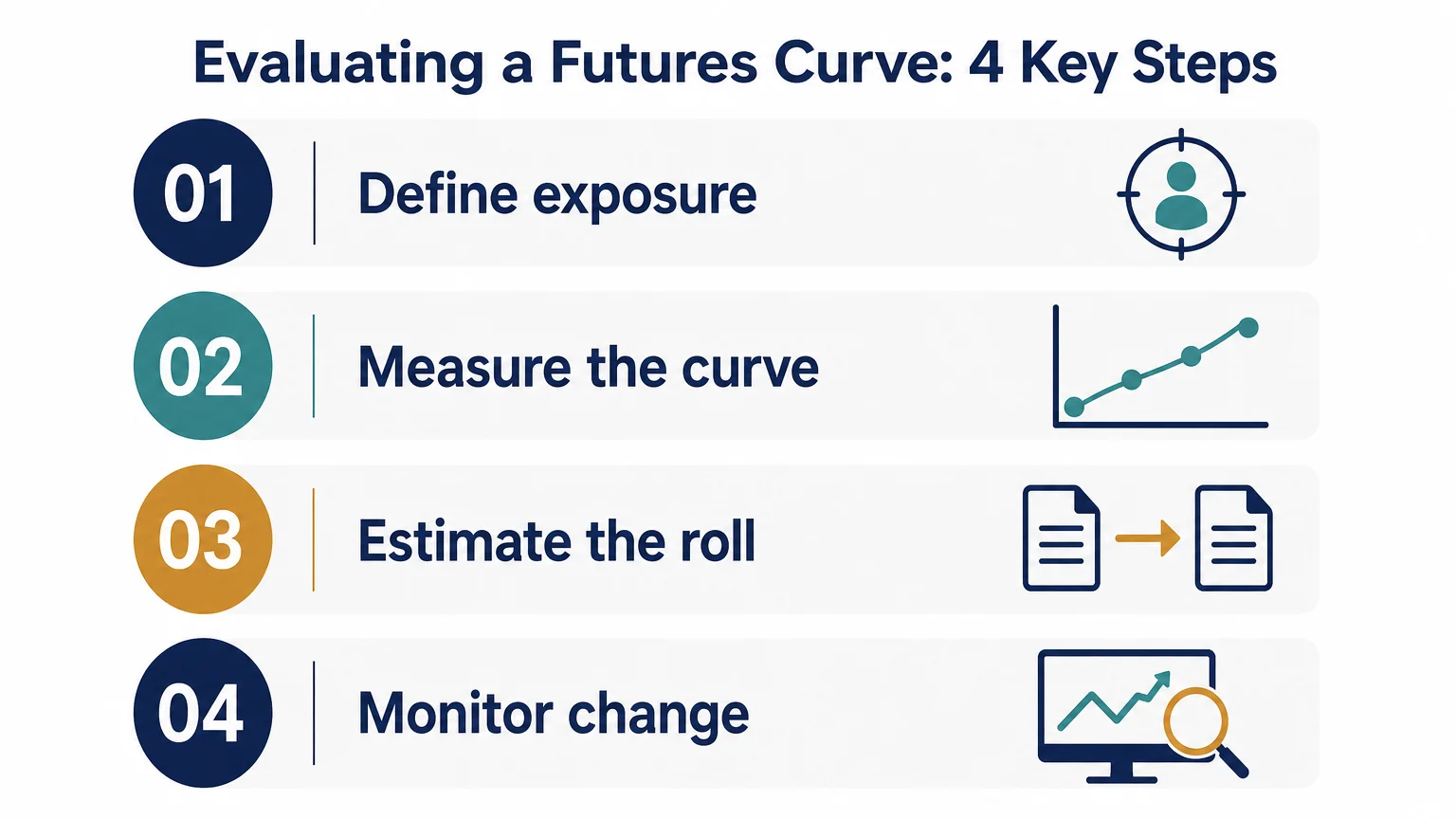
- Define the exposure: decide whether you need physical ownership, a short-term hedge, or longer-term market exposure.
- Measure the curve: compare nearby, deferred, and relevant annualized price differences.
- Estimate the roll: calculate how much it may cost to close the expiring contract and open the next one.
- Review operational risk: include margin, liquidity, settlement, financing, and transaction costs.
- Monitor change: reassess the curve when inventories, rates, policy, or market demand shift.
For EU ETS participants, our EU ETS trading platform article provides additional context on evaluating access, execution, transparency, and workflow requirements. These considerations matter because curve analysis is only useful when the trading or procurement process can apply it efficiently.
What to remember about futures contango
Futures contango means that later delivery is priced at a premium to nearby delivery or spot, but the premium is not automatically a forecast of higher prices. It may reflect financing, storage, insurance, inventory conditions, convenience yield, interest rates, or expectations about future supply and demand. For anyone holding or rolling futures, the key consequence is often negative roll yield. Review the full curve, understand its driver, model convergence, and include margin, liquidity, and transaction costs before acting.
Take action with Initiativ
When contango affects procurement, hedging, or trading decisions, you need more than a price view. You need clear market data, controlled execution, and an operational process that connects trading with risk and reporting.
We provide professional access to EUA spot and derivatives markets, including futures and options, with live prices, order-book visibility, configurable alerts, pre-trade risk controls, API connectivity, position monitoring, and confirmation and settlement workflows. Explore our futures trading solutions for traders and corporates to assess how our infrastructure may fit your trading or compliance workflow.
Frequently Asked Questions
Is contango bullish or bearish?
Contango is not inherently bullish or bearish. It describes the relationship between futures prices and nearby or spot prices, which may reflect carrying costs, inventory, financing, or market expectations.
Why can contango reduce long-term futures returns?
A long investor usually rolls from an expiring contract into a later-dated contract. When the market is in contango, the later contract costs more, which can create negative roll yield and reduce returns even when the spot price is stable.
Does contango always mean that the spot price will rise?
No. Contango can occur because carrying costs exceed the convenience yield or because near-term supply is abundant. The curve provides market information, but it is not a guaranteed forecast of future spot prices.
How does contango affect carbon allowances?
For EU allowances, contango can reflect financing, compliance timing, auction supply, regulatory expectations, and the value of holding allowances for future obligations. Physical storage costs are less central than they are for commodities such as oil or metals.
Can Initiativ support analysis of EUA futures contango?
Eligible professional participants can use our platform to access EUA spot and derivatives markets, monitor live prices, manage positions, and apply risk controls. Our API and reporting workflows can also support trading operations that require integration with existing systems.
This may interest you



Let’s connect
Do you want more information about what we do?