


Summary: EUA futures are derivatives for hedging and speculation; EUA spot contracts involve immediate delivery. Futures account for 89% of EU ETS on-exchange volume.
In 2025, approximately 11.2 billion EU Allowances changed hands on European exchanges, representing a market value of around €845 billion. Behind that figure lies a critical distinction that every carbon market participant should understand: the difference between EUA futures and EUA spot contracts. These two instruments serve fundamentally different purposes, carry different risk profiles, and attract different types of market participants.
Whether you are a compliance entity managing surrender obligations or a financial participant seeking carbon price exposure, understanding how each contract type works is essential. This article breaks down the mechanics, pricing dynamics, and strategic uses of both instruments within the emissions trading instruments available in the EU ETS.
What Is an EUA Spot Contract?
An EUA spot contract is an agreement to buy or sell EU Allowances at the current market price, with near-immediate delivery. When you execute a spot trade, the allowances transfer to your registry account typically within one to two business days. Each EUA represents the right to emit one tonne of CO₂ equivalent under the EU Emissions Trading System.
Spot contracts are the most direct way to participate in the carbon market. When a buyer acquires allowances on the spot market, those EUAs are removed from the available supply, which means the transaction has a direct relationship with the environmental mechanism underpinning the EU ETS. Compliance entities (power plants, industrial operators, airlines) frequently use the spot market to acquire allowances ahead of their annual surrender deadline.
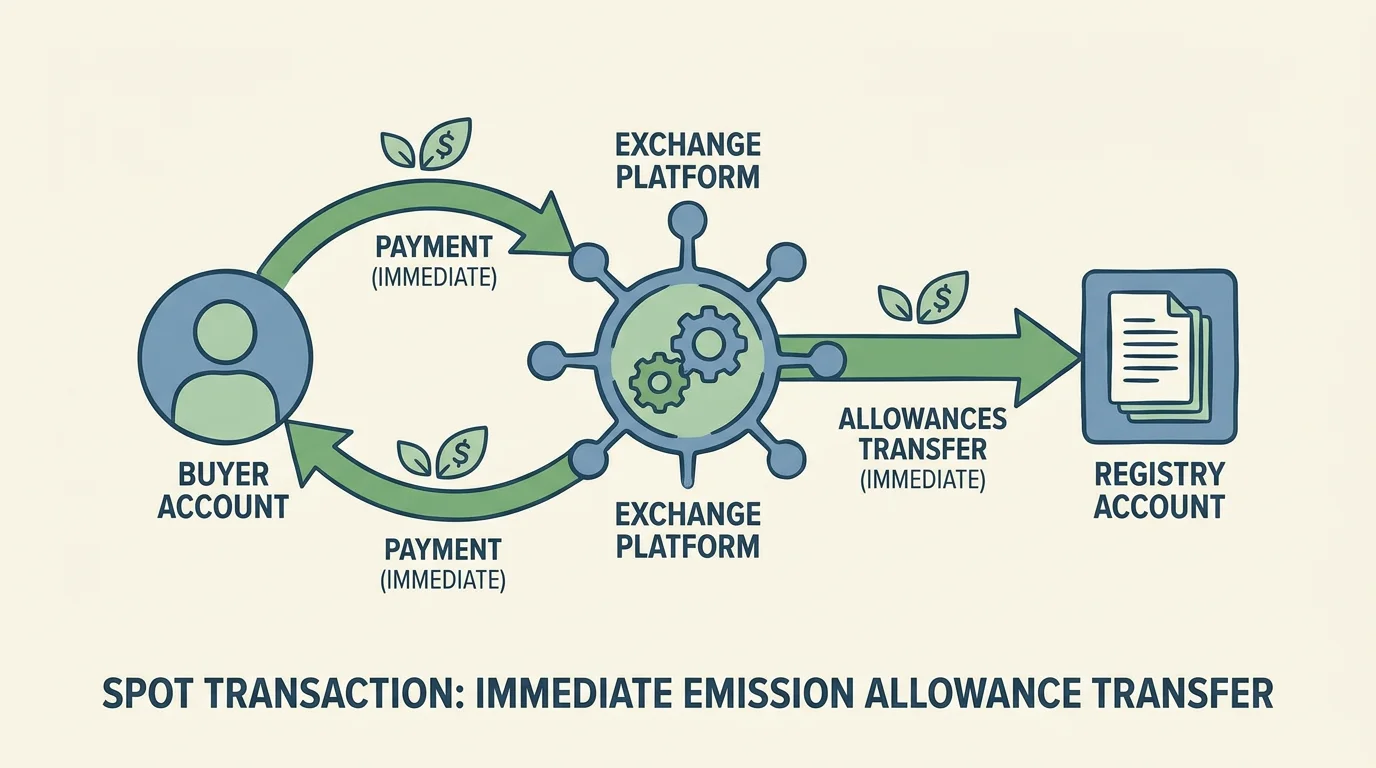
On exchanges like EEX, the standard lot size for EUA spot is 1,000 allowances, with fulfillment occurring on the first clearing business day after the trade. Spot trades are settled by physical delivery: the buyer pays and receives actual EUAs in the European Registry system.
What Is an EUA Futures Contract?
An EUA futures contract is a financial derivative. It obliges both parties to buy or sell a specified quantity of EUAs at a predetermined price on a set future date. Unlike spot, the exchange of allowances does not happen immediately; it occurs at the contract's expiry (or upon exercise of the position).
EUA futures trade on venues such as ICE Endex and EEX, with monthly, quarterly, and yearly expiries available. The December contract historically concentrates the largest share of open interest because it aligns closely with the EU ETS compliance cycle. According to ESMA's 2025 Carbon Markets Report, futures contracts accounted for 77% of on-exchange and 64% of off-exchange trading in the EU ETS during 2024.
Futures contracts are marked to market daily, meaning gains and losses are settled through margin accounts at the end of each trading session. This requires participants to maintain initial and variation margin, adding a layer of capital management that spot trading does not impose.
How Do EUA Spot and Futures Prices Relate?
In theory, the relationship between EUA spot and futures prices follows a cost-of-carry model. The futures price should equal the spot price plus the cost of financing the position (essentially the risk-free interest rate) over the contract period. If the spot price is €70 today and the annualized risk-free rate is 3%, a one-year futures contract should trade around €72.10.
In practice, however, researchers have observed a persistent spread between EUA futures and spot prices that exceeds what the risk-free rate alone would predict. A 2025 study published in ScienceDirect identifies this anomaly as the "C-spread" and finds it is cointegrated with the credit spread of corporates involved in the EU ETS. The study suggests that including EUAs in the ECB's eligible collateral list could help resolve this market inefficiency.
Academic research also confirms that the futures market plays a leading role in price discovery. A study published in Frontiers in Energy Research found unidirectional causality from futures prices to spot prices, meaning that the futures market tends to absorb new information first and then transmit it to spot.
Volume and Liquidity: Where Does the Market Trade?
The EU ETS secondary market is heavily skewed toward futures. In 2025, futures trading represented 89% of total volume, while spot transactions accounted for roughly 6%, and auctions made up the remaining 5%. Spot volumes also shrank 26% year-on-year in 2025, while futures decreased only 3%.
This volume disparity does not mean that the spot market lacks importance. For compliance entities that need to physically hold and surrender allowances, the spot market is the point of final acquisition. The European Environment Agency's ETS data viewer tracks verified emissions and surrender data across all installations, illustrating the scale of physical allowance demand each year.
For participants seeking to understand how different routes to market in carbon emissions trading affect execution, the choice between spot and futures is often determined by the size of the position, the timeline, and the capital available for margin.
Who Uses EUA Spot and Who Uses Futures?
The participant base differs significantly between the two markets. ESMA's data shows that investment firms and credit institutions dominated both on-exchange and off-exchange volumes in 2024, accounting for 63.5% of total trading. Investment funds held around 6% of all derivatives positions, with an average of 909 daily position holders in the futures market.
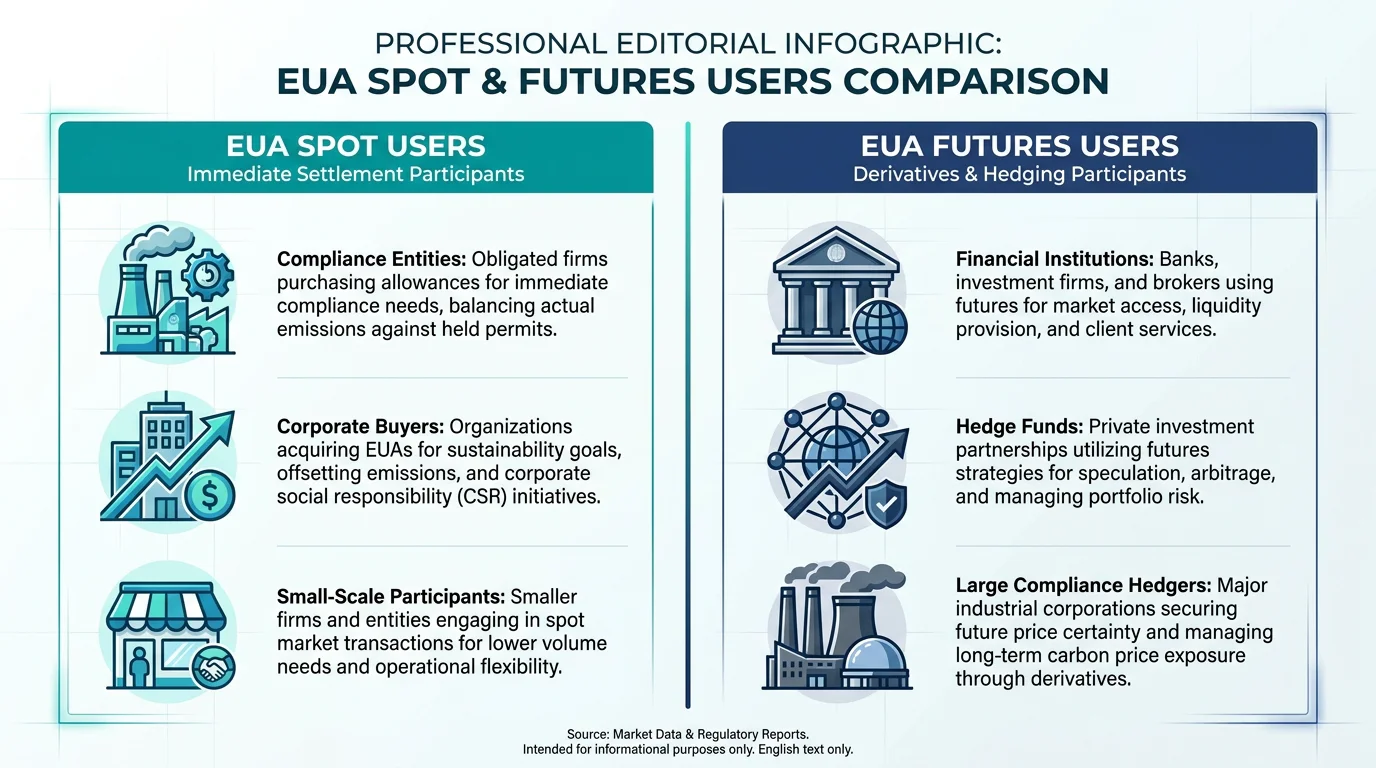
Compliance entities (power generators, cement producers, steel manufacturers) typically buy spot EUAs to meet surrender obligations. Some also use futures to hedge anticipated compliance costs, locking in prices months or years ahead. Financial participants, on the other hand, primarily use futures to speculate on carbon price movements or to facilitate client orders as market makers.
Smaller compliance entities often face barriers in the futures market due to the capital requirements associated with margin. This is where our approach to broker vs exchange for carbon trading becomes important: choosing the right execution venue can significantly affect the total cost of participation.
Key Differences at a Glance
Feature | EUA Spot | EUA Futures | Initiativ Platform |
|---|---|---|---|
Settlement | T+1 (physical delivery) | At contract expiry | Spot and futures available |
Minimum trade size (traditional) | 1,000 EUAs (1 lot) | 1,000 EUAs (1 lot) | From 1 EUA |
Margin requirement | Full upfront payment | Initial + variation margin | Pre-trade risk controls |
Primary use case | Compliance, direct acquisition | Hedging, speculation | Trading, compliance, automation |
Price discovery role | Follows futures | Leads price formation | Real-time price monitoring |
Share of EU ETS volume (2025) | ~6% | ~89% | Growing platform volume |
The Cost-of-Carry Spread and What It Means for Traders
The persistent gap between EUA spot and futures prices, sometimes called the C-spread, creates both opportunities and costs. For compliance entities that must eventually hold physical allowances, buying spot avoids the cost embedded in the futures premium. For financial participants, the spread represents a potential arbitrage signal, although capturing it requires the ability to hold spot EUAs and short futures simultaneously.
The C-spread has been linked to the creditworthiness of EU ETS participants. Because holding spot EUAs ties up capital without earning collateral benefits (unlike government bonds), the market prices in an additional premium for futures delivery. If the European Central Bank were to accept EUAs as eligible collateral, as some researchers recommend, this spread could narrow significantly.
Understanding this pricing dynamic matters when choosing between spot and futures execution. Participants who can access direct market access for emissions trading have the flexibility to optimize their entry point across both instrument types.
How to Choose Between EUA Spot and Futures
Your choice depends on three factors: your objective, your time horizon, and your capital structure.
- Compliance buyers with near-term surrender deadlines benefit from spot purchases, which provide immediate ownership and avoid margin management.
- Entities hedging future compliance costs may prefer futures, which allow them to lock in a price without deploying full capital upfront.
- Financial participants seeking price exposure typically favor futures for their leverage and liquidity.
- Smaller organizations may find the traditional 1,000 EUA lot size on legacy exchanges a barrier. Platforms that allow trading from 1 EUA reduce this minimum threshold considerably.
The expanding participation base in the EU ETS, which now includes maritime shipping and will soon encompass buildings and road transport under ETS2, means that more entities will need to decide between spot and futures strategies. Choosing the right instrument and execution venue is increasingly a matter of operational efficiency, not just financial preference.
Conclusion
The distinction between EUA futures and EUA spot contracts is not merely technical; it shapes how participants manage cost, risk, and compliance across the EU ETS. Futures dominate volume and lead price discovery, while spot contracts remain the mechanism through which allowances are physically acquired and surrendered. The persistent cost-of-carry spread between the two instruments adds complexity but also strategic opportunity for well-informed participants.
With roughly €845 billion in market value traded in 2025 alone, the EU carbon market demands precision in execution and transparency in pricing. We designed our platform to support both spot and futures trading from as little as 1 EUA, with real-time pricing, pre-trade risk controls, and API integration, all within a single workflow.
To see how this works in practice, explore our carbon trading for traders and corporates and request access to our demo environment.
Frequently Asked Questions
Can I trade both EUA spot and futures on the same platform?
Yes. Several venues offer both spot and derivatives. We provide spot, futures, and options trading on a single platform, which simplifies workflow and reduces the need for multiple exchange memberships.
Why are EUA futures prices usually higher than spot?
Futures prices incorporate the cost of carry, which includes the risk-free interest rate and, in the case of EUAs, a credit premium. This spread reflects the capital cost of deferring delivery to a future date.
What is the minimum trade size for EUA spot and futures?
On traditional exchanges like EEX and ICE, the standard lot is 1,000 EUAs for both spot and futures. However, newer platforms such as ours allow trading from 1 EUA, making the market accessible to a wider range of participants.