




A carbon purchase can settle today or commit you to tonnes that may not yet exist. For professional participants, EUA futures versus spot contracts shows the same timing distinction in a regulated allowance market, while spot carbon contracts involve additional questions about project quality, verification, and retirement.
The most important distinction is whether you are buying an existing environmental instrument or contracting for future production. Voluntary carbon credits and regulated allowances are different products, although both may be traded through spot, forward, or derivative structures. The CFTC market distinction separates voluntary carbon markets from mandatory systems such as emissions trading schemes.
What do spot carbon contracts mean?
Short answer: A spot carbon contract is an agreement to buy and sell an available carbon instrument for prompt settlement. In voluntary markets, this usually means an issued carbon credit that can be transferred or retired. In regulated markets, it can mean an allowance such as an EUA that is available for immediate delivery.
Spot does not necessarily mean the transaction settles instantly. The contract still needs clear terms for payment, registry transfer, delivery timing, eligibility, and retirement instructions. The defining feature is that the underlying unit already exists, unlike a forward purchase or a project investment based on expected future issuance.
| Contract type | Delivery timing | Price and payment | Main risk profile | Best fit |
|---|---|---|---|---|
| Spot carbon contracts | Prompt delivery of issued units | Market price, usually paid near settlement | Availability, quality, and price risk | Immediate needs and flexible volumes |
| Forward carbon contracts | One future delivery date or schedule | Fixed or formula-based price, payment varies | Project, delivery, and counterparty risk | Near or medium-term price planning |
| Carbon offtake contracts | Recurring future deliveries | Fixed, indexed, or hybrid pricing | Multi-year volume and quality risk | Long-term supply security |
| Direct carbon project investment | Future credits as a project develops | Capital or milestone funding | Development, performance, and issuance risk | Strategic buyers seeking influence |
| Carbon credit contracts | Defined by the agreement | Defined by negotiated terms | Legal, verification, delivery, and liability risk | Allocating responsibilities clearly |
Spot carbon contracts

Best for: Spot carbon contracts suit buyers that need issued units for near-term claims, compliance planning, inventory management, or a trial purchase. They also suit organizations whose annual volume changes and cannot be forecast accurately several years ahead.
A spot purchase normally starts with a defined credit specification. The buyer may require a particular project type, methodology, vintage, registry, geography, permanence profile, or set of social safeguards. After the parties agree on price and quantity, the units are transferred between registry accounts or retired for the buyer, subject to the relevant registry rules. Standardized documentation can support both spot transfers and retirement instructions. ISDA documentation for VCC transactions provides examples of standardized terms for physically settled spot and forward transactions.
Pricing reflects the units available at the time of purchase. A carbon spot price definition is therefore useful, but the headline price alone does not describe credit quality. Methodology, vintage, registry, verification history, permanence, co-benefits, and buyer demand can all influence the price of a specific unit.
Pros:
- Immediate availability: The credits already exist and can usually move toward transfer or retirement without waiting for project development.
- High flexibility: Buyers can adjust quantity, project selection, and timing from one purchase cycle to the next.
- Lower delivery uncertainty: The buyer is not relying on a project to generate a future volume, although quality and reversal risks may remain.
- Simple budgeting for small purchases: The buyer can avoid a long-term obligation when needs are uncertain.
Cons:
- Limited supply security: The preferred credit type may not be available when the buyer needs it.
- Market exposure: Prices may rise before the next purchase, particularly for scarce or highly specified credits.
- Less project influence: A secondary-market purchase usually provides less ability to shape project design or future impact attributes.
Forward carbon contracts
Best for: Forward carbon contracts are suitable for buyers that want to secure a known quantity for a future date without committing to a long recurring programme. They can help plan near-term procurement and manage exposure to future price changes.
A forward contract usually covers a single future delivery or a defined short schedule. The underlying credits may not yet be issued, and the project may still be completing validation, implementation, monitoring, or verification. The price can be fixed, indexed to a reference, or adjusted according to agreed conditions. Payment may occur upfront, at milestones, on delivery, or through a combination of these approaches.
A forward purchase is not automatically the same as a standardized futures contract. The parties may negotiate project attributes, delivery terms, replacement provisions, and settlement mechanics directly. Buyers that want to understand the difference between bespoke future delivery and exchange-traded products can also review our explanation of carbon offset futures contracts.
Pros:
- Future price visibility: A fixed or formula-based price can improve planning when future market conditions are uncertain.
- Earlier access: The buyer may secure a preferred project or credit type before the units reach the spot market.
- Project support: A purchase commitment can provide revenue visibility that helps a project progress.
- Defined delivery: The contract can specify volume, timing, quality, and remedies before the credits are issued.
Cons:
- Delivery risk: The project may be delayed, underdeliver, or fail to issue the expected credits.
- Quality uncertainty: The final credits may differ from the buyer’s expectations if the project design or methodology changes.
- Reduced flexibility: The buyer may remain obligated even if emissions fall or procurement priorities change.
- Payment exposure: Upfront funding increases the buyer’s exposure if delivery does not occur.
Carbon offtake contracts
Best for: Carbon offtake contracts suit organizations with predictable future demand and a strategic need for recurring access to specific credits. They are often considered when a buyer wants a longer relationship with a project developer.
An offtake agreement normally covers multiple delivery periods. The buyer commits to purchase a defined volume over several years, while the developer agrees to supply credits as the project produces and verifies them. The contract may include annual volumes, minimum purchase obligations, delivery tolerances, price escalators, indexation, payment milestones, and remedies for shortfalls.
Offtake contracts can be useful when high-quality supply is limited or when the buyer wants input into project characteristics. That advantage comes with a longer commitment. The buyer must assess whether its future emissions profile, reporting approach, budget, and credit preferences are stable enough to support the agreement.
Pros:
- Long-term supply planning: Recurring deliveries can reduce the need to source the full requirement during each spot purchase cycle.
- Greater price structure: Fixed pricing, indexation, collars, or other mechanisms can make future costs more predictable.
- Strategic engagement: A large buyer may have more influence over methodology, monitoring, co-benefits, or project reporting.
- Developer financing: Contracted demand can help a project secure capital and plan its operating model.
Cons:
- Long-term obligation: The buyer may need to purchase credits even if its future requirements change.
- Underdelivery risk: The project may produce fewer credits than expected or deliver them later than planned.
- Complex negotiation: Volume, price, quality, force majeure, replacement, and termination provisions require careful drafting.
- Opportunity cost: The agreed price may become unattractive if market prices fall or better alternatives emerge.
Direct carbon project investment
Best for: Direct investment suits experienced buyers with longer time horizons, strong due diligence capacity, and an interest in supporting project development directly. It is less suitable for an organization that needs credits for an immediate reporting deadline.
In a direct investment structure, the buyer provides capital to help develop or scale a carbon project. Funding may support land preparation, equipment, infrastructure, monitoring, or other development milestones. In return, the buyer may receive future credits, preferential purchase rights, or an agreed share of project output.
This approach gives the buyer more visibility into the project and may create opportunities to influence design. It also transfers more development risk to the buyer. Weather, permitting, construction, operating performance, verification, registry issuance, and changes in methodology can all affect the volume and timing of future credits.
Pros:
- Early project access: The buyer may secure future supply that is not available through the spot market.
- Greater influence: Capital participation can support dialogue about project design, monitoring, and co-benefits.
- Potential cost efficiency: Early funding may provide access to credits on terms that differ from later market purchases.
- Strategic alignment: The investment can connect procurement with a broader climate finance programme.
Cons:
- High development risk: The project may not perform as planned or may fail to produce credits.
- Capital lock-in: Funds may remain committed for years before credits become available.
- Volume uncertainty: Actual issuance can differ from initial forecasts.
- Due diligence burden: The buyer needs technical, financial, legal, and environmental expertise.
Carbon credit contracts: terms that matter
Best for: A well-structured carbon credit contract is essential for any buyer or seller that needs responsibilities, quality standards, payment duties, and remedies to be clear. The contract type matters, but the wording often determines how risk is allocated.
Every agreement should describe the underlying instrument precisely. That description can include the crediting programme, registry, project, methodology, vintage, unit type, eligibility requirements, and treatment of labels or co-benefits. A buyer should also confirm whether the transaction ends with transfer into its account or retirement on its behalf.
Registry records are central to ownership and retirement. For example, the Verra VCU framework describes issuance, transfer, and retirement records for its units. Other standards and registries have their own rules, so the contract should identify the applicable system rather than relying on general market language.
Pros:
- Clear accountability: The parties can assign responsibility for delivery, verification, payment, and registry actions.
- Better risk allocation: Replacement units, compensation, force majeure, and termination provisions can address foreseeable problems.
- Quality control: Detailed eligibility criteria can reduce the risk of receiving credits that do not meet the buyer’s policy.
- Operational certainty: Settlement, reporting, and retirement instructions can be agreed before execution.
Cons:
- Contract complexity: Detailed environmental attributes and registry rules can make drafting and review demanding.
- Potential disputes: Ambiguous quality, delivery, or replacement language can create disagreement later.
- Changing frameworks: New registry rules, methodologies, or regulations may require amendment mechanisms.
How should you choose between carbon procurement structures?
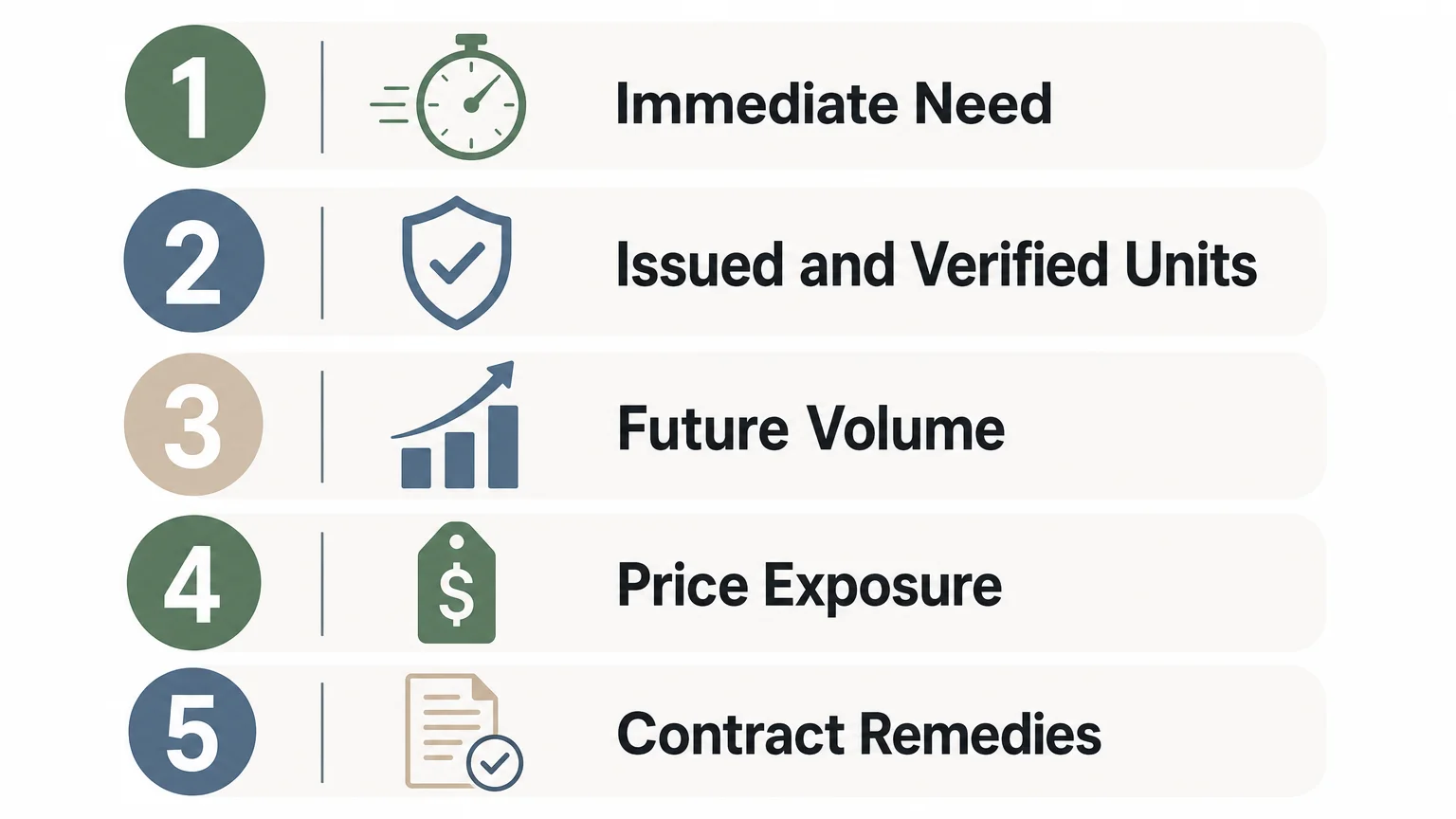
Suppose your organization needs credits for a claim within the next reporting cycle. A spot contract is usually the most direct route because the units already exist. If the need is several years away, a forward or offtake structure may provide better supply planning, provided the delivery risk is acceptable.
Start with the following decision questions:
- When must delivery occur? Immediate needs favor issued spot units. Future needs may support a forward, offtake, or investment structure.
- What quality criteria are mandatory? Define the standard, registry, methodology, vintage, geography, permanence expectations, and co-benefits before discussing price.
- How predictable is your volume? Variable demand favors spot purchases or flexible contract clauses. Stable demand can support recurring offtake commitments.
- Who carries delivery risk? Review underdelivery, delay, replacement, cancellation, force majeure, and counterparty provisions.
- How will units be handled? Specify transfer, custody, retirement, evidence, reporting, and registry responsibilities.
A diversified approach can be practical. An organization may use spot purchases for immediate or residual needs, then add forward or offtake commitments for a defined share of future demand. Direct investment may be appropriate only for a smaller strategic allocation that the buyer can monitor closely.
Conclusion: match the contract to the risk
Spot carbon contracts provide the clearest route to issued units and the greatest procurement flexibility, but they do not guarantee future supply or price. Forward contracts improve future planning, offtakes secure recurring volumes, and direct investments provide deeper project engagement with greater development exposure. The right structure depends on delivery timing, quality requirements, volume certainty, budget horizon, and the level of risk your organization can manage.
Take action with Initiativ
Carbon procurement decisions depend on more than the instrument itself. Professional participants also need transparent prices, controlled execution, position visibility, and operational workflows that connect trading with risk management.
We provide access to EUA spot and derivatives markets through exchange infrastructure designed for professional participants. Our platform supports live market monitoring, configurable alerts, pre-trade controls, API connectivity, order-book access, position management, reporting, confirmation, and settlement workflows. To explore how carbon trading for traders and corporates can fit your organization, connect with our team.
Frequently Asked Questions
What is a spot carbon contract?
A spot carbon contract is a transaction for an existing carbon credit or emissions allowance with prompt settlement. The unit may be transferred to the buyer or retired according to the applicable registry and contract instructions.
Are spot carbon contracts the same as carbon futures?
No. Spot contracts involve available units, while futures are standardized derivative contracts for a later date. A forward contract is also different because it is usually negotiated directly between counterparties.
What is the main advantage of a spot purchase?
The main advantage is flexibility. Buyers can select available credits based on current needs without accepting a multi-year purchase obligation or waiting for a project to develop.
What is the main risk of buying carbon credits on the spot market?
The main risks are price movement and limited availability of the preferred credit type. A buyer must also assess quality, verification, registry status, permanence, and retirement evidence.
Should a company use spot, forward, and offtake contracts together?
A blended strategy can be useful when an organization has both immediate and future procurement needs. The appropriate mix depends on its emissions pathway, budget, quality policy, volume certainty, and tolerance for delivery risk.


Let’s connect
Do you want more information about what we do?