
Summary: Futures trading lets participants hedge risk or speculate on price movements across commodities, indices, and carbon allowances, in a market valued at $5.05 billion in 2026.
The global futures trading service market is projected to reach $10.08 billion by 2035, growing at a compound annual rate of 8%. That trajectory reflects surging demand from institutional hedgers, corporate compliance teams, and financial speculators who rely on futures contracts to manage price uncertainty. Whether you trade equity indices, energy commodities, or EU Allowances (EUAs), understanding how futures trading works is fundamental to sound risk management.
Futures are no longer the exclusive domain of large banks and trading houses. Smaller lot sizes, programmable exchange infrastructure, and API connectivity are opening participation to mid‑market firms and compliance entities alike. This article covers how futures contracts work, who uses them, the strategies that matter, and how carbon markets are reshaping the landscape.
What Is a Futures Contract and How Does It Work?
A futures contract is a standardized agreement to buy or sell a specific asset at a predetermined price on a set future date. The global futures trading service market size is estimated at USD 5.05 billion in 2026, underscoring how central these instruments have become to global finance. Unlike a spot transaction, which settles immediately, a futures contract locks in terms today for execution later.
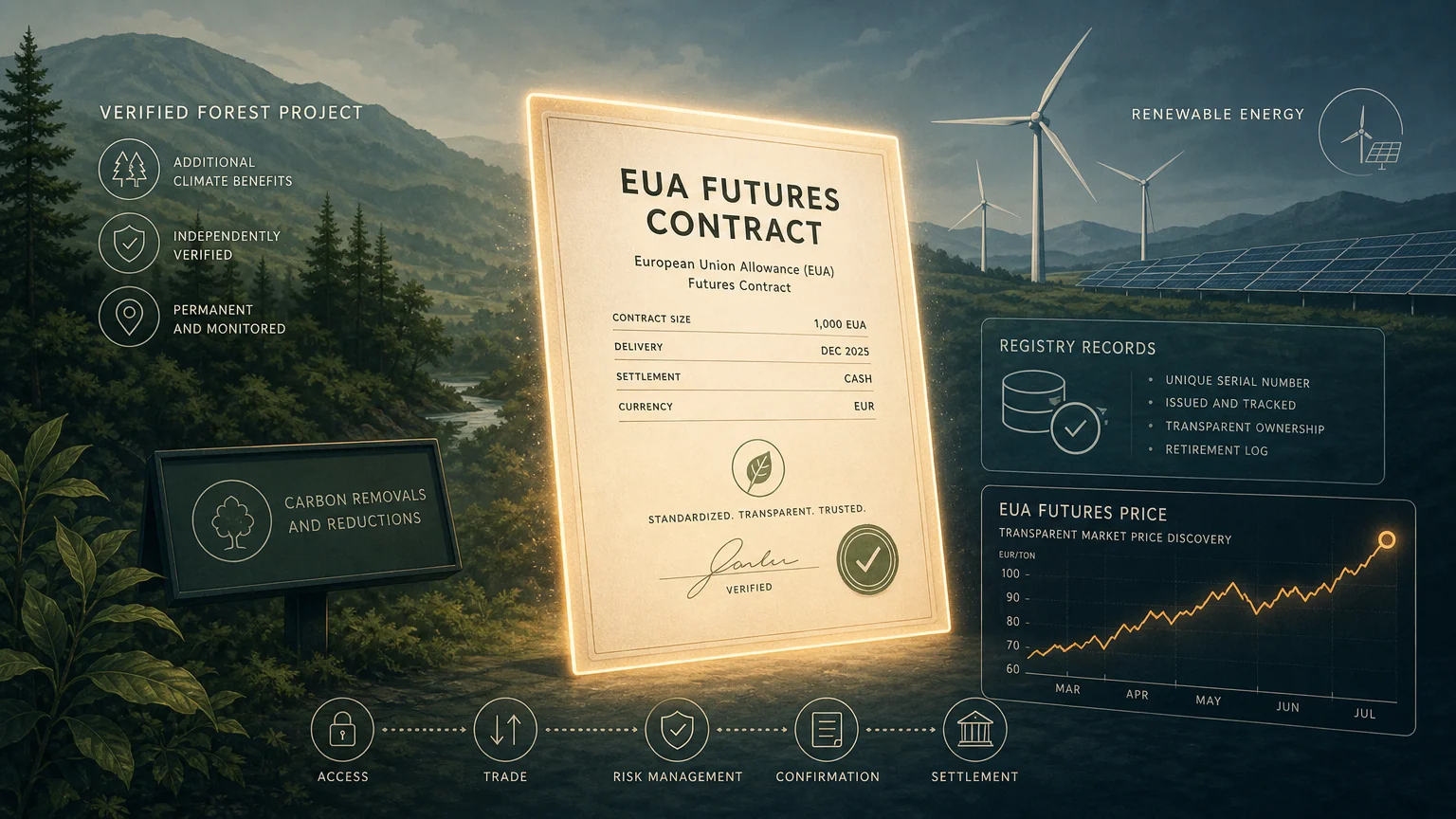
Every futures contract carries defined specifications. Contract size dictates the quantity of the underlying asset per contract; for instance, one crude oil contract on the CME represents 1,000 barrels. Tick size is the minimum price increment the contract can move, often measured in fractions of a cent. Delivery terms specify whether the contract settles in cash or through physical delivery of the asset.
Most participants never take physical delivery. Instead, they close or "roll" their positions before expiration. This mechanism allows hedgers and speculators alike to gain exposure to price movements without handling the underlying commodity. If you want to understand the infrastructure behind how trades reach the market, our article on broker vs exchange breaks down the key differences.
Who Participates in the Futures Markets?
Futures markets attract a diverse ecosystem of participants, each with distinct objectives. Understanding who you trade alongside helps clarify how pricing, liquidity, and volatility form.
- Hedgers: Commercial producers and consumers (airlines hedging fuel costs, farmers locking in crop prices) use futures to reduce exposure to adverse price swings.
- Speculators: These participants seek profit from price fluctuations. They accept risk that hedgers want to offload, adding liquidity to the market.
- Institutional investors: Banks, pension funds, and asset managers use futures for portfolio diversification and interest rate management.
- Compliance entities: In regulated carbon markets, companies obligated to surrender emission allowances trade EUA futures to manage their compliance costs over time.
As the CFTC explains, most participants in the futures markets are "commercial or institutional" users who trade to maximize asset value and reduce risk. Speculators complement this by absorbing risk and tightening bid‑ask spreads.
Margin, Leverage, and How Money Moves
One concept that distinguishes futures from equities is margin. When you open a futures position, you do not pay the full notional value of the contract. Instead, you deposit an initial margin, which acts as a performance bond.
This leverage means a relatively small capital outlay controls a much larger position. If one crude oil futures contract has a notional value of $65,000, your initial margin might be only a fraction of that. While leverage amplifies gains, it equally amplifies losses. Your account is marked to market daily: at the close of each session, unrealized gains and losses are credited or debited. If your equity drops below the maintenance margin, you must deposit additional funds immediately or face liquidation.
Pre‑trade risk controls are essential in this environment. Automated checks that limit position size, enforce margin thresholds, and flag unusual activity can prevent catastrophic drawdowns. We built these safeguards directly into our traders and corporates platform so that risk management happens before execution, not after.
Key Strategies for Trading Futures
How you approach the futures market depends on your objectives, risk tolerance, and time horizon. Three core strategies dominate.
Hedging
A manufacturer that consumes large quantities of natural gas can buy futures to lock in a purchase price months ahead. If spot prices rise, the gain on the futures position offsets the higher procurement cost. This is the most traditional use of futures and remains the primary reason commodity markets exist.
Speculating
Speculators take directional positions, going long if they anticipate a price increase or short if they expect a decline. Automation and algorithmic strategies accounted for nearly 61% of the increased demand for futures trading services, reflecting how technology has accelerated speculative participation across asset classes.
Spreading
Calendar spreads involve buying one contract month while selling another on the same underlying asset. This strategy profits from changes in the price difference between contract months rather than outright directional moves, reducing exposure to broad market risk.
Carbon Futures: A Growing Frontier
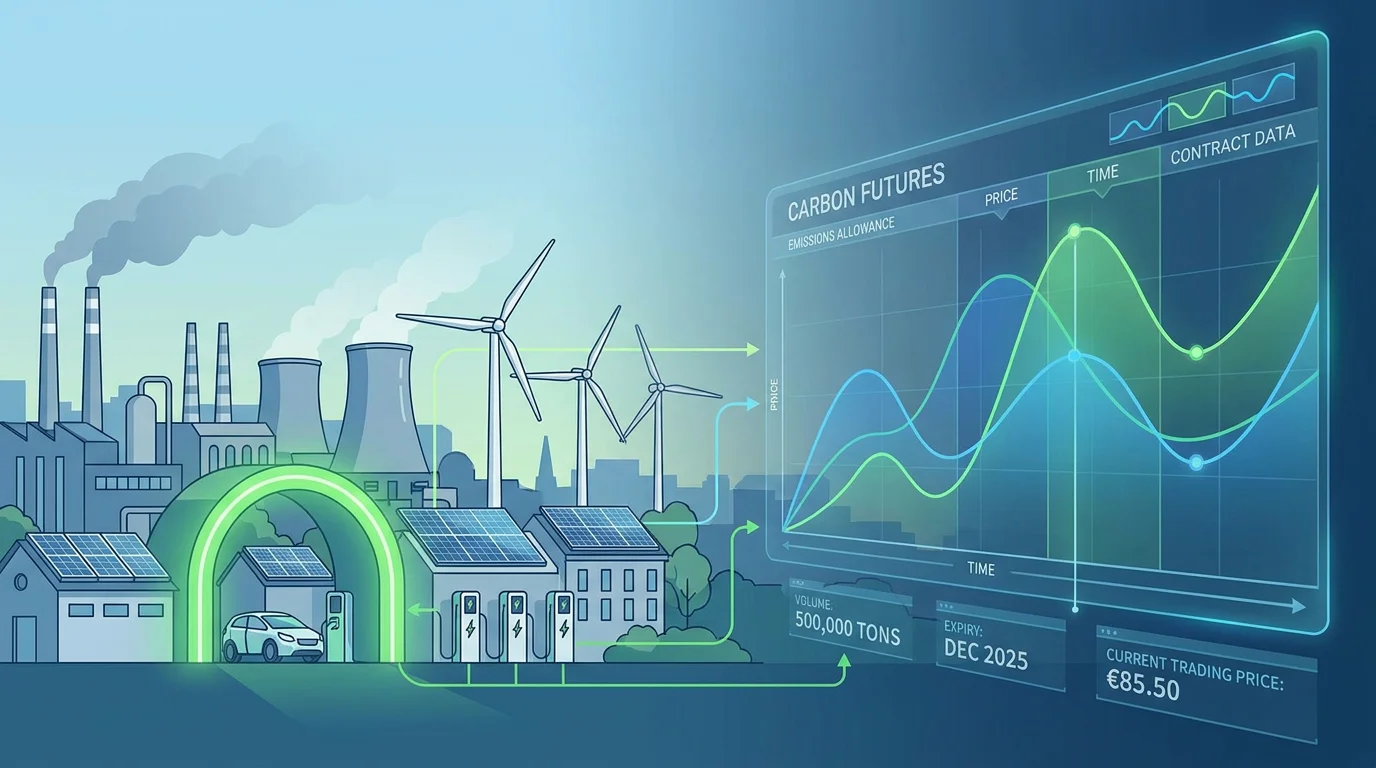
While equity index and energy futures dominate headlines, carbon allowance futures are among the fastest growing segments globally. Under the EU Emissions Trading System (EU ETS), companies must hold enough allowances to cover their verified emissions each year. EUA futures let compliance entities and financial participants plan ahead, locking in carbon costs or speculating on policy driven price shifts.
The World Bank forecasts that overall commodity prices will rise 16% in 2026, driven by energy, fertilizer, and metals. Carbon allowance prices are influenced by overlapping forces: energy costs, regulatory tightening, industrial output, and climate policy ambition. These dynamics make EUA futures an increasingly strategic tool for both risk management and capital allocation.
Traditional carbon exchanges require a minimum lot size of 1,000 EUAs, which prices out many smaller compliance entities and mid‑market participants. We reduce that barrier to just 1 EUA, equivalent to 1 tonne of CO₂, so that organizations of any size can access routes to market in emissions trading without overcommitting capital.
Choosing the Right Exchange and Access Model
Not all exchanges serve the same audience or offer the same terms. When evaluating where to trade futures, consider these factors:
| Criteria | Traditional Exchanges | Initiativ |
|---|---|---|
| Minimum lot size (EUAs) | 1,000 EUAs | 1 EUA |
| Live price transparency | Varies; often delayed for non‑members | Real‑time, visible to all participants |
| API access for automation | Available, typically at premium cost | Included with standard access |
| Trading hours | Standard market hours | Extended hours |
| Pre‑trade risk controls | Available through third‑party systems | Built into the platform |
| Cash protection | Depends on clearing structure | Guaranteed up to €100k (FGDR) |
The difference between a broker and an exchange matters here. Our guide on direct market access vs exchanges explains how DMA models compare to exchange execution, particularly for firms that need transparency and speed.
Risk Management: Protecting Your Capital
Futures can be volatile, complex, and unforgiving. Sound risk management separates sustainable participants from those who exit the market prematurely.
- Position sizing: Never allocate more capital to a single trade than your risk framework allows. Smaller lot sizes (like 1 EUA) let you scale positions precisely.
- Stop‑loss discipline: Define your maximum acceptable loss before entering any trade. Automate exits where possible.
- Diversification: Spread exposure across uncorrelated assets. A portfolio combining equity index futures, energy, and carbon allowances reduces concentration risk.
- Daily monitoring: Because futures accounts are marked to market daily, real‑time price monitoring and configurable alerts are not optional; they are essential.
Security and fraud risks impacted approximately 35% of traders' confidence in emerging market platforms, which is why regulatory compliance, clearing guarantees, and transparent infrastructure should be non‑negotiable criteria when selecting a trading venue.
The Role of Technology and Automation
Cloud‑based trading infrastructure adoption rose to 46% among active futures brokerage service providers globally. This shift reflects a broader trend: manual order entry and phone‑based brokerage are giving way to API driven execution, algorithmic strategies, and programmable infrastructure.
For compliance teams managing EUA procurement, automation means scheduling purchases across multiple delivery dates, triggering trades when prices hit predetermined levels, and integrating execution data directly into enterprise risk systems. For professional financial participants, it means lower latency, tighter spreads, and the ability to deploy systematic strategies at scale.
Technology also enhances transparency. Live price visibility, once reserved for exchange members and large institutions, is now accessible to any qualified participant on modern platforms. This democratization of data narrows information asymmetry and improves market efficiency.
Futures trading sits at the intersection of risk management, price discovery, and strategic capital deployment. Whether you are hedging commodity exposure, speculating on macroeconomic trends, or managing carbon compliance obligations, futures contracts provide a standardized, regulated mechanism for navigating uncertainty. The data is clear: with the market projected to double by 2035 and automation driving over 60% of new demand, the participants who succeed will be those with transparent pricing, robust risk controls, and flexible infrastructure. Our exchange platform delivers exactly that, from 1 EUA lot sizes to built‑in pre‑trade safeguards and real‑time monitoring. Ready to see how it works? Explore the next emissions exchange we are building and request access today.
Frequently Asked Questions
What is the difference between futures and options?
A futures contract obliges both parties to fulfill the agreement at expiration, while an option gives the buyer the right, but not the obligation, to execute. Both instruments are used for hedging and speculation, but their risk profiles differ significantly.
Can smaller companies trade carbon futures?
Yes. While traditional exchanges require a minimum lot of 1,000 EUAs, our platform allows trading from just 1 EUA. This makes carbon futures accessible to mid‑market and smaller compliance entities that previously could not participate efficiently.
How much capital do I need to start trading futures?
Capital requirements depend on the contract and the exchange's margin rules. Initial margin is a fraction of the contract's notional value, but you should account for potential margin calls and daily mark‑to‑market adjustments. Starting with a clear risk budget is more important than the absolute dollar amount.