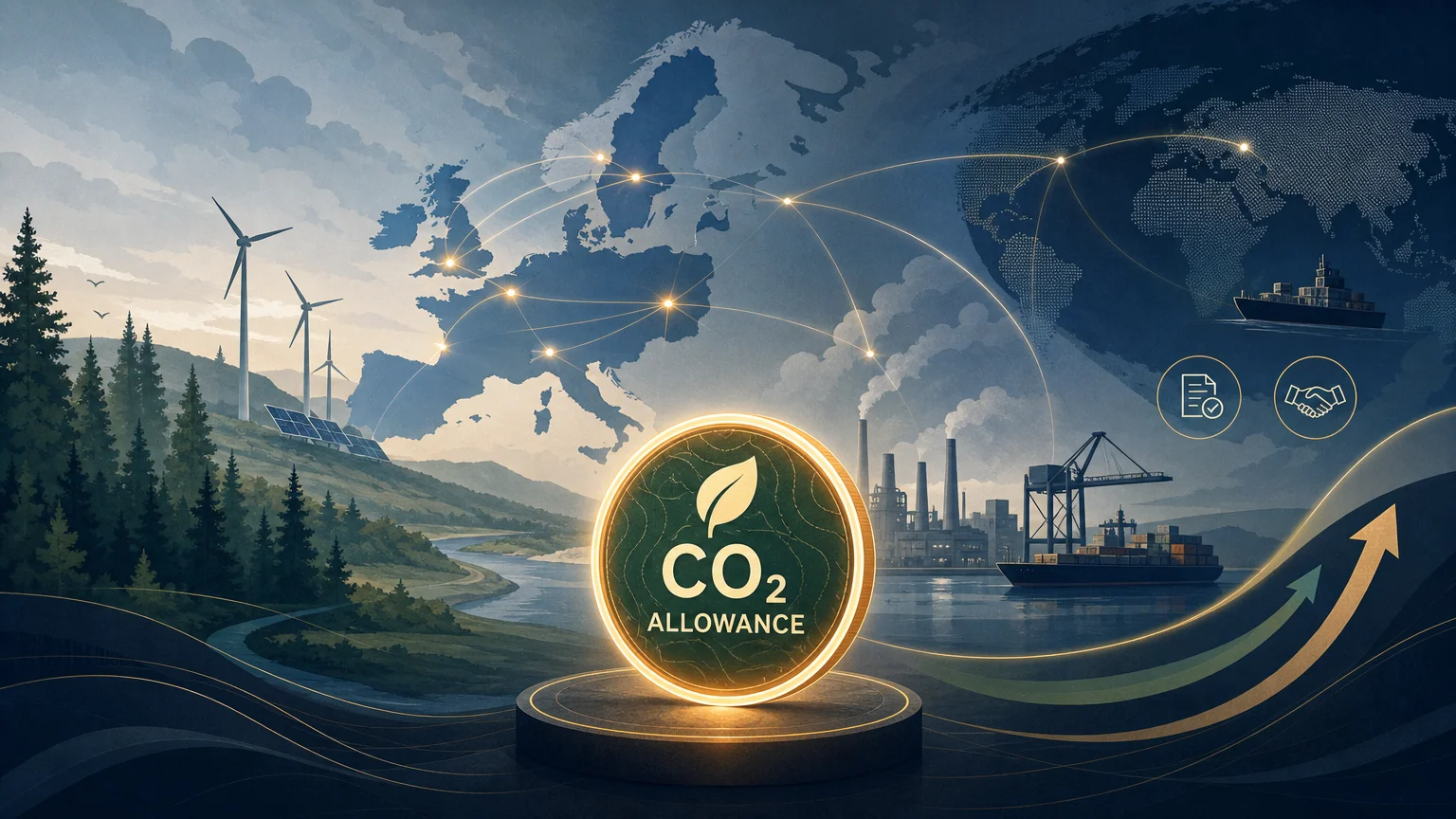

Summary: Environmental commodities trading platforms enable businesses to buy and sell carbon credits, allowances, and RECs, in a market projected to grow at over 23% CAGR through 2034.
The global carbon credit trading platform market is expanding at an unprecedented pace. The market is projected to grow from $235.50 million in 2026 to $1.27 billion by 2034, exhibiting a CAGR of 23.47%. Behind that growth curve sits an urgent question for compliance teams, traders, and sustainability officers: which trading platform for environmental commodities actually delivers the transparency, execution speed, and risk controls that modern carbon markets demand?
Whether you operate under the EU Emissions Trading System, participate in voluntary offset programs, or trade renewable energy certificates, the platform you choose shapes every outcome, from execution cost to regulatory compliance. This guide breaks down how these platforms work, what distinguishes them, where the market is heading, and how to evaluate your options with clarity.
What Are Environmental Commodities and Why Do They Trade on Platforms?
Environmental commodities are tradeable instruments that represent a measurable environmental benefit. Carbon credits, EU Allowances (EUAs), Renewable Energy Certificates (RECs), and water trading rights all fall into this category. Unlike traditional commodities such as oil or wheat, their value is derived not from physical properties but from the environmental outcome they represent.
Platforms exist to solve a coordination problem. Buyers and sellers of these instruments need transparent pricing, reliable settlement, and audit trails that satisfy regulators. Exchanges are uniquely positioned to drive solutions by delivering transparent price discovery, facilitating capital formation, risk management, and efficient post-trade settlement. Without centralized infrastructure, participants would rely on bilateral deals with limited visibility into fair market value.
The distinction between compliance and voluntary markets matters here. Compliance markets, like the EU ETS, are mandated by regulation; companies must hold enough allowances to cover their emissions. Voluntary markets let organizations purchase credits to meet self-imposed sustainability goals. Both require robust platforms, but the regulatory complexity differs sharply. For a deeper look at how these two systems interact, see our analysis of voluntary credits vs emissions trading.
The Forces Driving Platform Growth in 2026
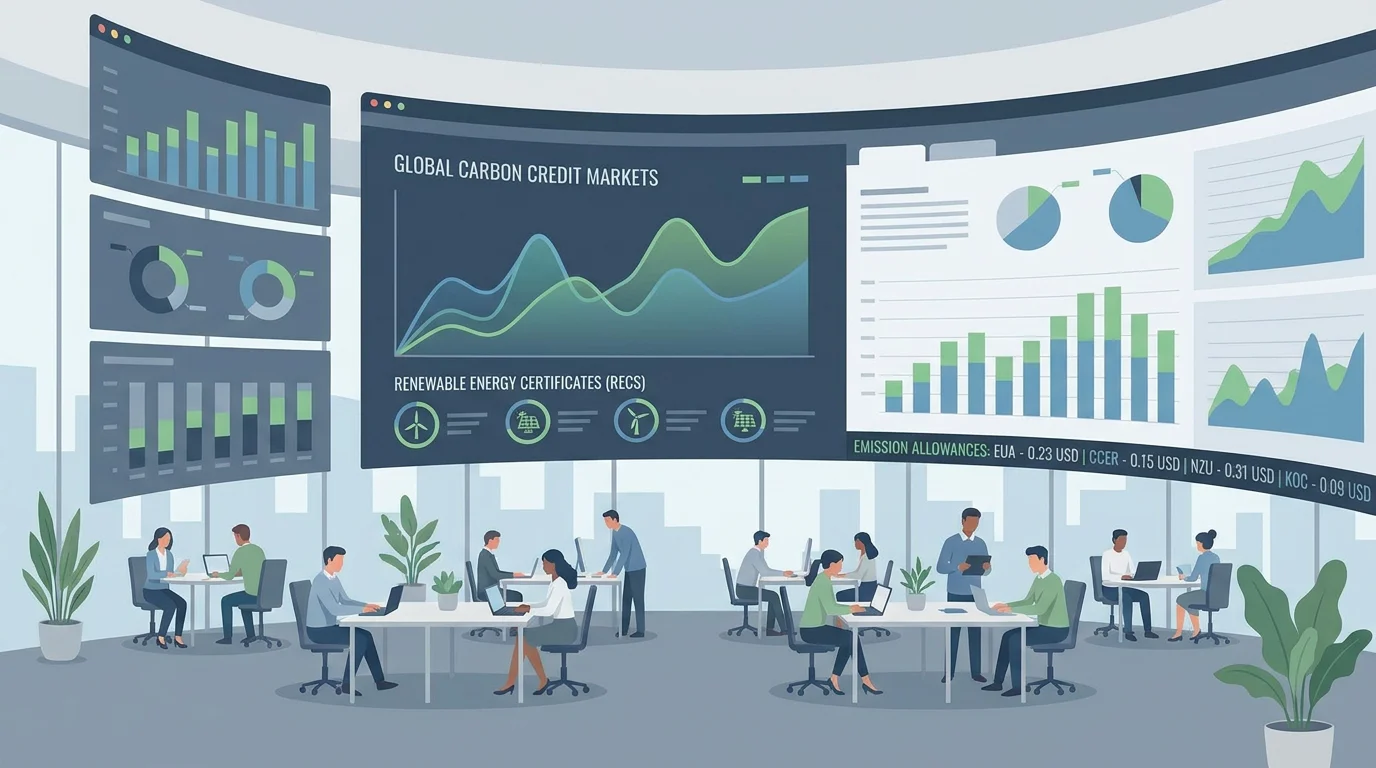
Thirty-eight emissions trading systems operate globally, with twenty additional schemes under development across Brazil, India, and Indonesia. Each new system creates demand for digital infrastructure that can handle auctions, secondary trading, and compliance reporting. India's intensity-based Carbon Credit Trading Scheme will fully operate by 2026 and cover nine industrial sectors, opening a new compliance venue for exchange operators.
Corporate sustainability commitments are equally powerful. As businesses increasingly set net-zero emissions targets and integrate ESG factors into their operations, the demand for carbon credits to offset emissions has surged. According to Fortune Business Insights, Europe dominated the carbon credit trading platform market with a market share of 38.47% in 2025, reflecting the maturity of the EU ETS and the regulatory density of European climate policy.
Technology is the third catalyst. Blockchain verification, API-driven automation, and digital measurement, reporting, and verification (MRV) tools are compressing timelines that once stretched for years. Automated MRV solutions shorten verification from 2.5 years to a matter of weeks by ingesting satellite, drone, and IoT sensor data directly into registry pipelines. Platforms that integrate these capabilities offer a tangible operational advantage.
Key Features That Define a Credible Trading Platform
Not every platform is built equally. When evaluating an environmental commodities exchange, five capabilities separate functional tools from genuine infrastructure.
Transparent Price Discovery
Live, visible pricing is foundational. Without it, participants cannot assess fair value or time their trades effectively. Many legacy systems obscure pricing behind broker intermediaries. For insight into this distinction, explore the difference between a broker vs exchange in commodity trading.
Pre-trade Risk Controls
Position limits, margin requirements, and automated alerts prevent costly errors before execution, not after. For compliance entities managing annual allowance obligations, this is not optional; it is operationally essential.
API Access and Automation
Manual order entry does not scale. Programmable interfaces let firms integrate carbon trading into existing risk management systems, automate procurement schedules, and react to market movements in real time.
Flexible Trade Sizes
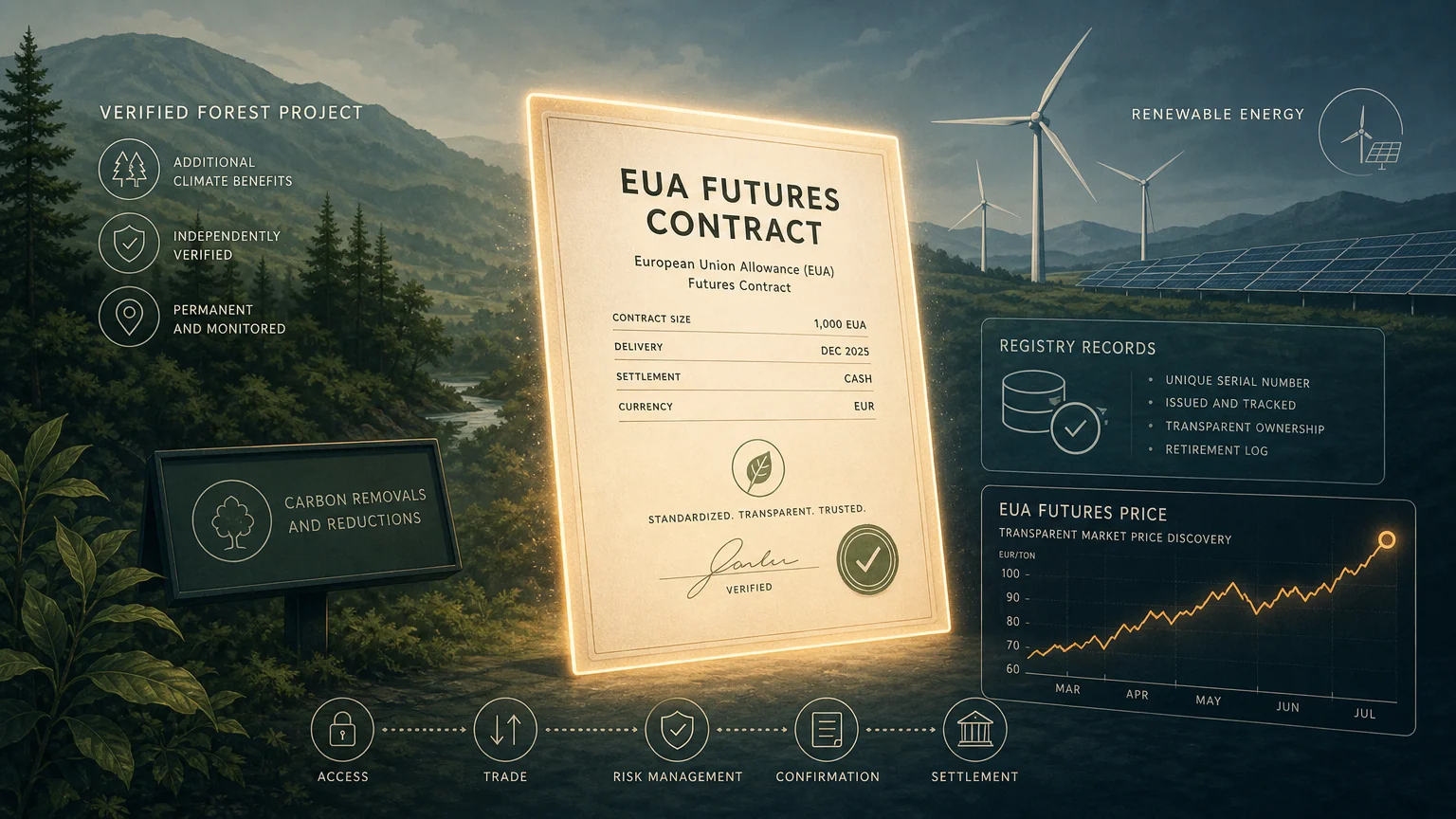
Traditional carbon exchanges require minimum lots of 1,000 EUAs, equivalent to 1,000 tonnes of CO₂. That threshold excludes smaller compliance entities and mid-market corporates. Platforms offering granular lot sizes open access to a broader set of participants.
Regulatory Compliance Infrastructure
Platforms serving compliance buyers must integrate registry updates, handle government auctions, and maintain rigorous audit trails aligned with statutory disclosure rules. MiFID II alignment, KYC/KYB onboarding, and clearing guarantees are baseline requirements in European markets.
How the EU ETS Shapes Platform Design
The EU Emissions Trading System remains the world's largest and most liquid compliance carbon market. Global ETS revenue climbed to $74 billion in 2023, according to data cited by Mordor Intelligence, with the EU ETS contributing a significant share. Any platform operating in this ecosystem must accommodate spot trading of EUAs, futures and options for hedging, and real-time connectivity to the European registry.
The compliance cycle creates predictable demand patterns. Emitters must surrender allowances annually, generating concentrated trading activity around surrender deadlines. Platforms that support scheduled procurement and configurable alerts help compliance teams avoid last-minute price spikes. Understanding these dynamics is critical; our overview of routes to market in carbon emissions trading provides additional context.
Smaller industrial emitters face a particular challenge. Many lack the capital or trading expertise to operate on legacy exchanges with high minimum lot sizes and complex onboarding. This structural gap is precisely what newer exchange models aim to close.
Comparing Environmental Commodities Trading Platforms
The market includes established exchanges, specialized brokers, and newer entrants. The table below compares key differentiators across several dimensions that matter most to active participants.
| Feature | Initiativ | Legacy Exchanges | OTC Brokers |
|---|---|---|---|
| Minimum trade size (EUAs) | 1 EUA | 1,000 EUAs | Varies (often 500+) |
| Live price transparency | Yes, real-time | Yes (delayed for non-members) | Quote-based only |
| API access | Yes | Yes (premium tiers) | Limited |
| Pre-trade risk controls | Built-in | Available | Manual |
| Instruments | Spot, futures, options | Spot, futures, options | Spot, forwards |
| Regulatory framework | MiFID II, FGDR guarantee | MiFID II / national regulators | Varies |
| Onboarding complexity | Streamlined KYC/KYB | High | Moderate |
Legacy exchanges offer deep liquidity and a long operational track record. OTC brokers provide relationship-driven execution and bespoke structuring. However, neither model was designed with mid-market accessibility or programmable exchange infrastructure in mind.
Why Accessibility Is the Next Frontier
Carbon markets have historically been built for large utilities and financial institutions. The standard 1,000 EUA lot size on established exchanges effectively sets a minimum transaction value of tens of thousands of euros. For small and mid-sized industrial emitters, this creates a structural barrier to efficient compliance.
The issue extends beyond lot sizes. Complex membership requirements, opaque fee structures, and limited trading hours all restrict participation. The multi-trillion-dollar global energy transition is creating significant trading, data, and new product opportunities for exchanges to channel investment into mitigation projects, new technologies, and alternative fuels. Capturing that opportunity requires platforms that serve the full spectrum of market participants, not just the largest ones.
We built our platform with this gap in mind. By enabling trades from 1 EUA, providing transparent live pricing, and offering competitive fees with extended trading hours, our trading platform for traders and corporates removes the barriers that have kept smaller participants on the sidelines. Cash deposits are protected and guaranteed up to €100,000 by the FGDR, adding a layer of security that OTC arrangements simply cannot match.
Technology Trends Reshaping the Landscape
Three technological shifts are converging to redefine what a carbon trading platform can deliver.
Blockchain and Digital Registries
Immutable ledgers reduce double-counting risk and provide auditable settlement trails. Immutable ledgers provide auditable trails that deter double counting, while smart-contract escrow functionality abstracts settlement risk. Several emerging markets, including Zimbabwe, have already launched blockchain-based registries.
AI-driven Analytics
Machine learning models can forecast allowance prices, optimize procurement schedules, and flag anomalous trading activity. As the World Federation of Exchanges has documented, technology integration is essential for scaling environmental commodity markets to the size the energy transition demands.
API-first Architecture
Modern participants expect to connect carbon trading systems to their existing ERP, treasury, and risk platforms. API-first design allows automated order routing, real-time position monitoring, and seamless reporting. This architecture is central to our vision of building a next-generation emissions exchange platform that works the way industrial firms actually operate.
Evaluating a Platform: A Practical Checklist
Before committing to any environmental commodities trading platform, run through these evaluation criteria.
- Regulatory status: Is the platform authorized under MiFID II or an equivalent framework? What clearing and custody arrangements are in place?
- Market coverage: Does it support the instruments you need (spot, futures, options) in the specific compliance markets you operate in?
- Minimum trade size: Can you trade in sizes that match your actual compliance or hedging needs, not just standard institutional lots?
- Price transparency: Is live pricing visible before you commit to a trade, or is it quote-driven and opaque?
- Integration capability: Does it offer API access that connects to your existing risk management and reporting systems?
- Cost structure: Are fees clearly stated? Watch for hidden spreads, membership charges, and data fees.
- Counterparty risk management: Does the platform use central clearing or a deposit guarantee to protect your capital?
A platform that checks all of these boxes does more than execute trades; it becomes a core component of your emissions management workflow.
The trajectory for environmental commodities trading platforms points clearly upward. Increasing regulatory pressure on companies to meet carbon emissions reduction targets, combined with stricter emissions caps, is driving businesses to seek cost-effective compliance through carbon credit trading platforms. New emissions trading systems in India, Brazil, and Indonesia will expand the addressable market significantly over the next five years. Meanwhile, voluntary markets, valued at $1.6 billion in 2025, are projected to grow to $47.5 billion by 2035 according to Roots Analysis, creating additional demand for robust trading infrastructure. The platforms that will win are those combining institutional-grade risk controls with genuine accessibility. We designed our exchange to deliver exactly that: the power of an exchange, available with a single click. To see how it works in practice, explore our new financial exchange for industrial commodity markets.
Frequently Asked Questions
What types of environmental commodities can be traded on a platform?
The most common instruments include carbon credits, emission allowances (such as EUAs in the EU ETS), Renewable Energy Certificates (RECs), and clean fuel credits. Some platforms also support water trading rights and recycled material certificates. The specific instruments available depend on the platform's regulatory scope and market focus.
How do compliance and voluntary carbon markets differ for platform users?
Compliance markets are driven by government-mandated caps on emissions, requiring companies to hold sufficient allowances. Voluntary markets let organizations offset emissions beyond regulatory requirements. Initiativ focuses on the EU ETS compliance market, offering spot, futures, and options trading on EU Allowances with trade sizes starting from just 1 EUA.
What should smaller companies look for in a carbon trading platform?
Flexible lot sizes, transparent pricing, and straightforward onboarding are the three most important factors. Many legacy exchanges require minimum trades of 1,000 allowances, which can represent a significant capital commitment. Platforms that allow smaller trade sizes, paired with real-time price visibility and pre-trade risk controls, make carbon markets accessible without sacrificing execution quality.