




Could an EUA trade near €150 per tonne by 2030, or could faster decarbonisation keep it materially lower? The answer depends on how you define the market and which assumptions you use. For a practical starting point, review our EUA price trends and forecasts through 2030, then test the outlook against supply, demand, regulation, and energy conditions.
If you search for “eua price forecast 2030”, you are usually asking for a planning range rather than a precise prediction. The European Commission’s 2025 analysis recorded ETS1 prices between €60 and €80 during 2025 and noted only modest futures increases through 2027, while policy decisions in 2026 could still change the longer-term path, according to the Commission analysis.
What does an EUA price forecast for 2030 actually measure?
An EUA forecast concerns the price of one European Union Allowance within the existing EU ETS, commonly called ETS1. Each allowance represents the right to emit one tonne of carbon dioxide equivalent, subject to the system’s compliance rules. The price reflects the balance between available allowances, expected emissions, hedging demand, policy ambition, and the cost of reducing emissions.
This distinction matters because ETS1 and ETS2 are separate markets. ETS1 covers established sectors such as power generation, energy intensive industry, aviation, and maritime transport. ETS2 is designed for road transport, buildings, and other sectors, and a 2026 European Parliament briefing says that it is expected to begin operating in 2028, rather than being treated as the same allowance market.
For compliance teams, the relevant question is usually how much procurement may cost over several years. For financial participants, the question may concern volatility, forward curves, liquidity, collateral, or the relationship between EUAs and energy markets. A useful forecast must therefore explain its assumptions instead of presenting a single number without context.
Our EUA price forecasts and trading insights can help frame that analysis around spot prices, derivatives, market structure, and trading decisions. The forecast itself remains an analytical input, not a guarantee of future performance.
What range is plausible for EUA prices in 2030?
A practical 2030 planning range for ETS1 is approximately €90 to €150 per tonne, with meaningful downside and upside risks around it. This range should not be read as a guaranteed market target. It combines the direction of current policy, the continuing reduction in allowance supply, and published financial market scenarios.
ABN AMRO’s 2026 scenario work places its baseline EUA price near €145 per tonne in 2030. Its analysis also shows that faster technological progress and lower demand could produce a materially lower outcome, while weaker transition progress and stronger allowance demand could push prices higher.
Other official modelling can produce different values because it uses different assumptions about economic growth, fuel prices, emissions, technology costs, market stability rules, and the future structure of the EU ETS. This is why a forecast range is more useful for procurement and risk planning than one headline estimate.
The most useful interpretation is scenario based:
- Lower price scenario: faster emissions reductions, weaker industrial demand, more effective abatement technologies, or additional compliance flexibility.
- Base scenario: continued cap tightening, steady industrial activity, gradual decarbonisation, and no major dilution of scarcity mechanisms.
- Higher price scenario: delayed transition investment, stronger industrial output, constrained allowance supply, or stricter market stability rules.
In 2026, these scenarios should be updated as new regulatory decisions become clearer. A 2030 target created before the 2026 EU ETS review may not remain suitable for long-term procurement planning.
Which forces could push EUA prices higher?

Supply is the first structural driver. The EU ETS cap declines over time, which limits the number of allowances available to covered installations. When emissions do not fall as quickly as the cap, compliance buyers and financial participants compete for a smaller pool of allowances.
The Market Stability Reserve can reinforce this effect by removing allowances when the market carries a large surplus. Its future operation is particularly important because changes to thresholds, intake rates, release rules, or invalidation could alter the amount of supply available to the market.
Free allocation and the Carbon Border Adjustment Mechanism also matter. As free allocation changes over time, some industrial companies may need to purchase a greater share of their compliance position. That can increase demand, although the effect will vary by sector, emissions intensity, production levels, and exposure to international competition.
Policy ambition is another source of upward pressure. The European Commission stated in 2026 that its proposed ETS revision would update rules on free allocation and CBAM, strengthen provisions for aviation and maritime transport, and gradually extend coverage to additional areas. Those changes could affect both expected demand and the perceived scarcity of EUAs.
Energy prices can amplify these structural effects. When gas becomes relatively expensive compared with coal, power producers may shift their fuel mix, increasing emissions and EUA demand. When renewable generation is strong or industrial output weakens, demand can fall. This is why our EU ETS and energy market price drivers analysis treats carbon, power, gas, coal, weather, and industrial activity as connected variables.
What could keep the 2030 price below bullish forecasts?
Higher prices are not inevitable in a straight line. A faster transition can reduce emissions more quickly than expected, lowering the number of allowances required for compliance. Strong renewable generation, improved energy efficiency, electrification, fuel switching, and industrial production cuts can all reduce near-term demand.
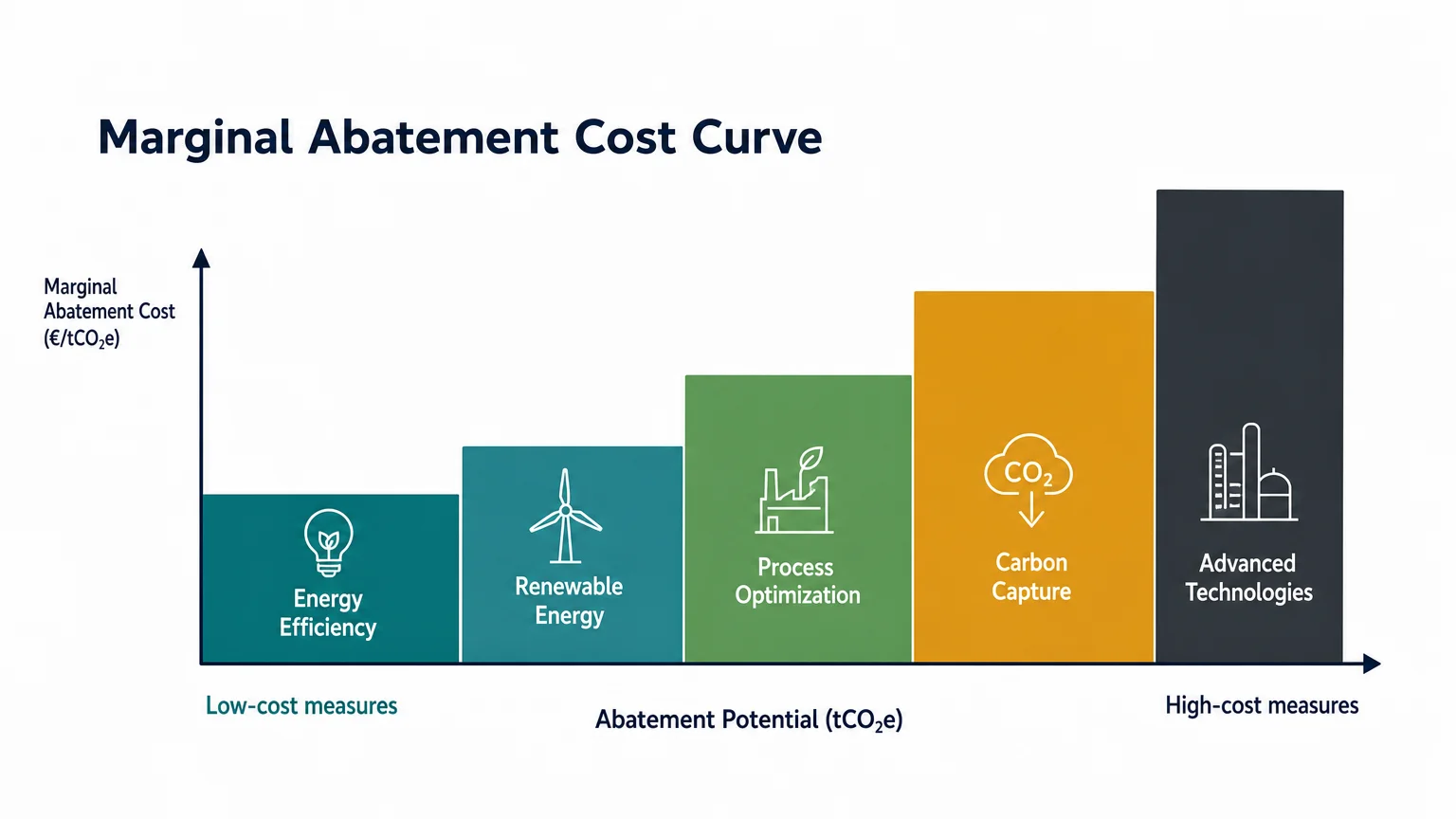
Technological progress can also change the market balance. If low carbon technologies become cheaper and easier to deploy, companies may reduce emissions without purchasing as many additional EUAs. This can moderate prices even while the regulatory cap continues to tighten.
Carbon removals or other future compliance options could have a similar effect if they are introduced in a form that reduces demand for allowances. However, the impact would depend on eligibility rules, available volumes, monitoring standards, and the cost of each removal technology.
Market linkage is another variable. Linking the EU and UK emissions trading systems could improve liquidity and create access to a broader allowance pool. Depending on the relative scarcity of each system, that could lower or raise EUA prices. The direction would depend on the final design, timing, and treatment of cross market compliance.
Macroeconomic conditions remain important in 2026. The European Commission noted that recent EUA prices had already moved through a wide range, while forward market liquidity beyond the near term remained limited. That means the market may react sharply to changes in growth expectations, energy prices, policy announcements, and industrial production.
How should businesses use an EUA forecast?
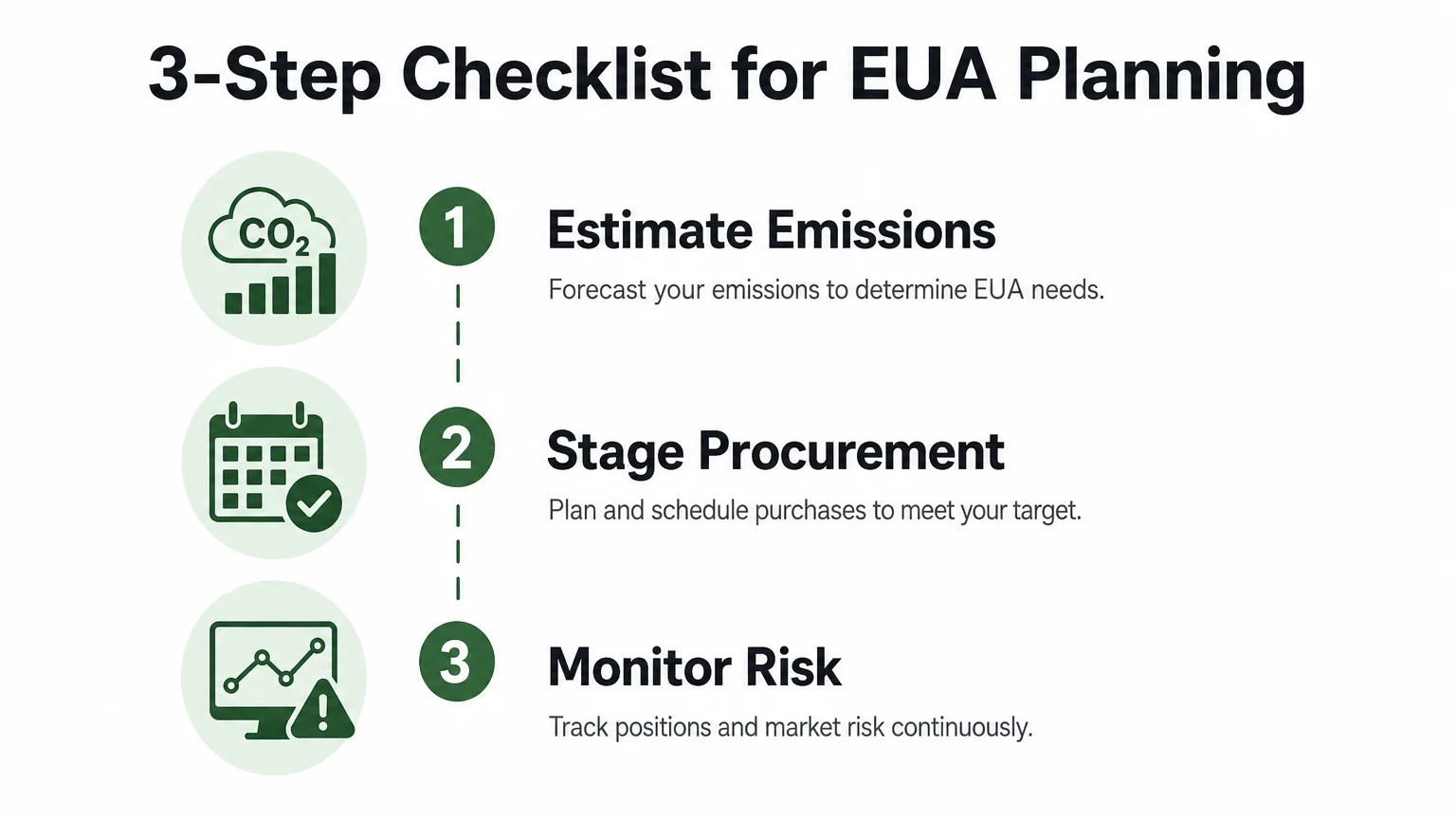
A forecast becomes useful when it supports a decision. A compliance buyer should first estimate expected emissions, existing allowance holdings, free allocation, procurement timing, and acceptable budget risk. The next step is to test that position against several price paths rather than relying on one annual average.
A simple planning framework can include three questions:
- What volume is required? Estimate annual emissions and separate confirmed compliance needs from discretionary inventory.
- When should procurement occur? Compare immediate purchases, staged buying, forward contracts, and options against liquidity and collateral requirements.
- What would invalidate the plan? Define triggers linked to policy changes, energy prices, production levels, allowance balances, and market volatility.
Professional market participants may also need a more detailed operating process. That can include position limits, pre trade controls, price alerts, order type selection, margin requirements, post trade reporting, and settlement procedures.
For teams managing these workflows, our ETS trading price trends and forecasts connect the market outlook with practical execution considerations. This is particularly relevant when procurement is shared across a trading desk, compliance function, treasury team, or corporate risk department.
What does the forecast mean for traders and compliance teams?
For compliance entities, a higher 2030 EUA price increases the value of disciplined procurement. Delaying every purchase until the compliance deadline can create concentration risk, especially if prices rise during a period of stronger industrial demand or tighter supply.
For traders, the opportunity is not simply to predict direction. It is to understand how policy announcements, energy spreads, auction volumes, market stability rules, and industrial data may change volatility and liquidity. Spot, futures, and options can serve different purposes, but each introduces separate execution, margin, and risk considerations.
For corporate teams, governance is equally important. A forecast should be connected to documented limits, approval rules, position reporting, and a clear distinction between hedging and speculative activity. Transparent market information can improve decisions, but it does not remove market risk.
The central lesson is that the 2030 EUA market should be managed as a changing policy and commodity market. The most resilient approach combines scenario analysis, staged procurement, live monitoring, and the ability to adjust as new information arrives.
Conclusion: plan around scenarios, not certainty
The 2030 EUA price forecast is best understood as a range shaped by allowance scarcity, EU ETS reform, industrial demand, energy markets, technology costs, and market design. A base case around €90 to €150 per tonne can support initial planning, but current 2026 policy uncertainty justifies wider stress scenarios. If you are managing exposure, update assumptions regularly and connect every forecast to a defined procurement or risk decision.
Take action with Initiativ
Forecasts are most useful when you can connect them to execution, monitoring, and risk controls. If your organisation trades EUAs or manages compliance procurement, the next step is to evaluate how your market access and operating workflow support your objectives.

We provide EU ETS trading for traders and corporates, including EUA spot and derivatives access, live price monitoring, configurable alerts, pre trade risk controls, API connectivity, position visibility, and reporting workflows. Professional participants can use the platform for procurement, trading, team access management, and post trade processes.
Frequently Asked Questions
What is the most likely EUA price in 2030?
There is no single reliable target, but a broad planning range of €90 to €150 per tonne is reasonable for current 2026 scenario analysis. Actual prices could move below or above that range if policy, industrial demand, energy markets, or technology adoption differ from expectations.
Is the EUA forecast the same as the ETS2 forecast?
No. EUA prices refer primarily to the existing ETS1 market, while ETS2 is a separate system covering additional sectors such as road transport and buildings. Their launch dates, supply rules, demand drivers, and price dynamics are different.
Why can forecasts from banks and official institutions differ?
Forecasts use different assumptions about emissions, economic growth, energy prices, allowance supply, technology costs, and market regulation. Comparing the assumptions behind each scenario is more useful than comparing headline prices alone.
How can a company prepare for higher EUA prices?
A company can estimate future emissions, review allowance holdings, stage procurement, and define risk limits before prices move. It should also monitor regulatory changes, energy markets, industrial output, and the cost of available abatement options.
Can professional teams manage EUA trading through one platform?
Our platform supports professional EUA spot and derivatives trading, live price monitoring, API access, risk controls, team permissions, position views, reporting, confirmation, and settlement workflows. Eligibility remains subject to onboarding, KYC and KYB requirements, and professional client qualification under MiFID II.



Let’s connect
Do you want more information about what we do?