

Summary: Demo trading uses virtual funds to simulate real market conditions, helping traders build skills before risking capital; fewer than 13% of day traders stay profitable short-term.
Fewer than half of active traders finished 2025 in profit. That is a sobering figure for anyone considering the leap from watching markets to participating in them. The concept of demo trading exists precisely to bridge this gap: it provides a risk-free environment where beginners and experienced traders alike can refine strategies, test platforms, and build confidence before committing real capital.
The global online trading platform market is expanding rapidly, and more participants than ever are entering financial markets through digital tools. Yet the data makes clear that preparation separates those who survive from those who do not. Understanding how to practice trading effectively, and what to look for in a demo environment, can dramatically change your trajectory as a trader or as a compliance entity navigating specialized markets like carbon emissions.
What Is a Demo Trading Account?
A demo trading account is a simulated environment provided by a broker or exchange that replicates live market conditions using virtual funds. You can place orders, track price movements, and manage positions without any financial risk. The experience mirrors a live account in most respects: real-time data feeds, charting tools, and order types all function as they would in production.
The primary purpose is education. New traders learn how an order book works, how spreads fluctuate, and how slippage can affect execution. Experienced traders, on the other hand, use demo accounts to test new strategies or familiarize themselves with an unfamiliar platform before switching providers.
There are important limitations. Most demo environments do not account for slippage under volatile conditions, and the psychological pressure of risking real money is absent. Interest, dividend adjustments, and out-of-hours price movements may also behave differently. Keep these differences in mind as you transition from practice to live execution.

Why Practicing With Virtual Funds Matters
The statistics on trader profitability are stark. Most studies show that only 10 to 13% of day traders are profitable in the short term, and less than 1% remain profitable over five years. According to a BrokerChooser report, less than half (47.86%) of day traders analyzed made a profit in 2025.
These figures underscore a single point: entering live markets without preparation is a recipe for losses. A paper trading environment lets you make mistakes, ones that would cost real money, in a consequence-free setting. You learn which order types suit your approach, how position sizing affects your overall exposure, and whether your strategy holds up under various market conditions.
Beyond individual skill-building, demo accounts also serve institutional needs. Compliance teams can test workflows for regulated markets, treasury desks can rehearse procurement schedules, and IT departments can validate API integrations before go-live. For organizations exploring how commodity markets work, practicing in a sandbox environment reduces operational risk significantly.
Key Features to Look for in a Demo Environment
Not all demo accounts are created equal. The value you extract depends on how closely the simulated environment mirrors live conditions. Here are the critical features to evaluate:
- Real-time market data: The demo should stream live prices, not delayed or synthetic data. Without accurate pricing, any strategy backtesting is unreliable.
- Full order-type support: Limit orders, stop-losses, and market orders should all be available. Some platforms restrict functionality in demo mode, which limits learning.
- Pre-trade risk controls: The ability to set position limits and risk parameters in the demo mirrors what you will need in production.
- API access: For firms automating execution or integrating with risk systems, the demo environment must support the same API endpoints as the live platform.
- Configurable account balance: Adjusting virtual capital to match your actual intended account size produces more realistic results.
We designed our demo environment with these exact criteria in mind. Through our trading platform for traders and corporates, you can access a full simulation of the EU Allowances exchange, including spot, futures, and options, before committing to live execution.
The Online Trading Market Is Growing; Preparation Must Keep Pace
The global online trading market is forecast to increase at a compound annual growth rate of 6.4%, reaching an estimated $13.3 billion in 2026, up from a base of around $10.21 billion in 2022, according to Statista. A separate Research and Markets report projects growth from $11.97 billion in 2025 to $13.02 billion in 2026 at an 8.7% CAGR.
This expansion is fueled by several factors: rising retail participation, lower barriers to entry through mobile apps, and broader internet penetration. During the 2020 COVID lockdowns, platforms saw record sign-ups; in the U.S. alone, more than 10 million brokerage accounts were opened that year. The influx of new participants has not slowed, and many of them arrive with limited experience.
As the market grows, so does the number of traders who skip foundational preparation. A well-structured trading simulator bridges this gap. It transforms an abstract understanding of markets into a practical, hands-on skill set that reduces costly early mistakes.
Demo Trading for Specialized Markets: Carbon and Emissions
Demo accounts are not limited to equities, forex, or crypto. Specialized markets, such as the EU Emissions Trading System (EU ETS), present unique challenges that make simulation even more valuable. The EU ETS involves compliance obligations, specific contract sizes, and regulatory requirements under MiFID II that are unfamiliar to most newcomers.
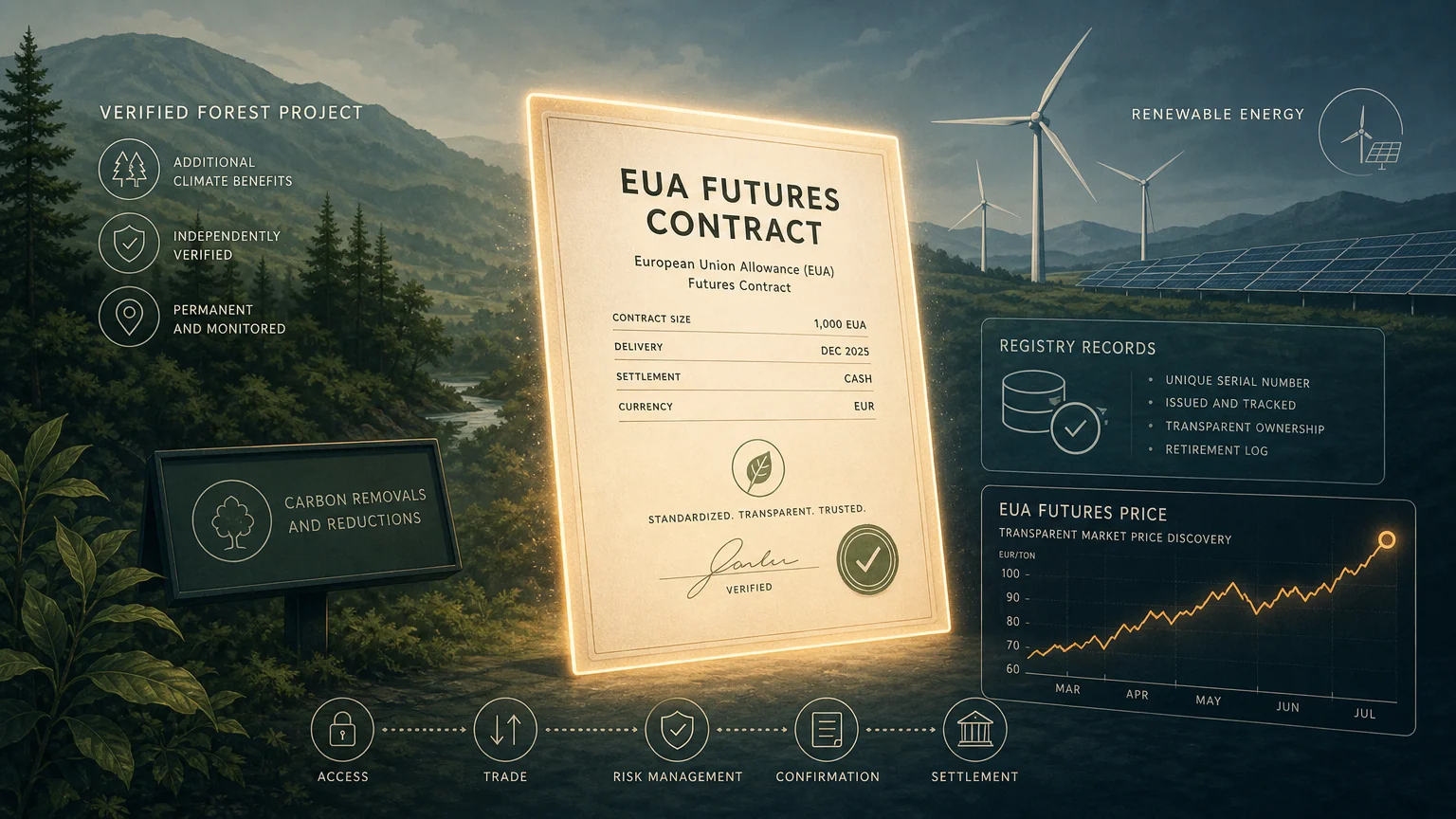
Traditionally, participants in carbon markets had to trade in large lot sizes (1,000 EUAs, equivalent to 1,000 tonnes of CO₂). This created a high barrier for smaller compliance entities and new professional participants. Practicing in a demo environment that reflects these exact market conditions, including smaller trade sizes, live pricing, and the full contract lifecycle, allows organizations to onboard with confidence.

Understanding routes to market in emissions trading is essential before committing capital. A demo lets you explore how spot and futures orders execute, how margins work, and how the compliance calendar affects pricing, all without financial exposure.
Common Mistakes Traders Make in Demo Mode
A demo account is only as useful as the discipline you bring to it. Many traders fall into predictable traps that undermine the entire exercise.
Overtrading without a plan. The absence of real risk encourages reckless behavior. If you would not place a trade with real capital, do not place it in the demo. The most frequent mistakes among traders include overtrading, poor risk management, and emotional decision-making.
Ignoring position sizing. Trading with an unrealistic virtual balance ($100,000 when you plan to deposit $5,000) creates a false sense of what is achievable. Scale your virtual capital to match your intended live account.
Skipping the transition plan. Many traders practice for weeks, feel confident, and then switch to live trading overnight. A better approach is to reduce virtual position sizes gradually, then start live trading at a fraction of your demo volume.
Not testing risk controls. Use the demo to configure stop-losses, alerts, and position limits. These tools protect your capital in live markets, so practice using them until they become reflexive.
How to Transition From Demo to Live Trading
The shift from simulated to real execution is where most traders stumble. The psychological difference is enormous: watching a position move against you when actual money is at stake triggers emotional responses that demo accounts cannot replicate.
A structured transition helps. Start by documenting your demo performance over at least 30 to 50 trades. Look for consistency in your win rate, average gain versus average loss, and adherence to your trading rules. If the numbers are not positive and consistent, you are not ready.
When you do go live, trade the smallest position sizes available. In many markets, this still means significant lot sizes, but platforms are evolving. We offer trading from 1 EUA (equivalent to 1 tonne of CO₂), compared to the traditional 1,000 EUA lot, so you can enter live markets with minimal exposure while you build experience. Understanding the broker vs exchange differences is also important at this stage, since it affects your execution path and cost structure.
Journal every live trade. Compare your live results against your demo performance. Discrepancies will reveal where psychology, slippage, or execution speed is affecting outcomes. Adjust your plan accordingly.
Choosing the Right Platform for Demo and Live Trading
The best demo environment is one that matches your live trading needs exactly. This means the same instruments, the same order types, the same risk controls, and the same API endpoints. Switching platforms between demo and live stages introduces unnecessary friction and learning curves.
Consider these factors when evaluating platforms:
| Feature | What to Look For | Why It Matters |
|---|---|---|
| Market coverage | Instruments you plan to trade (equities, FX, commodities, carbon) | Demo practice is only relevant if it covers your target market |
| Data quality | Real-time, not delayed feeds | Strategy testing requires accurate pricing |
| Risk tools | Pre-trade controls, alerts, stop-losses | Builds good habits before live exposure |
| API support | Same endpoints in demo and live | Automated strategies must be tested identically |
| Minimum trade size | Small lots available for live trading | Enables gradual transition from demo to live |
| Transparency | Live price visibility, clear fee structure | Reduces surprises when switching to real money |
For traders and compliance entities active in EU carbon markets, direct market access explained in the context of emissions trading can help clarify how your orders reach the exchange and what execution advantages you gain.
Frequently Asked Questions
How long should I practice in a demo account before going live?
There is no universal timeline, but most trading educators recommend completing at least 30 to 50 trades while maintaining a consistent, positive track record. Focus on process over duration: if your risk management is disciplined and your results are repeatable, you are closer to being ready.
Can demo trading help me learn about carbon markets?
Yes. Specialized demo environments simulate the exact conditions of markets like the EU ETS, including contract types, lot sizes, and compliance workflows. We offer a dedicated demo environment that mirrors our live exchange for EU Allowances, making it straightforward to learn before committing capital.
Is there a difference between a demo account and paper trading?
The terms are often used interchangeably. Both refer to simulated trading with virtual funds. Some platforms call it a "virtual portfolio" or "trading simulator." The core concept is the same: you practice without financial risk, using real or near-real market data.
The data is unambiguous: demo trading is not a luxury; it is a necessity. Research from the University of California indicates that only 13% of traders managed to maintain consistent profitability over six months, which makes the case for rigorous preparation before going live. Whether you trade equities, forex, or carbon allowances, a structured practice phase protects your capital and accelerates your learning curve. Our exchange platform combines transparent pricing, small trade sizes, and pre-trade risk controls to help you transition from simulation to live markets with confidence. Get access today to our demo environment and see how practice can transform your trading outcomes.