



What looks like one number can represent several different markets. Dutch natural gas prices may describe a day-ahead quote, a month-ahead contract, a seasonal future, or a retail tariff. For a clear starting point, our TTF gas prices resource explains the benchmark behind most European wholesale references.
For anyone monitoring dutch natural gas prices, the most important distinction is between the Dutch TTF hub and the specific contract being quoted. The IEA Q3 report recorded a TTF average of nearly $16 per million British thermal units in the second quarter of 2026, 32% above the second quarter of 2025, showing how quickly regional prices can change.
What Dutch natural gas prices actually measure
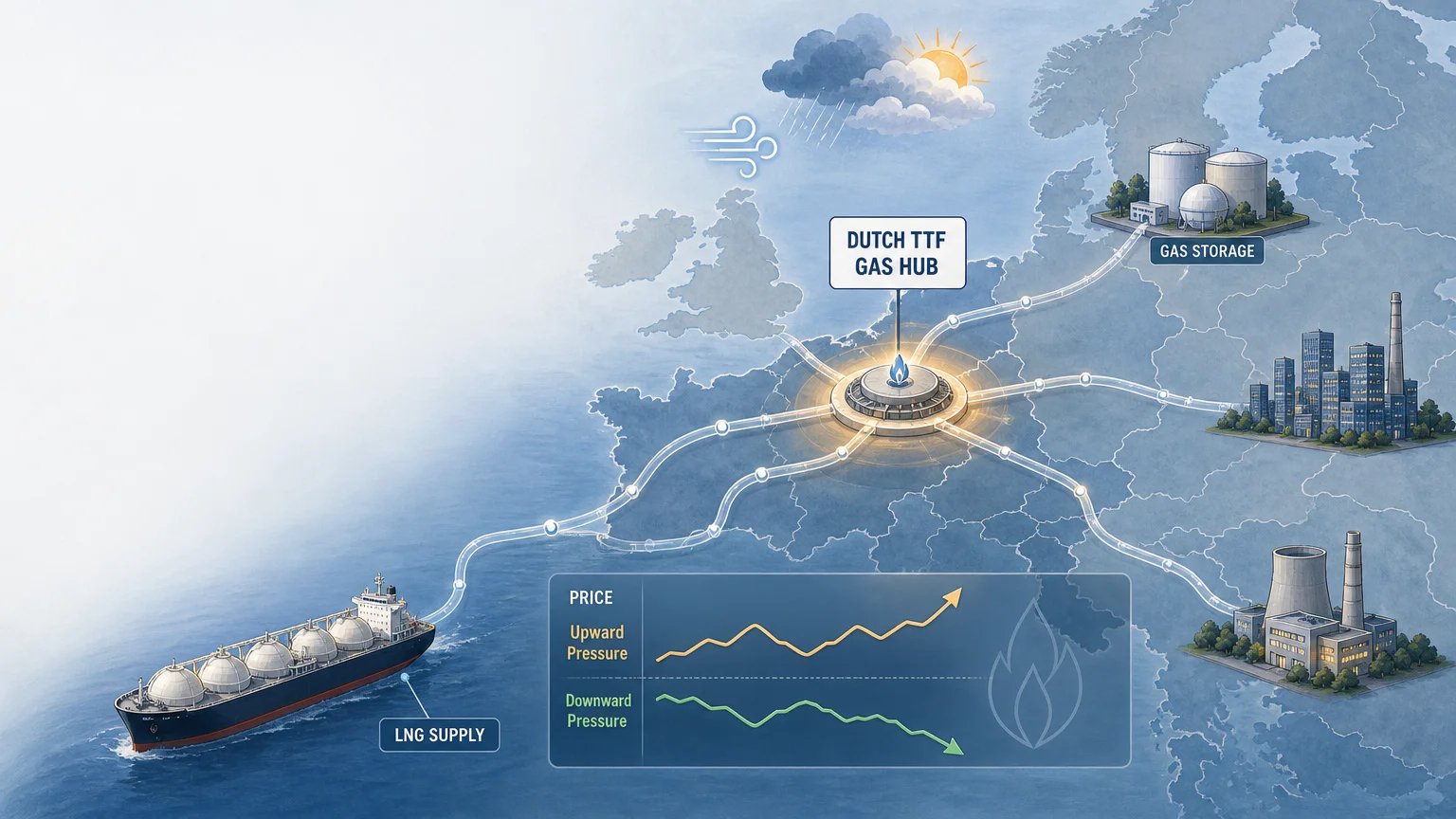
Dutch natural gas prices generally refer to the Title Transfer Facility, or TTF. TTF is a virtual trading point within the Dutch gas network. Market participants exchange rights to gas already held in the system, rather than trading gas at a single physical warehouse or pipeline location.
The benchmark is widely used because it connects Dutch infrastructure with the broader European gas market. It reflects expectations about supply, demand, storage, transport capacity, weather and global LNG competition. A TTF quote can therefore influence procurement costs well beyond the Netherlands.
In 2025, roughly 80% of European gas trading took place on TTF, according to Gasunie’s 2025 report. That scale helps explain why TTF is used as a reference for wholesale contracts, hedging programs, power generation assumptions and industrial purchasing decisions.
The quoted unit is normally euros per megawatt-hour, written as €/MWh. This is an energy price, not a household price per cubic metre. Converting it into a retail gas bill requires additional assumptions about gas quality, distribution charges, taxes, supplier margins, exchange rates and consumption volume.
How high are Dutch TTF prices in 2026?
As of September 11, 2026, the latest available market snapshot in the research material placed European gas at approximately €79.73/MWh. The snapshot showed a daily decline of 2.82%, while the price remained substantially above its level one year earlier.
This figure should be treated as a dated market reference, not as a universal or continuously executable price. Data providers may display delayed prices, CFD references, exchange futures or indicative quotes. The contract month also matters, because October 2026, winter 2026, annual 2027 and longer-dated contracts can trade at different levels.
The wider 2026 context has been volatile. The IEA reported that TTF and Asian LNG benchmarks reached their highest second-quarter averages since 2022. It also noted that changing price spreads encouraged some flexible LNG cargoes to move between Europe and Asia.
For companies purchasing gas, this means that the headline price is only one part of the decision. The relevant question is whether you need immediate physical supply, protection against winter risk, a fixed forward price, or flexibility to respond to changing consumption.
Why storage, LNG, weather and geopolitics move TTF prices
Storage is one of the clearest indicators of European gas market tension. When inventories are low ahead of winter, buyers compete more aggressively for injections and future supply. When storage is comfortable, the market can absorb temporary disruptions with less upward pressure.
According to Gasunie’s 2026 update, Dutch gas storage was 5% full at the end of the winter season on March 31, 2026, and 26% full on June 30, 2026. The same report stated that storage levels remained below the comparable points in 2025.
LNG availability adds a global dimension. Europe competes with Asian buyers for flexible cargoes, especially when pipeline supply is constrained. Shipping costs, liquefaction outages, canal access, vessel availability and regional weather can all change the destination that offers the best commercial return.
Weather affects both sides of the market. A cold winter increases heating demand and storage withdrawals. A hot summer can increase electricity demand for cooling, while low wind or reduced nuclear output may increase gas-fired power generation. These effects can tighten the market even outside the traditional heating season.
Geopolitical events can amplify every other driver. A disruption affecting a major pipeline, LNG route or producing region can change forward expectations immediately. The market may price a risk premium before physical volumes are materially lost, particularly when storage buffers are already limited.
Why spot prices and futures prices can differ

A spot or near-term quote describes gas for prompt delivery. A futures quote reflects the market’s expectation for a defined delivery period. The difference between them is not necessarily an error. It may reflect storage economics, seasonal demand, interest costs, transport constraints, risk premiums and expectations about future supply.
For example, a winter contract can trade above a summer contract when traders expect stronger heating demand or tighter storage conditions. The curve can also invert when immediate supply is scarce and the market expects conditions to improve later.
Futures are used by industrial buyers, utilities, producers, banks and trading firms to manage price exposure. A buyer may accept a higher forward price to reduce uncertainty, while another participant may prefer open exposure because it expects prices to fall.
The choice between spot and futures therefore depends on the underlying risk. A compliance or procurement team may prioritise budget certainty. A trading desk may focus on liquidity, volatility, curve shape and optionality. Neither approach is automatically suitable for every organisation.
When your analysis includes emissions costs, the relationship becomes more complex. Our guide to EU ETS and energy markets explains why carbon allowance prices can influence the economics of gas-fired power generation and broader energy procurement decisions.
How to read Dutch natural gas price data correctly
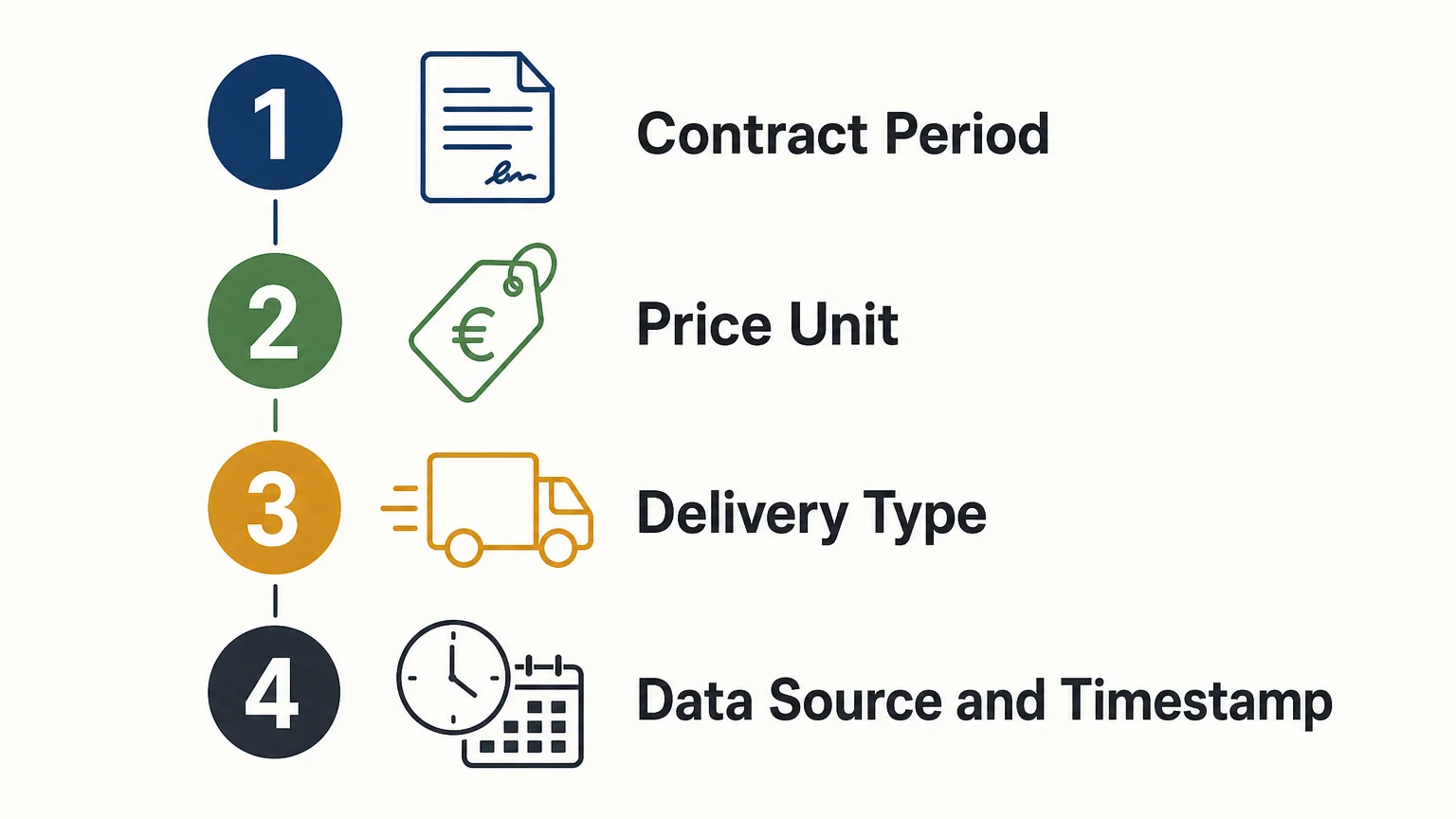
Before comparing two quotes, check four details: the contract period, the unit, the delivery basis and the timestamp. A price for October 2026 cannot be compared directly with a year-ahead contract without considering the different risk and delivery assumptions.
You should also identify whether the quote is an exchange settlement, an OTC assessment, a CFD reference or an indicative retail display. These formats may use different liquidity pools, update schedules and methodologies. Some providers publish delayed information, while others show a tradable bid, offer or last price.
National statistics can help explain the physical market, but they do not replace a wholesale benchmark. The Dutch government dataset distinguishes average prices paid by end users from wholesale market pricing. It also notes that household and industrial prices include supply and network components.
Historical comparisons require the same discipline. A 2022 crisis peak, a 2025 average and a September 2026 front-month quote answer different questions. Always state the date, frequency and contract type when reporting a price series.
For professional users, it is also useful to monitor volume, open interest, bid and offer depth, settlement conventions and margin requirements. These details can matter more than a single headline number when a position must be executed at scale.
What Dutch gas prices mean for corporate procurement and trading
Corporate buyers usually begin with physical exposure. They may need gas for manufacturing, heating, power generation or resale. The challenge is to decide how much exposure to secure, when to secure it and which contract structure best matches operational needs.
A procurement process can combine fixed-price purchases, indexed contracts, layered hedging and flexible volume provisions. The appropriate balance depends on consumption predictability, credit capacity, risk limits and the organisation’s tolerance for price movements.
Trading firms and financial participants approach the market differently. They may analyse the forward curve, seasonal spreads, volatility, cross-market relationships and event risk. Their needs often include reliable execution, order controls, position visibility, reporting and integration with existing risk systems.
Our commodity markets coverage provides broader context for participants comparing energy, emissions and other contracts. For a professional trading operation, the objective is not simply to observe a quote. It is to connect market information with authorised execution, exposure monitoring and post-trade controls.
In both cases, the key principle is consistency. Use the same benchmark, contract definition and timestamp across procurement analysis, internal reporting and risk decisions. This reduces the chance that a nominal price difference is mistaken for a genuine market opportunity.
What to remember about Dutch natural gas prices
Dutch natural gas prices are best understood through the TTF benchmark, the delivery period and the data methodology behind each quote. In 2026, storage conditions, LNG competition, weather and geopolitical risks have kept European gas markets sensitive to sudden changes. A responsible analysis therefore identifies the contract, unit, timestamp and source before drawing conclusions. For procurement and trading teams, the most useful price is the one that matches the exposure being managed.
Take action with Initiativ
When Dutch TTF prices affect procurement, compliance or trading decisions, you need more than a headline quote. You need a controlled process for observing the market, assessing exposure and executing within defined operational limits.
We provide energy and environmental commodity trading for corporates, with access to EU Allowance spot and derivatives markets, live price monitoring, configurable alerts, pre-trade risk controls, API connectivity, position management and reporting workflows. Professional eligibility, onboarding and applicable market requirements remain part of the process.
Frequently Asked Questions
What are Dutch natural gas prices?
Dutch natural gas prices usually refer to wholesale prices at the Dutch Title Transfer Facility, or TTF. They are commonly quoted in euros per megawatt-hour and can describe different spot or futures delivery periods.
Why is TTF important for Europe?
TTF is a major virtual trading hub connected to the wider European gas network. Its liquidity and broad use make it a reference point for procurement contracts, hedging, power generation and market analysis.
Why can two TTF prices differ?
Two quotes may represent different delivery months, trading venues or data methodologies. They may also differ because one is an exchange price while another is an OTC assessment, CFD reference or delayed indicative quote.
Which factors affect TTF prices in 2026?
Storage levels, LNG availability, weather, pipeline flows, electricity demand and geopolitical developments are major influences. The balance between European buyers and Asian LNG demand can also affect the price of flexible cargoes.
Can Initiativ support professional energy market participants?
Yes. Initiativ supports professional participants with EU Allowance spot and derivatives access, market monitoring, risk controls, API connectivity, position management, reporting and related trading workflows, subject to onboarding and eligibility requirements.
This may interest you


Let’s connect
Do you want more information about what we do?