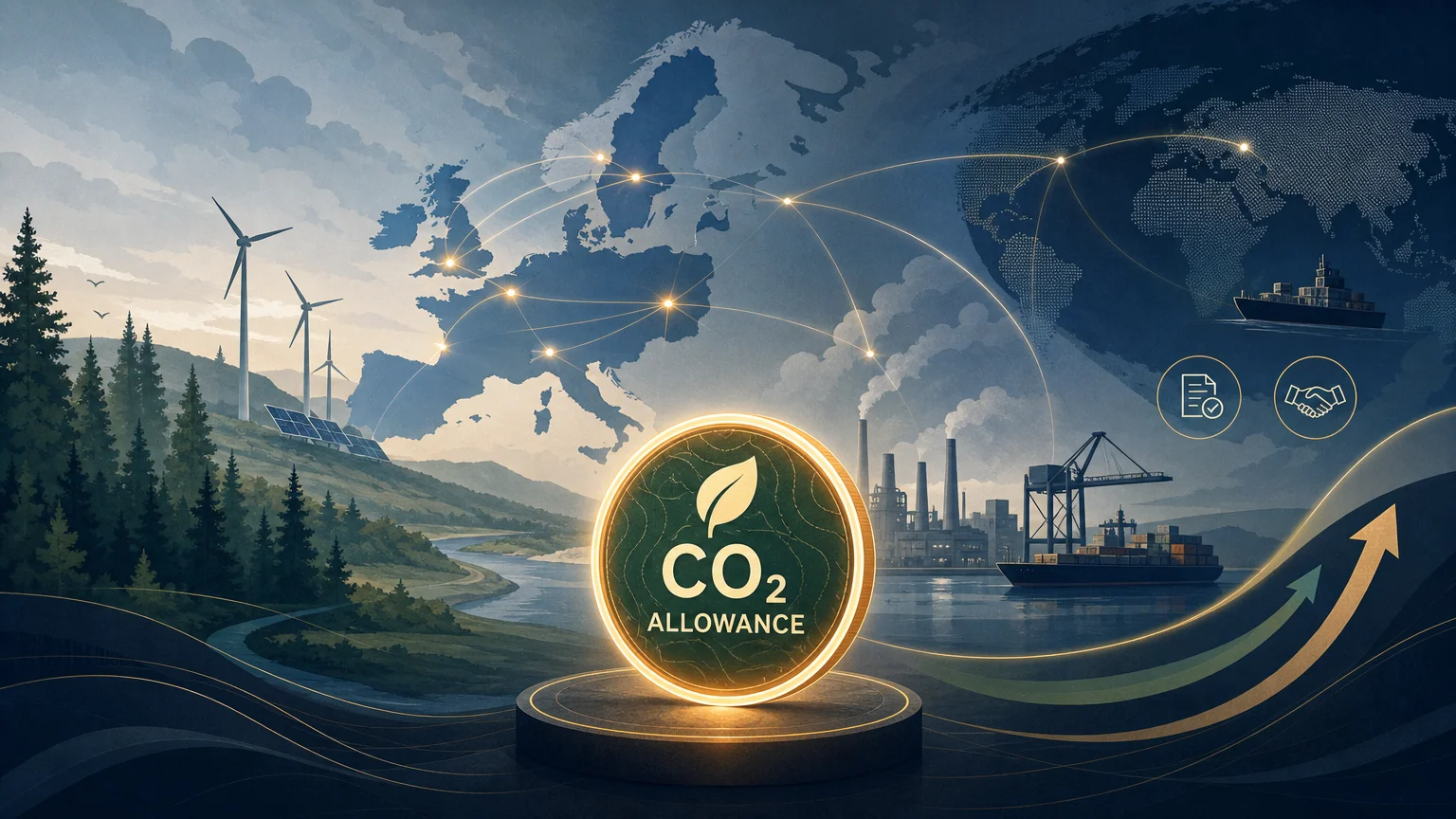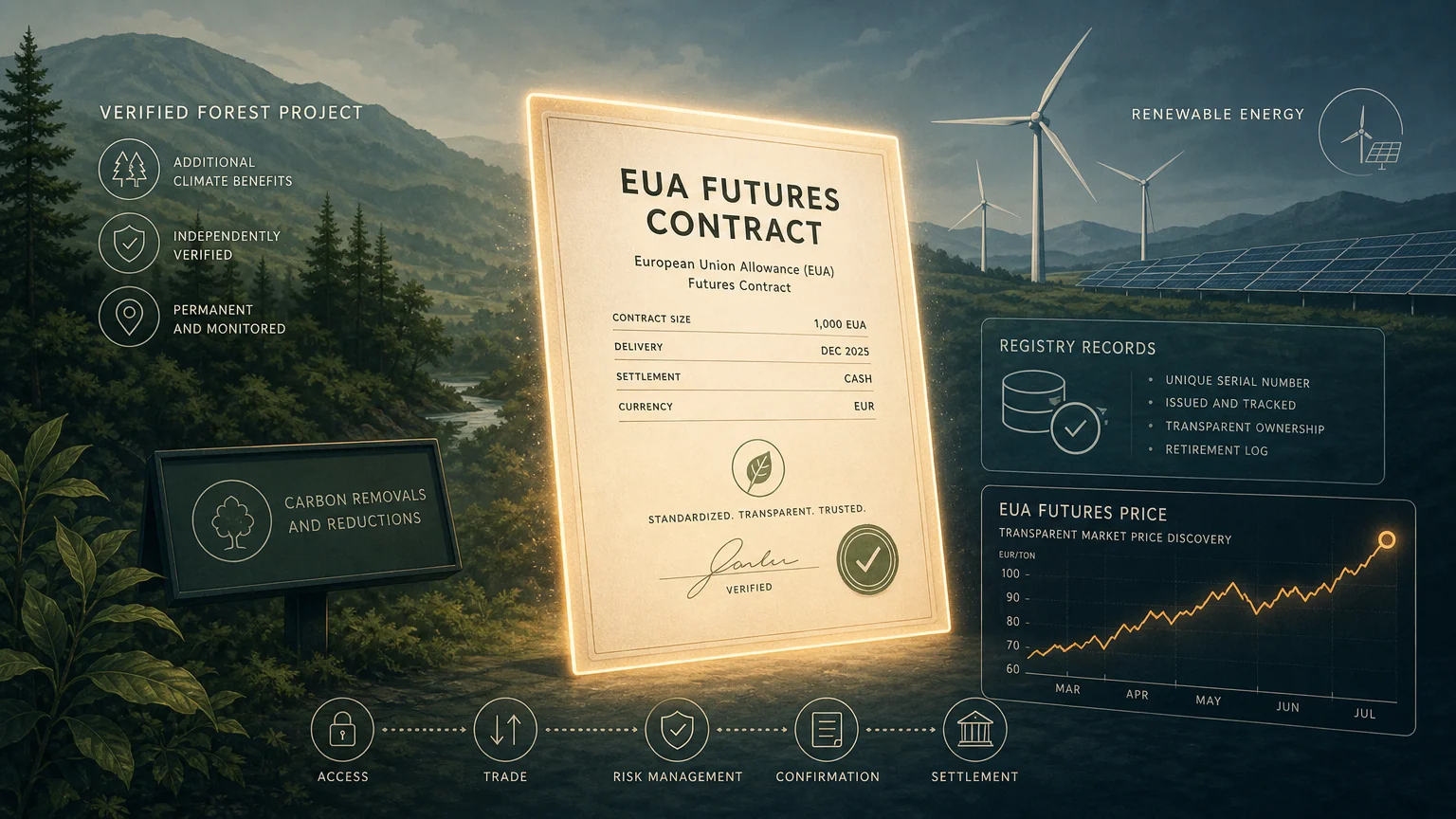


Summary: An ETS trading platform enables buying and selling EU Allowances (EUAs) in the world's largest carbon market, where 9.7 billion EUAs were traded in 2024 alone.
The EU Emissions Trading System is the world's most valuable carbon market by far, and it is entering a pivotal phase. In 2024, EUA prices averaged 22% lower year on year, yet the supply of available allowances is set to drop roughly 8% in 2026, tightening the market significantly. For compliance entities and financial participants alike, the choice of an ETS trading platform has never mattered more. The right platform determines execution quality, cost efficiency, and risk management capabilities.
Despite covering around 40% of the EU's greenhouse gas emissions, the carbon market remains notoriously difficult to access for mid-sized industrials and smaller compliance entities. Traditional lot sizes of 1,000 EUAs, limited price transparency, and complex onboarding have kept many participants on the sidelines. This article examines what defines a modern trading platform for the ETS, how the market is evolving, and what features matter most when selecting one.
What Is an ETS Trading Platform and Why Does It Matter?
An ETS trading platform is a digital venue where participants buy, sell, and manage EU Allowances and related derivatives. Each EUA represents one metric ton of CO₂ that a covered entity is authorized to emit. At the end of each compliance cycle, companies must surrender enough allowances to cover their verified emissions or face penalties.
The distinction between platforms matters because the EU ETS operates across multiple layers: primary auctions conducted by the European Energy Exchange (EEX) and secondary markets where participants trade among themselves. According to ESMA's 2025 Carbon Markets Report, there were on average 909 daily derivative position holders in 2024, with investment firms and credit institutions holding 51% of all positions. The market is active, liquid, and increasingly dominated by sophisticated participants.
For compliance entities (power plants, manufacturers, maritime operators), the platform they use determines how efficiently they procure allowances. For financial participants, it dictates execution speed, hedging flexibility, and data quality. In both cases, the platform is not just an interface; it is a strategic tool.
The EU ETS Market in 2026: Key Forces Shaping Platform Needs

Several converging forces are reshaping what participants need from a trading platform for the EU ETS. Understanding them is essential for choosing the right infrastructure.
Tightening supply. The EU's linear reduction factor is accelerating. The cap was set at 1,185 MtCO₂e for 2026, with annual reductions of 4.3% for 2024 to 2027 and 4.4% from 2028 onward. Fewer allowances in circulation means higher procurement urgency and more competitive trading.
Expanding scope. Maritime transport entered the EU ETS in 2024, adding over 3,300 shipping companies to the compliance pool. Aviation free allowances dropped to 50% in 2025 and are fully phased out from 2026. The new EU ETS 2 for buildings and road transport is expected to become operational in 2027. These expansions mean more entities competing for a shrinking pool of allowances.
CBAM activation. The Carbon Border Adjustment Mechanism entered its definitive stage in 2026, gradually replacing free allocation. This shifts cost structures for importers and creates new hedging needs that platforms must accommodate.
Price recovery expectations. While 2024 saw price declines, EU carbon permits recently rose to €75.51, the highest level since early 2026. Analysts project prices could average close to €150 per ton by the end of the decade, making trading strategy and platform capability increasingly consequential.
Core Features Every ETS Trading Platform Should Offer
Not all platforms serve the same participants equally. However, there are baseline capabilities that any serious ETS trading platform must deliver.
Real-time price transparency is non-negotiable. Carbon prices correlate with natural gas prices, weather events, and regulatory announcements. Without live visibility, traders risk executing at stale prices. A platform should show bid/ask spreads in real time, not delayed snapshots.
Flexible lot sizes determine who can actually participate. The traditional standard lot on major exchanges is 1,000 EUAs, equivalent to 1,000 metric tons of CO₂. For a mid-sized industrial with modest compliance needs, that represents a significant capital commitment at current prices. Platforms that support smaller trade sizes lower the barrier to entry.
Pre-trade risk controls protect participants from costly errors. Position limits, margin requirements, and order validation checks should be configurable. This is especially important for compliance entities that are not full-time traders.
API access and automation serve participants who need to integrate carbon trading into broader risk management or procurement systems. Manual order entry does not scale for organizations managing complex, multi-commodity portfolios.
Regulatory alignment with MiFID II and related frameworks ensures that participants trade within a compliant structure. This includes KYC/KYB onboarding, transaction reporting, and market abuse prevention.
Broker, Exchange, or Platform: Choosing the Right Access Model
One common point of confusion is the difference between a broker, an exchange, and a platform. These are not interchangeable terms, and each model carries distinct implications for cost, control, and transparency.
A broker acts as an intermediary, sourcing liquidity on behalf of clients. Brokers can offer personalized service but often lack price transparency and may introduce counterparty risk. An exchange provides a centralized order book where buyers and sellers meet directly. Exchanges typically offer better price discovery but can impose high minimum trade sizes and fees. A trading platform can combine exchange-grade infrastructure with more flexible access, sometimes offering features like smaller lot sizes, extended trading hours, and programmable execution.
Understanding these distinctions is critical. For a deeper analysis, see our resource on broker vs exchange in emissions trading. The best model depends on your trade frequency, compliance obligations, and technical requirements.
Why Accessibility and Small Lot Sizes Are Game Changers
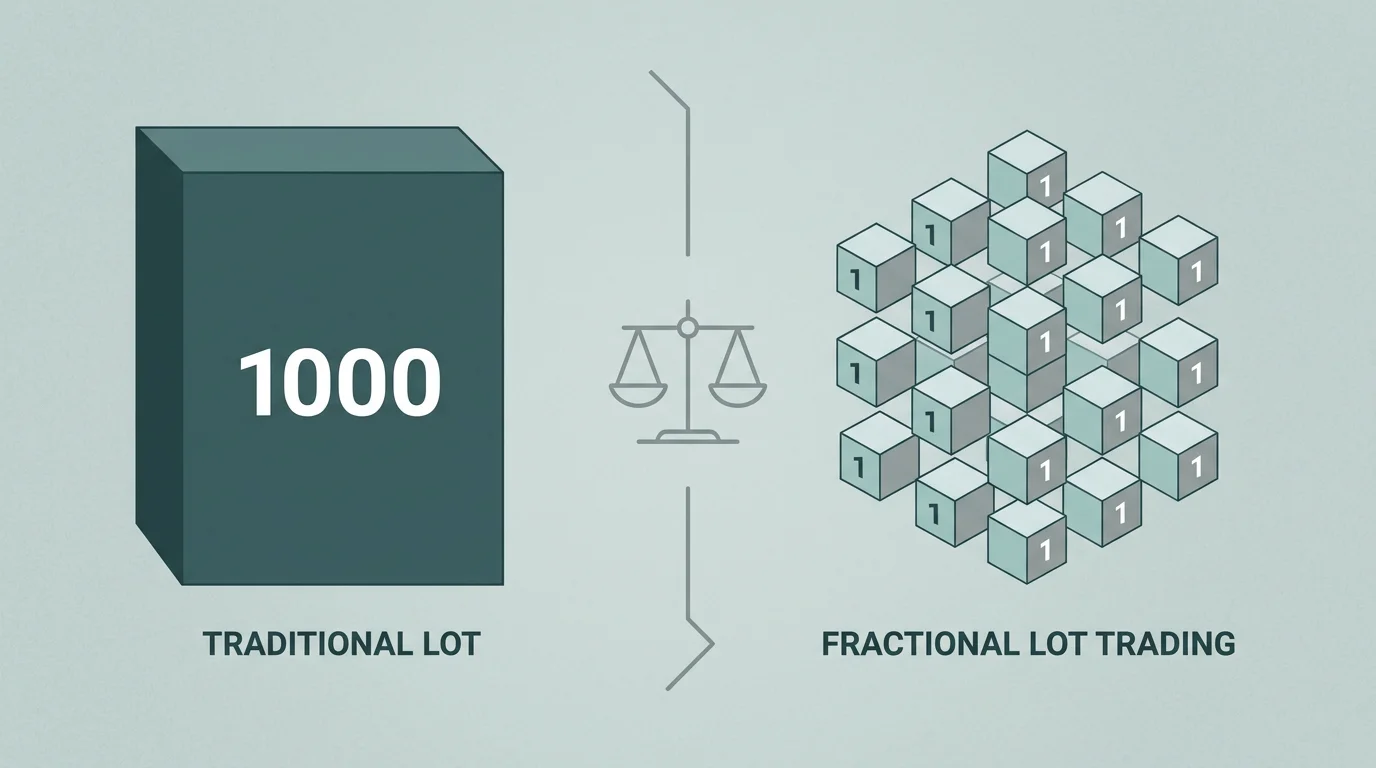
Consider a mid-sized manufacturer that needs to surrender 2,500 EUAs for annual compliance. At a price of approximately €75 per allowance, the total cost is around €187,500. On a platform that only trades in lots of 1,000, this company must buy 3,000 EUAs (spending €225,000) and manage the surplus, or enter complex partial-lot arrangements through a broker.
This scenario illustrates why small trade sizes represent a genuine structural improvement. Platforms that allow trading from a single EUA enable precise procurement aligned to actual compliance needs. No surplus inventory, no wasted capital, no unnecessary exposure.
We built our infrastructure around this principle. Through our trading platform for corporates and traders, participants can trade from 1 EUA, equivalent to 1 metric ton of CO₂. Combined with real-time pricing, pre-trade risk controls, and API access, this makes the carbon market accessible to compliance entities that were previously underserved by traditional venues.
The ERCST's 2025 State of the EU ETS Report confirmed that 9.7 billion EUAs were traded in 2024 with a stable auction coverage ratio of 1.73, indicating a well-functioning market. Yet much of that volume flows through a small number of large institutions. Broadening access to smaller participants adds depth and resilience to the market as a whole.
How Price Dynamics Influence Platform Strategy
Carbon prices are not static. They respond to energy markets, policy signals, weather, and geopolitical developments. In 2023, EU carbon permits averaged €84 per ton and briefly exceeded €100. By 2024, prices had fallen significantly, driven by lower gas prices and reduced industrial energy demand.
As of early 2026, the trajectory has reversed. According to Trading Economics, EU carbon permits gained 13.05% over a recent four-week period. The proposed adjustments to the Market Stability Reserve, which would retain more allowances rather than invalidating them, suggest policymakers intend to limit volatility without flooding supply.
For platform users, these dynamics create several imperatives. First, configurable alerts are essential for tracking price movements without watching screens all day. Second, the ability to schedule procurement (buying allowances gradually over time) reduces the risk of buying at a peak. Third, futures and options contracts allow compliance entities to lock in costs months ahead, smoothing budget uncertainty.
Understanding the various routes to market in carbon emissions trading helps participants select instruments that match their risk tolerance and compliance calendar.
Comparing ETS Trading Platform Models
The table below summarizes how different platform models serve key participant needs. It reflects general market characteristics rather than specific vendor claims.
| Feature | Traditional Exchange | OTC / Broker | Initiativ |
|---|---|---|---|
| Minimum lot size | 1,000 EUAs | Negotiable | 1 EUA |
| Live price transparency | Yes (for members) | Limited | Yes (open) |
| Pre-trade risk controls | Exchange-level | Varies | Configurable |
| API access | Available | Rare | Yes |
| Instruments | Spot, futures, options | Spot, forwards | Spot, futures, options |
| Target participants | Large institutions | All sizes | Enterprise, mid-market, SMB |
| Cash protection | Clearing house | Counterparty dependent | FGDR guarantee up to €100k |
The OTC segment remains significant. ESMA data shows that the OTC share among non-financial participants stood at 36% in 2024. Yet the trend is toward exchange-grade infrastructure with more inclusive access terms, which is exactly the gap a next-generation emissions trading exchange can fill.
What to Look for When Evaluating an ETS Trading Platform
Selecting a platform is a decision that affects compliance outcomes, cost management, and operational efficiency. Here is a practical checklist for evaluators.
- Regulatory status: Is the platform MiFID II compliant? Does it require professional client classification and complete KYC/KYB?
- Custody and settlement: Are allowances held in the European register? Is cash protected through a recognized banking partner or deposit guarantee?
- Execution quality: Does the platform publish live prices? Are fills fast and reliable? Can you verify best execution?
- Flexibility: Can you trade in lot sizes that match your actual needs? Are trading hours extended beyond traditional sessions?
- Integration: Does the platform offer API access for automation, reporting, and integration with existing risk systems?
- Fee structure: Are fees transparent and competitive? Hidden costs in spreads or settlement can erode value quickly.
For participants weighing direct market access vs exchanges, the evaluation criteria above apply to both models. The key is matching the platform's strengths to your specific operational profile.
Conclusion: The Platform Decision Is a Strategic One
The EU ETS is entering its most consequential period yet. The cap is tightening, new sectors and entities are joining, CBAM is reshaping cost structures, and prices are projected to climb significantly through 2030. In this environment, an ETS trading platform is not a commodity; it is core infrastructure that determines how efficiently you comply, hedge, and manage carbon exposure.
The most impactful shift may be structural: the move from a market designed for large institutions to one that serves all participants with equal transparency and execution quality. Smaller lot sizes, live pricing, configurable risk controls, and programmable infrastructure are no longer niche features; they are market requirements. Our exchange platform delivers these capabilities in a single environment, purpose-built for EU Allowances. To explore how it works, discover our new financial exchange for industrial emissions trading and see the difference firsthand.
Frequently Asked Questions
Who can trade on an ETS trading platform?
Compliance entities (power plants, manufacturers, airlines, shipping companies) and professional financial participants can trade. Most regulated platforms require MiFID II professional client classification along with completed KYC and KYB onboarding. At Initiativ, we support both compliance entities and financial participants with spot, futures, and options on EU Allowances.
What is the minimum trade size for EU Allowances?
On traditional exchanges, the standard lot is 1,000 EUAs. However, newer platforms have introduced smaller minimums. Initiativ allows trading from 1 EUA (equivalent to 1 metric ton of CO₂), making the market accessible to mid-sized and smaller compliance entities.
How are EU carbon prices expected to evolve?
While 2024 saw a 22% average price decline, the market has shown strong recovery momentum in 2026. Analysts project EU Allowance prices could approach €150 per ton by the end of the decade, driven by tightening supply, expanded sectoral coverage, and the gradual phase-out of free allocation under CBAM.