




If you are assessing the eua carbon price forecast 2030, the practical question is not simply whether EUAs can rise. You need to determine how much scarcity your procurement, trading, and compliance assumptions should absorb. For a structured view, you can consult our EU ETS price forecast for 2030 analysis, which frames the market through scenarios rather than a single target.
The latest 2026 outlooks show why caution matters. One revised bank scenario places the 2030 EUA price at €91 per tonne of CO2 after a less scarce policy outlook, compared with €138 in its earlier 2026 baseline, according to the latest ABN outlook. The difference is not a minor modelling detail. It changes how you should value inventory, hedge future exposure, and assess the cost of delayed decarbonisation.
What is the most credible EUA price forecast for 2030?
There is no single reliable EUA price target for 2030. The most defensible answer is a scenario range shaped by policy design, market scarcity, energy prices, and industrial emissions. Current 2026 forecasts demonstrate a wide spread, with published outcomes ranging from approximately €91 to €138 per tonne of CO2 under different assumptions.
The €91 figure reflects a less scarce policy setting after the EU ETS review. The €138 figure comes from an earlier baseline that assumed stronger scarcity and a more supportive structural balance. Neither figure should be treated as a guaranteed market level. Each is an analytical result that depends on assumptions about supply, demand, regulation, and the pace of industrial transition.
For professional planning, a useful approach is to establish three cases. A lower case can reflect weaker industrial demand and additional policy flexibility. A central case can use the latest baseline available to your organisation. A higher case should test faster supply tightening, stronger compliance demand, or delayed investment in lower carbon technologies.
This approach is more practical than relying on a single headline number. It also recognises that the EUA market can move before policy changes become legally effective. Compliance entities and financial participants often price expectations into futures, options, and forward procurement decisions well before the underlying rules change.
Why do 2026 forecasts vary so much?
Forecast divergence begins with the distinction between a market that is structurally tightening and a market whose rules are still being reviewed. The EU ETS has a declining allowance cap, but the timing of supply reductions, reserve interventions, free allocation changes, and possible reforms affects the price path.
The Market Stability Reserve is central to this process. It can remove allowances when the market carries a large surplus, or release allowances when circulation falls below defined thresholds. A forecast that assumes a stricter reserve response will generally produce a tighter market than one that assumes more flexibility.
The European Commission’s analysis shows that ETS1 prices averaged about €80 per tonne in 2022 and 2023 before falling to approximately €65 in 2024. It also notes that futures markets available at the time signalled only limited near term increases through 2027. These figures illustrate why the short term path does not automatically determine the 2030 outcome. You can review the underlying context in the European Commission analysis.
Forecast timing also matters. A 2025 Veyt update projected EUA prices at €158 per tonne in 2027 and €169 in 2028. That trajectory is materially higher than the revised 2026 ABN scenario for 2030, showing that analysts can reach different conclusions even when they agree that the market faces long term tightening. The difference may reflect changes in demand, trade policy, industrial output, and expectations about the regulatory review.
For a more detailed market comparison, you can also use our EUA price trends and forecasts through 2030 as a reference when comparing assumptions across published scenarios.
Which policy mechanisms could lift or lower EUA prices?

Policy is the main reason a long term EUA forecast should be presented as a range. The EU ETS is designed to reduce emissions through a declining supply of allowances. However, policymakers can influence the pace and distribution of scarcity through the cap, the reserve, free allocation, carbon leakage measures, and the possible integration of removals.
A stricter policy path would normally support higher prices. Lower allowance supply increases the value of each remaining unit, especially when industrial emissions remain resilient. A more flexible path could moderate prices by releasing allowances, changing reserve thresholds, extending transitional measures, or expanding the number of compliance options available to regulated entities.
Carbon removals could also change the balance. If eligible removal technologies become usable for compliance, they may provide an additional route for meeting obligations. The price effect would depend on the volume, permanence, eligibility rules, and cost of those removals. Limited supply would reduce the moderating effect, while abundant lower cost removals could reduce demand for EUAs.
The treatment of free allocation and the Carbon Border Adjustment Mechanism also matters. As free allocation changes, industrial participants may face stronger incentives to procure allowances or invest in abatement. At the same time, border measures may alter the competitive position of exposed sectors and influence production, imports, and emissions within the EU.
These mechanisms do not operate independently. A lower cap can raise prices, but weaker industrial output can reduce demand. A stricter reserve can tighten supply, but faster clean technology adoption can reduce emissions. The 2030 price therefore depends on the interaction between policy ambition and real economy adjustment.
How do energy markets and industrial demand affect the outlook?
Energy markets remain one of the most important short and medium term influences on EUA prices. Power generators compare the relative cost of coal, gas, renewable generation, and carbon allowances when deciding which units to operate. A change in fuel spreads can therefore alter allowance demand even when the regulatory framework is unchanged.
Higher gas prices can encourage more coal generation in some market conditions, increasing carbon demand. Lower gas prices can support gas switching and reduce emissions from power generation. Renewable output, electricity demand, industrial production, weather, and economic growth can all change the number of allowances required by covered installations.
Recent academic research reinforces the importance of demand conditions. A 2026 study found that, after the introduction of the Market Stability Reserve, demand shocks accounted for 58% of EUA price variance in its model. The 2026 research paper also examined policy surprises, electricity sector conditions, fuel prices, and market specific effects.
Industrial recovery creates a similar tension. Stronger production can increase compliance demand, particularly in sectors that cannot decarbonise quickly. A weaker economy can reduce emissions and delay purchases, even while the long term allowance cap continues to decline.
This is why you should avoid treating the carbon market as an isolated policy asset. Energy prices, industrial output, interest rates, weather, and geopolitical developments can all affect the path toward 2030. Our analysis of EU ETS and energy market price drivers provides additional context for connecting carbon assumptions with broader energy market conditions.
What does the forecast mean for compliance procurement?
A forecast becomes useful only when it changes a decision. For a compliance entity, the key question is not whether the 2030 price will be €91 or €138. It is whether your procurement schedule remains affordable if the market moves toward the higher scenario.
You should begin with your emissions profile, allowance balance, surrender calendar, and expected production levels. Then separate the exposure that must be covered from the exposure that can be managed through operational changes, fuel switching, efficiency measures, or longer term investment.
Compliance procurement should usually be assessed across several time horizons. Near term purchases may address confirmed obligations. Forward purchases can reduce exposure to future scarcity. Options may provide protection against sharp increases while preserving flexibility if prices fall. The appropriate mix depends on liquidity, internal risk limits, governance, and access to suitable instruments.
Market access also affects the quality of a procurement strategy. Transparent live pricing, order types, reporting, confirmation, settlement, custody, and API connectivity can reduce operational friction. These capabilities do not remove market risk, but they can make exposure easier to monitor and manage.
Our carbon benchmark and EUA price trends resource can help you compare market reference points with your own procurement assumptions. The objective is not to predict every price movement. It is to understand how different price paths affect cost, liquidity, and compliance resilience.
How should you build a 2030 EUA scenario plan?
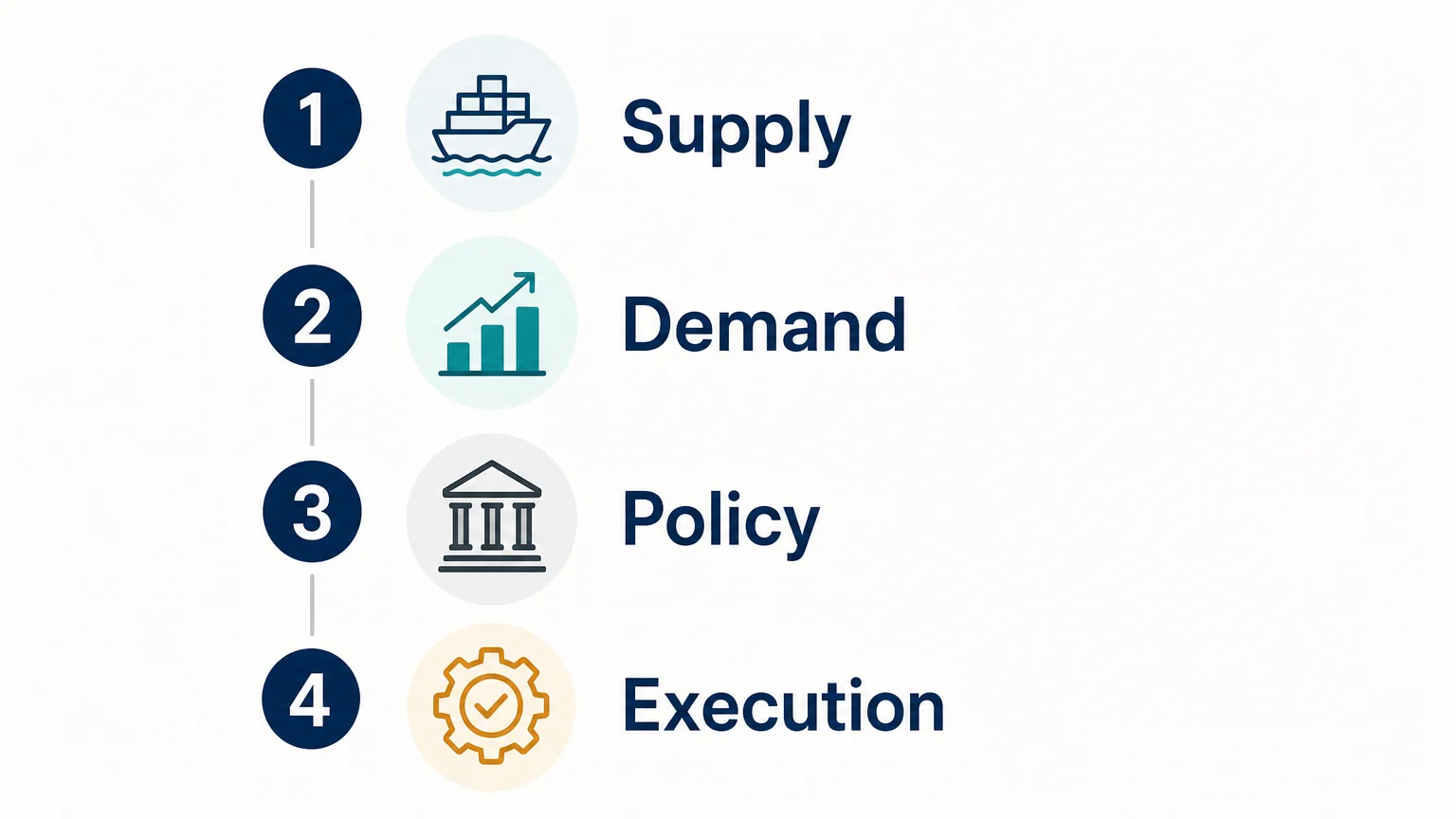
A robust scenario plan should connect the forecast to variables that your organisation can monitor. Start with the allowance supply path, then model demand from production and energy use. Add policy assumptions and define how your procurement or trading process responds to each outcome.
- Supply: Track the cap, auction volumes, free allocation, reserve activity, and possible changes to market design.
- Demand: Monitor industrial output, power generation, fuel spreads, renewable production, and compliance purchasing.
- Policy: Review regulatory developments, reserve reforms, border measures, removals, and sector coverage.
- Execution: Set procurement triggers, position limits, approved instruments, reporting rules, and escalation procedures.
You should also distinguish between a price forecast and a risk limit. A forecast estimates what may happen under specific assumptions. A risk limit defines what your organisation can tolerate if those assumptions fail. The two should be reviewed separately.
Price risk management is especially important when the market has a wide scenario range. A business that budgets at €100 per tonne may appear protected under one model but remain exposed to a sharper increase under another. Stress testing should therefore include higher prices, weaker liquidity, production changes, and delays to decarbonisation projects.
Professional market participants may also need to evaluate execution quality. This includes access to spot and derivatives markets, block execution, order book visibility, position monitoring, pre trade controls, settlement workflows, and integration with existing risk systems. The right infrastructure depends on your regulatory status, trading volume, operational model, and internal controls.
What the 2030 EUA outlook means for your decisions
The most useful EUA carbon price forecast for 2030 is not a single number. It is a disciplined range that shows how allowance supply, industrial demand, energy markets, regulatory reform, and the Market Stability Reserve could affect your cost base. Current 2026 forecasts already demonstrate that policy assumptions can move the projected outcome materially.
Use the latest available scenario as a planning anchor, then test lower and higher cases against your procurement schedule, hedging policy, liquidity needs, and decarbonisation timetable. This approach will not eliminate uncertainty, but it can make your decisions more resilient when the market moves faster than expected.
Take action with Initiativ
When your organisation needs to translate an EUA outlook into controlled market activity, execution and monitoring matter as much as the forecast. A professional workflow should connect procurement, trading, risk controls, position visibility, and post trade operations.

At Initiativ, we provide access to EUA spot and derivatives trading, live prices, order book visibility, configurable alerts, pre trade risk controls, API connectivity, team access management, reporting, confirmation, and settlement workflows. Explore Carbon trading for traders and corporates to assess how our infrastructure can support professional carbon market activity.
Frequently Asked Questions
What is the EUA carbon price forecast for 2030?
There is no single accepted forecast. Current 2026 scenarios show materially different outcomes because they use different assumptions about EU ETS reform, allowance scarcity, industrial demand, energy prices, and reserve management.
Why could the EUA price rise by 2030?
The allowance cap is designed to decline over time, which can create greater scarcity. Stronger industrial demand, slower decarbonisation, tighter reserve rules, or more ambitious climate policy could add further upward pressure.
Could EUA prices be lower in 2030?
Yes. Weaker industrial activity, faster clean technology adoption, lower emissions, additional compliance flexibility, or a less restrictive policy review could moderate demand and reduce the projected price.
Should companies buy EUAs all at once?
A single purchase may create timing risk, especially in a volatile market. Many organisations instead evaluate staged procurement, forward purchases, options, or other approved instruments alongside internal risk limits and compliance requirements.
Can Initiativ support professional EUA trading?
Initiativ provides access to EUA spot and derivatives markets, including futures and options, with live price monitoring, risk controls, API access, position management, reporting, confirmation, and settlement workflows. Participation requires onboarding and qualification as a professional client under the applicable requirements.




Let’s connect
Do you want more information about what we do?