


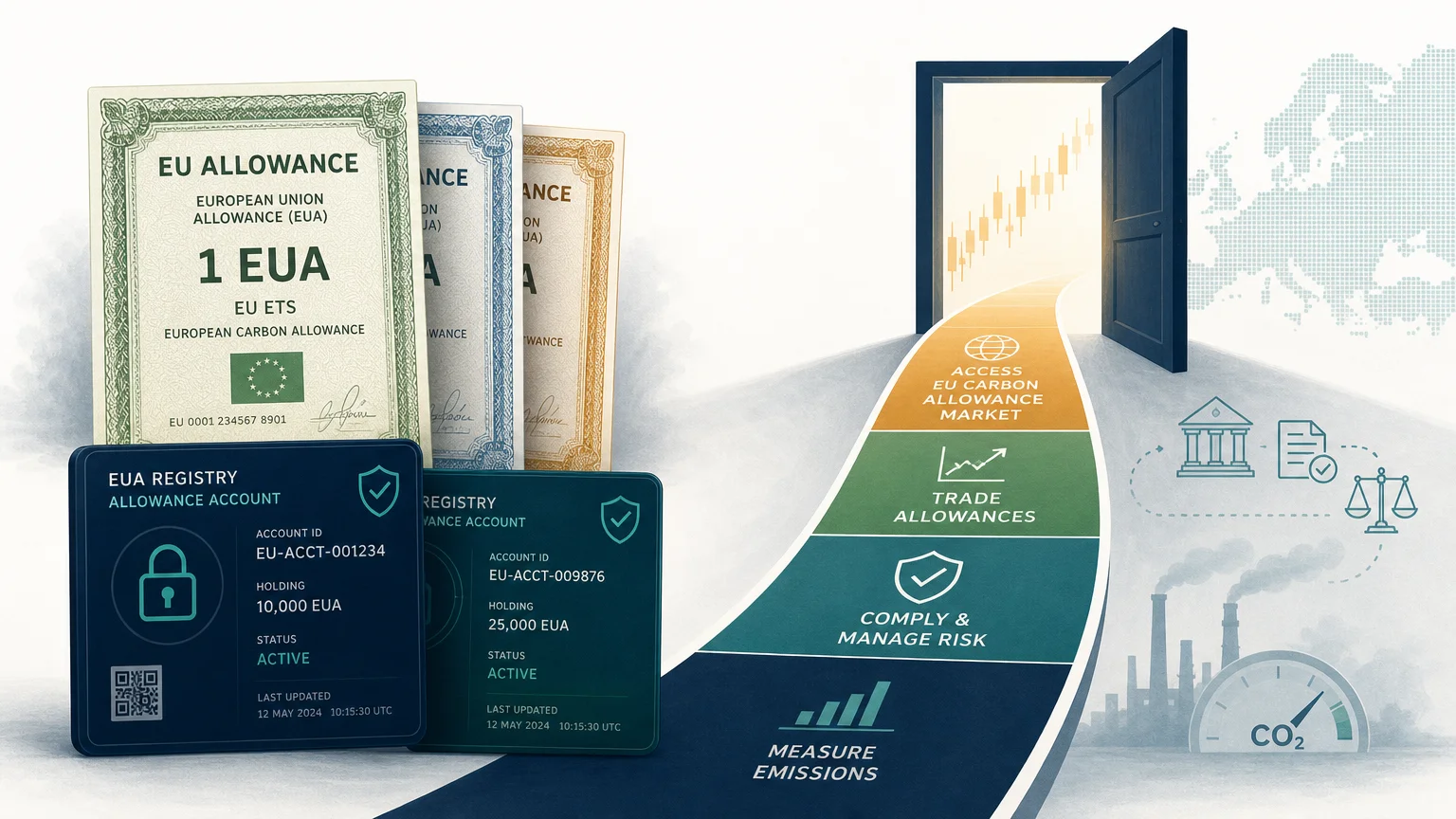

To understand how to buy EUAs, start by identifying your purpose. You may need allowances for compliance procurement, hedging, trading, or investment exposure. Professional participants can compare execution venues through an EU ETS trading platform, while other buyers may need an intermediary.
One EUA represents the right to emit one tonne of carbon dioxide equivalent under the EU ETS. The market has several access routes, but each has different eligibility, minimum size, custody, and settlement requirements. The European Commission auctioning rules provide the regulatory framework for the primary market.
Which type of buyer are you?
The first decision is not which platform to use. It is whether you are buying allowances for a regulated obligation or seeking market exposure.
Compliance entities include industrial installations, aircraft operators, and shipping companies covered by the EU ETS. These organizations need allowances to meet surrender obligations. Their purchasing decision usually focuses on expected emissions, delivery timing, budget certainty, and the ability to manage price risk.
Financial participants may buy EUAs for hedging, market making, proprietary trading, investment strategies, or client execution. Access normally depends on the participant’s regulatory status, onboarding checks, trading permissions, and clearing arrangements.
Retail investors face a different structure. Direct access to the institutional EUA market may not be available through a standard investment account. Instead, individuals may use a specialist intermediary or a financial product that provides exposure to allowance prices. You should verify whether the product gives you ownership of physical EUAs, exposure to futures, or only contractual exposure to a provider.
For professional participants comparing direct access, block execution, and automated workflows, our EU allowances resource explains the main product and market use cases.
How can you access the market?
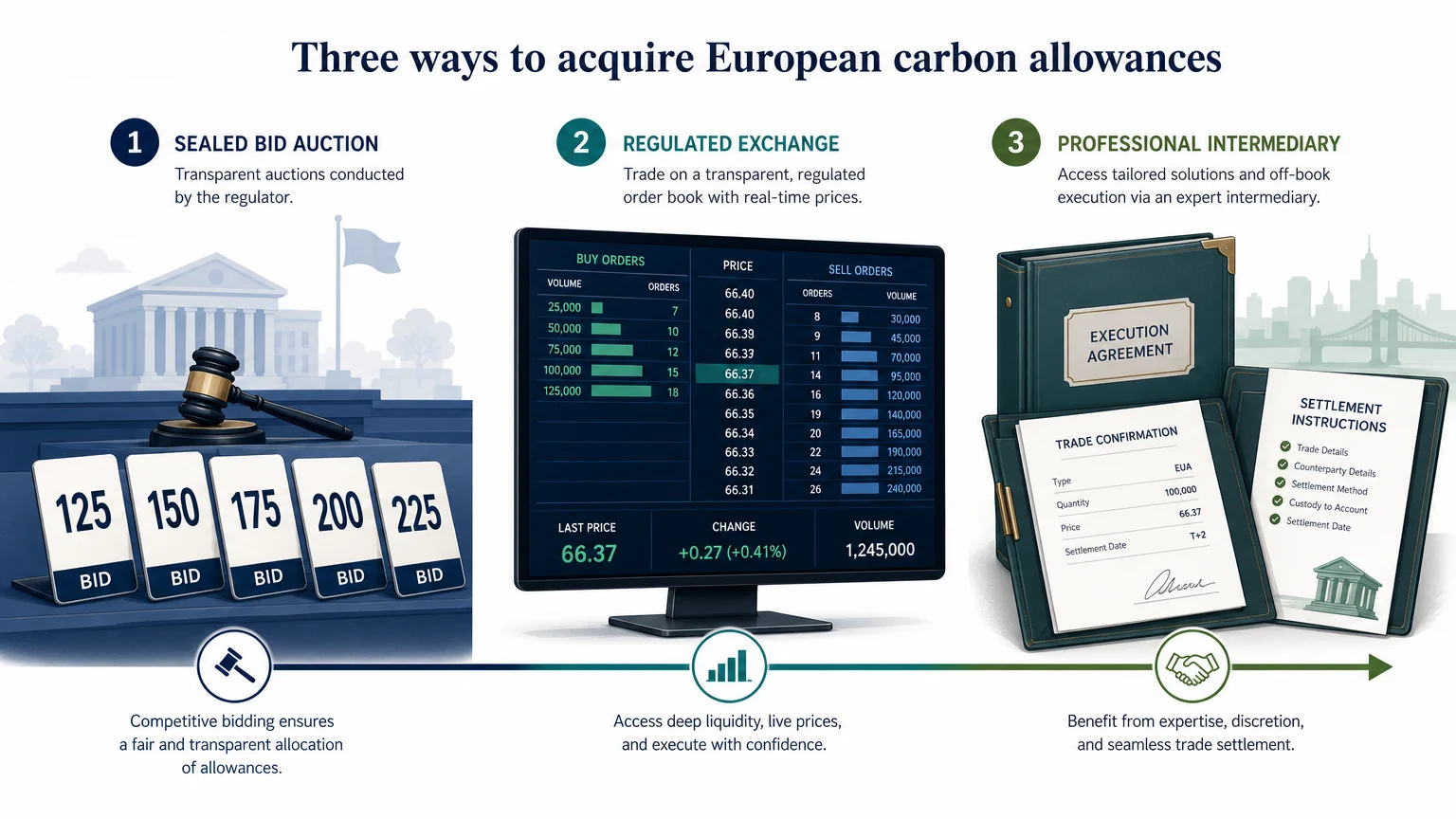
There are three practical routes: the primary market, the secondary market, and intermediary access.
Primary market auctions
EU ETS allowances are auctioned through approved auction platforms. Direct bidders must fit an eligible category and complete the required admission process. This can include compliance status, regulatory authorization, a registry account, a bank account, a bidder representative, and technical or clearing arrangements.
For 2026, EEX lists EUAs with delivery on the following business day and a minimum auction lot of 500 allowances. The common platform fee is listed as €1.73 per 500 allowance lot from September 1, 2026. These figures are specific to the published 2026 auction terms and should be checked again before bidding through the EEX EUA auction information.
Auctions can provide direct price discovery and predictable access to newly issued allowances. However, they may be inefficient for smaller buyers because admission, registry, banking, and clearing requirements create fixed administrative costs.
Secondary market purchases
Most professional buyers use the secondary market to purchase existing allowances or manage future exposure. Trading can take place on an exchange, through a broker, or over the counter. This route can provide more flexibility around timing, size, order type, and contract maturity.
Secondary market purchases may be preferable when you need to trade outside auction windows, source a specific volume, hedge a future requirement, or sell surplus allowances. You should compare the quoted price with the total cost of execution, including the spread, transaction fee, clearing charge, custody cost, and any transfer expense.
Intermediary or investment access
An intermediary can simplify the operational process by handling market access, execution, registry administration, custody, or settlement. For retail users, the intermediary may offer a structured product rather than direct ownership of EUAs.
Before committing funds, read the legal documents carefully. Confirm what you own, where the allowances are held, whether you can sell or retire them, how withdrawals work, and what happens if the provider becomes insolvent.
What should you buy: spot EUAs, futures, or options?
The instrument should match your objective, cash flow, and risk capacity. Buying a spot allowance is different from buying a derivative that references the future value of an allowance.
Spot EUAs are designed for immediate or near immediate delivery. They are commonly used for compliance procurement, physical holding, or direct market exposure. The buyer must consider registry ownership, delivery timing, custody, and the operational ability to transfer or surrender the allowances.
EUA futures create an obligation or economic exposure linked to a specified future delivery period. They are often used to hedge expected emissions costs or to manage forward price exposure. Futures require attention to margin, daily settlement, expiry, liquidity, and the relationship between the contract and the buyer’s eventual physical requirement.
EUA options provide the right, but not the obligation, to buy or sell a related EUA futures position at a defined strike price. Options can support asymmetric hedging strategies, but their pricing is more complex. You must understand the premium, implied volatility, expiry, exercise terms, margin treatment, and potential liquidity constraints.
Exchange specifications distinguish these instruments by contract volume, maturity, delivery, settlement, and exercise mechanics. The published EUA spot, futures, and options specifications should be reviewed before selecting a contract.
For a compliance buyer, spot or forward procurement may be more aligned with the need to cover verified emissions. For a trading desk, futures and options may provide more efficient hedging or relative value opportunities. The cheapest instrument is not necessarily the most suitable if it creates a mismatch with the eventual surrender obligation.
Where do the allowances go after purchase?
Ownership and settlement are central to the buying process. A trading confirmation is not the same as final delivery, and a price exposure product is not the same as holding an allowance.
The Union Registry records the holding and transfer of EU allowances. Depending on the route, the allowances may be delivered directly to your registry account, held in custody by a clearing participant, or retained by an intermediary on your behalf. The European Commission describes the registry as the electronic system used to record allowance holdings and transactions. You can review the practical structure in our guide to the Union Registry for EU ETS participants.
Ask the provider to explain the complete settlement chain. This should include the trading venue, central counterparty, clearing member, custody account, registry account, payment process, and delivery date.
For physical EUAs, confirm whether you retain legal ownership while the provider or clearing partner acts as custodian. Also verify whether allowances are held in a segregated account, whether they can be transferred to your own registry account, and whether they can be surrendered for compliance.
Cash arrangements deserve the same attention. Check whether funds are held in a segregated account, whether client money protections apply, and which entity is responsible for returning cash after a sale or redemption.
What will buying EUAs really cost?
The visible EUA price is only one part of the total cost. Your effective purchase price can include the bid and offer spread, exchange fee, broker commission, clearing charge, custody cost, registry transfer expense, financing cost, and foreign exchange exposure.
For auction buyers, the main costs may include admission, membership, trading, clearing, and banking arrangements. For secondary market buyers, the cost may be more variable because liquidity and order size influence execution. A large market order can move the price, while a limit order may remain unfilled.
Price risk is also significant. In a July 2026 update, ESMA reported that EU carbon markets reached €777 billion in 2025. It also reported that prices fell 29% over three months in early 2026, while volatility reached a two year high. These figures from the ESMA market update illustrate why purchase timing and risk limits matter.
Price movements can reflect energy markets, industrial output, weather, emissions expectations, regulatory changes, allowance supply, market stability measures, and changes in sector coverage. You should avoid assuming that the declining cap guarantees a gain. EUAs remain a regulated market instrument with material short term and medium term price risk.
Tax and accounting treatment also vary by jurisdiction and entity type. Obtain advice from a qualified tax or accounting professional before purchasing, especially if you are an international company, investment vehicle, or financial institution.
To monitor planned primary market dates and volumes, you can use our EU ETS auction calendars guide. A calendar does not remove price risk, but it can improve procurement planning.
What is a practical EUA buying process?
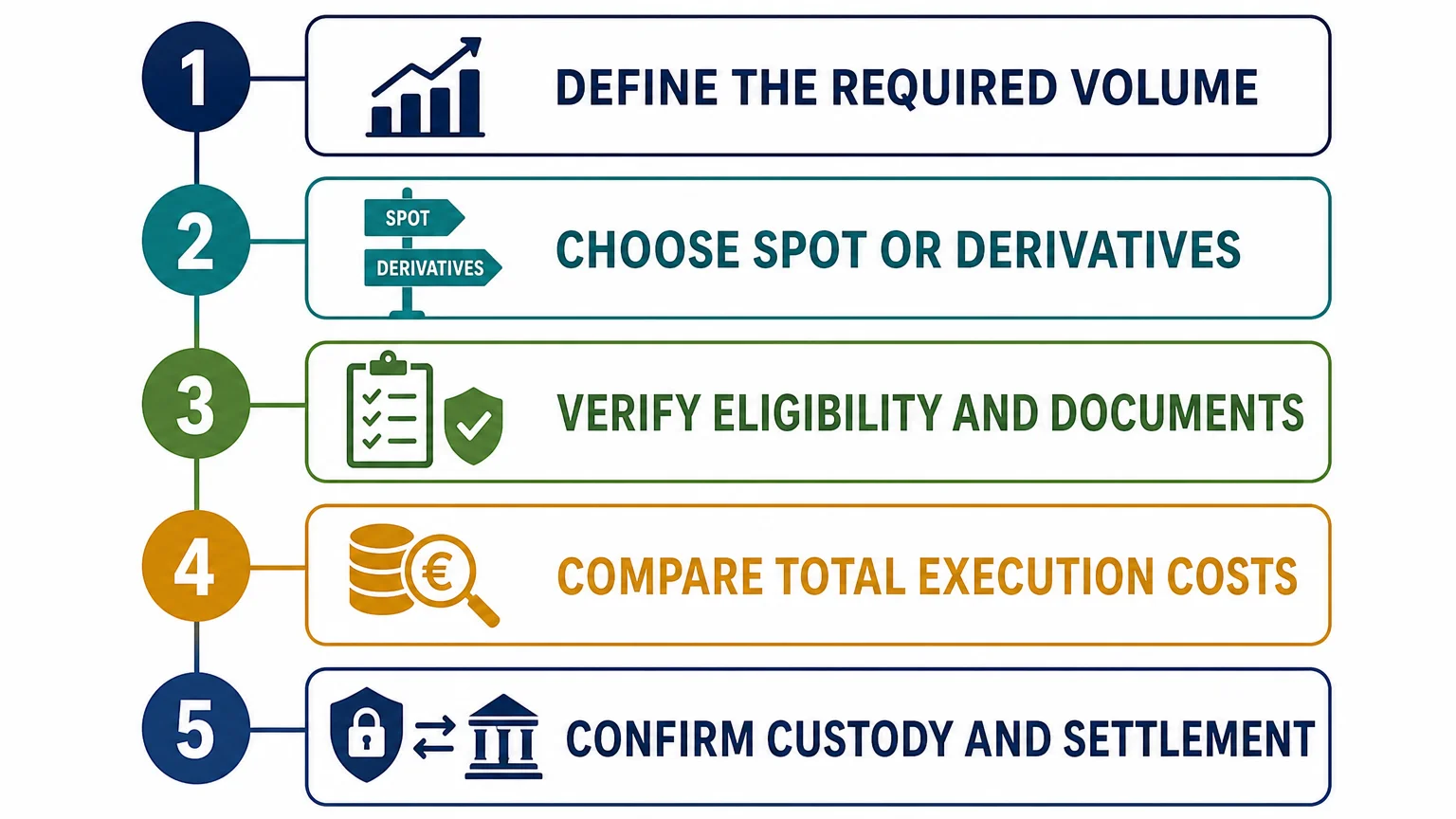
- Define the requirement. Estimate expected emissions, surrender deadlines, hedge ratios, or investment size. Separate the volume required for compliance from any discretionary trading position.
- Choose the instrument. Decide whether you need spot delivery, a future delivery period, or options protection. Consider liquidity, maturity, margin, and the relationship between the contract and your actual emissions exposure.
- Confirm eligibility. Prepare corporate documents, beneficial ownership information, tax details, regulatory permissions, bank information, and registry information. Professional venues may also require KYC, KYB, legal entity identifiers, and clearing documentation.
- Compare the full cost. Request the spread, commission, exchange fee, clearing cost, custody charge, funding cost, and transfer expense. Ask whether the quoted price is firm and whether partial execution is possible.
- Confirm settlement. Establish where the EUAs or derivative position will be recorded, when delivery occurs, who provides custody, and how you will receive confirmations and reports.
Once the account is active, define internal controls before placing an order. These may include position limits, approval thresholds, permitted products, counterparty limits, price alerts, and escalation procedures.
Professional teams may also need an execution policy. The policy can specify when to use market orders, limit orders, iceberg orders, block execution, or scheduled procurement. It should explain who can trade, who can approve transactions, and how positions are reconciled after settlement.
Which checks should you complete before placing an order?
Before purchasing, verify that the provider is authorized to offer the service in the relevant jurisdiction. Review the legal entity, regulatory permissions, client classification rules, complaints process, insolvency arrangements, and data protection terms.
Ask whether the transaction gives you a physical EUA, a futures position, an option, a note, or another contractual claim. Similar price exposure can involve very different ownership, custody, liquidity, and tax consequences.
You should also test the operational details with a small transaction where appropriate. Confirm how orders are entered, how trade confirmations are delivered, how cash is funded, how allowances are transferred, and how a position is closed.
Finally, treat market access as an ongoing process rather than a single purchase. Procurement plans should be reviewed when emissions forecasts, production levels, shipping activity, energy prices, or EU ETS rules change.
Make the buying route fit your objective
Buying EUAs is straightforward only after the underlying purpose and operational requirements are clear. Compliance entities should align the purchase with verified emissions and surrender deadlines. Financial participants should focus on liquidity, execution, margin, and risk controls. Retail investors should examine the legal structure, custody, fees, and exit terms of any intermediary product. Compare the complete transaction, not only the displayed EUA price, and confirm how ownership or exposure will be settled before committing funds.
Take action with Initiativ
Once you know your required volume, preferred instrument, and risk parameters, the next step is selecting infrastructure that supports professional execution. A connected workflow can reduce manual steps between market data, order entry, risk management, reporting, and settlement.
Our platform supports professional access to EUA spot and derivatives, including futures and options. It combines live price monitoring, configurable alerts, pre trade risk controls, API connectivity, position views, team access management, and post trade workflows. If your organization is ready to trade EUAs for traders and corporates, you can review the available access options with our team.
Frequently Asked Questions
Can any company buy EUAs?
Not every company can access every buying route directly. Compliance entities and eligible professional financial participants may apply for auction or exchange access, while other buyers may need an intermediary.
What is the minimum amount of EUAs I can buy?
The minimum depends on the venue and instrument. Some auction or exchange contracts use standard lots, while professional platforms may support smaller trade sizes subject to their rules and onboarding requirements.
Are EUAs the same as voluntary carbon offsets?
No. EUAs are regulated allowances used within the EU ETS, while voluntary offsets generally represent claimed emissions reductions or removals outside that compliance system. Their legal treatment, environmental claims, custody, and market structure can differ substantially.
Should I buy spot EUAs or futures?
Spot EUAs may suit buyers that need physical allowances for compliance or direct holding. Futures may suit buyers managing future price exposure, but they introduce margin, expiry, settlement, and basis risks that should be assessed before trading.
Does Initiativ support professional EUA trading?
Yes. Initiativ provides professional access to EUA spot and derivatives, together with live pricing, order management, risk controls, API connectivity, reporting, confirmation, and settlement workflows. Eligibility depends on onboarding, KYC or KYB requirements, and professional client qualification under applicable rules.



Let’s connect
Do you want more information about what we do?