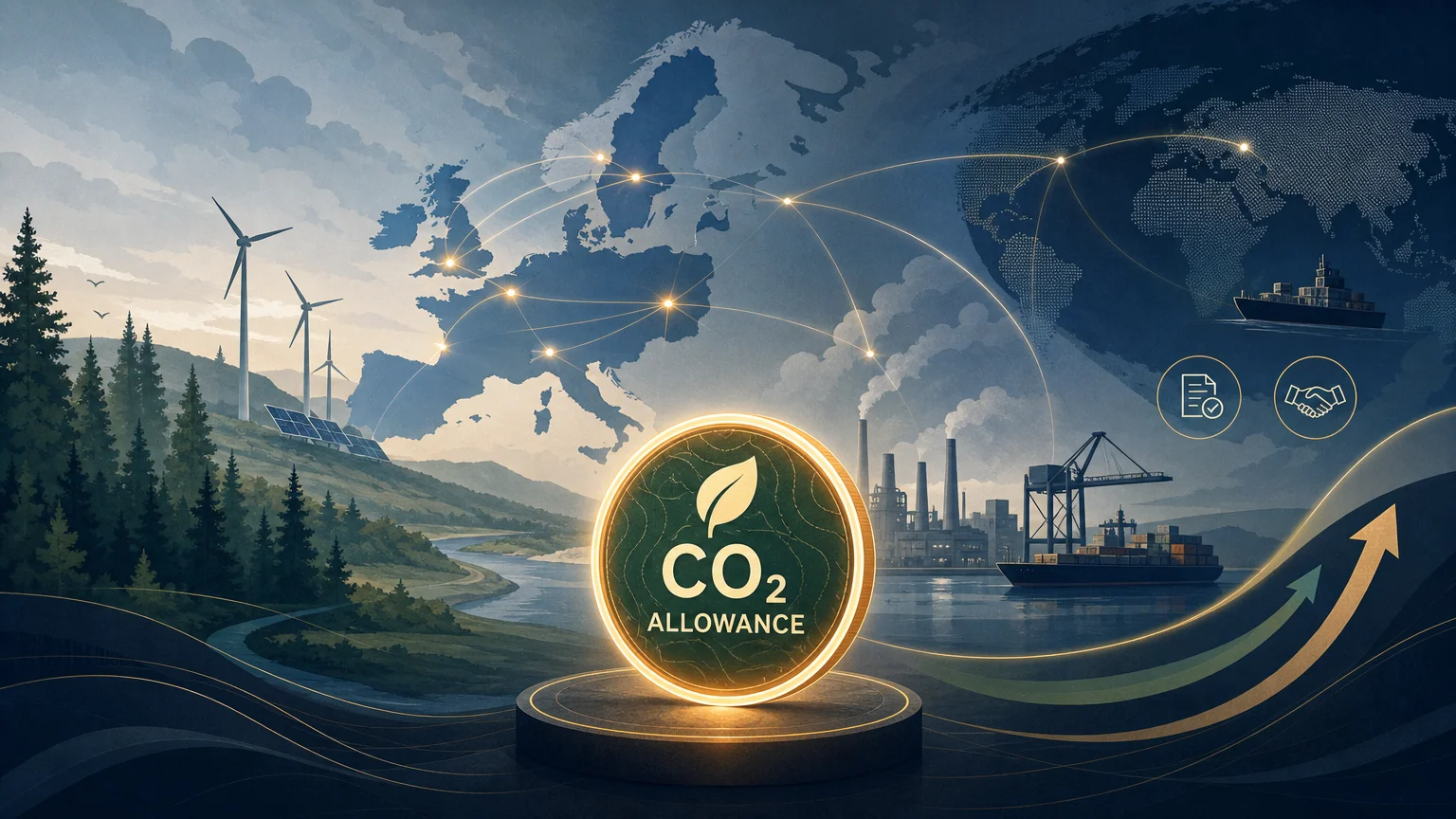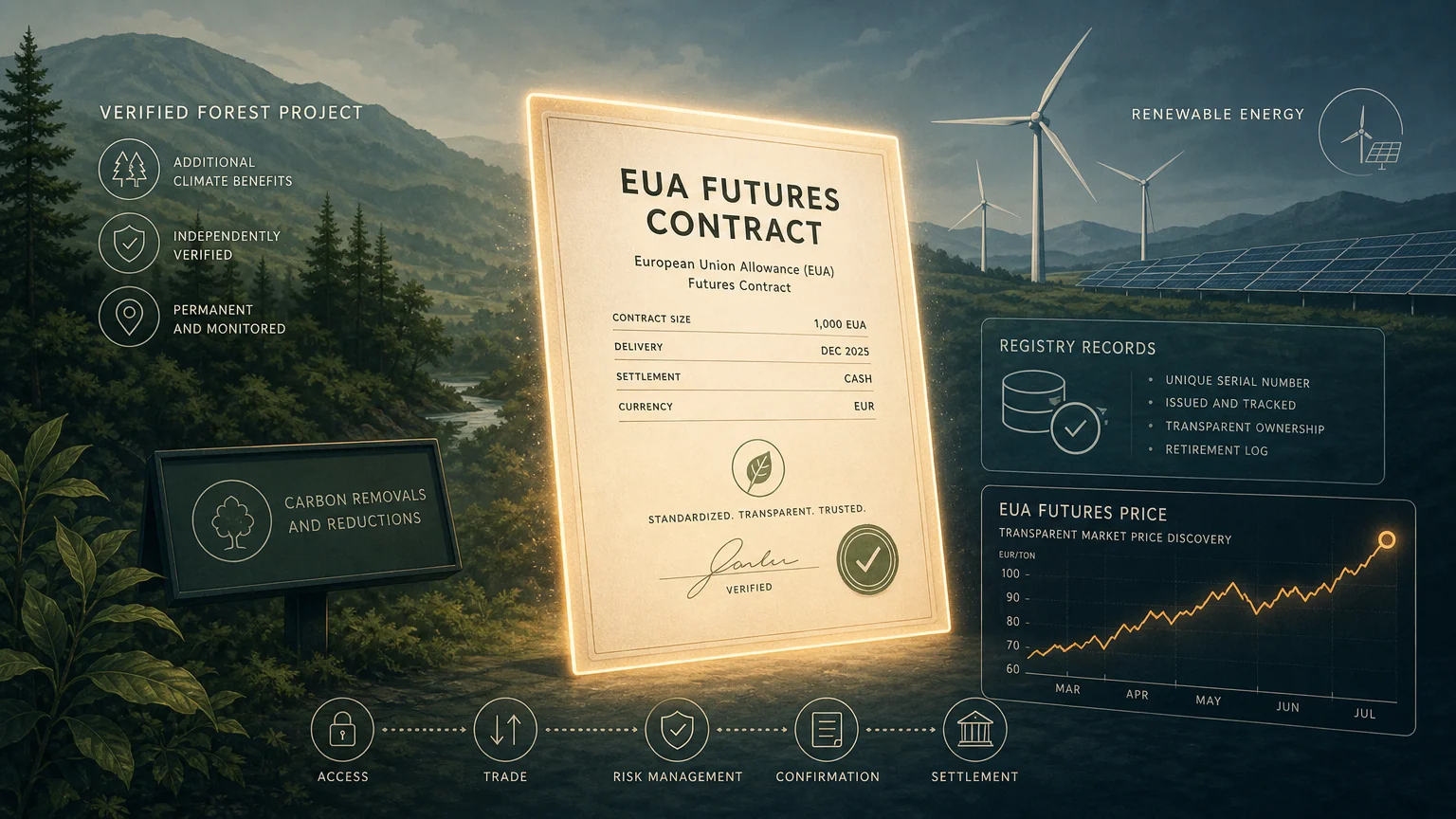


Summary: An environmental commodity exchange is a regulated venue where participants buy and sell emissions allowances, carbon offsets and renewable energy certificates. It converts the right to pollute into a priced, tradable asset. In Europe, the EU Emissions Trading System anchors this activity, with prices set through auctions and active secondary trading in spot and derivative form.
Since its launch in 2005, the EU Emissions Trading System has raised a cumulative total that reached EUR 265.7 billion by the end of 2025, a figure that reflects how much capital now flows through carbon pricing. Behind that number sits a specialized marketplace: the environmental commodity exchange, where the right to emit one tonne of carbon dioxide becomes a standardized, priced instrument. Understanding how these venues operate is essential for any industrial operator or financial participant exposed to emissions costs. To go deeper on venue selection, you may consult our guide to environmental commodities trading platforms.
These markets exist because governments cap emissions and let scarcity set a price. According to the International Carbon Action Partnership, that cumulative revenue has funded climate action across member states since inception. The result is a system where compliance obligations and financial strategy meet on the same order book.
What an environmental commodity exchange actually is
An exchange for environmental commodities is a marketplace that matches buyers and sellers of intangible energy and emissions credits. Unlike oil or wheat, the underlying asset has no physical substance. Its value derives entirely from regulation: a government caps how much a sector may emit, divides that cap into allowances, and lets the market price them.
The instruments traded fall into a few recognizable families. Carbon allowances, such as EU Allowances (EUAs), each represent the right to emit one tonne of carbon dioxide equivalent. Carbon offsets represent verified emissions reductions generated outside a mandated cap, for example through reforestation or methane capture. Renewable energy certificates prove that a defined quantity of electricity was generated from an eligible clean source. Each family trades under its own rules, registries and liquidity conditions.

How prices are discovered on carbon markets
Where does the price of a tonne of carbon come from? In the EU ETS, the primary market operates through regular auctions, while the deeper price signal forms in continuous secondary trading. Supply is fixed and declines each year, so demand shifts, driven by fuel prices, weather and industrial output, move the price.
The forward curve matters as much as today's spot level. BloombergNEF forecasts that the new EU ETS II, covering road transport, buildings and small industry from 2027, could push carbon prices toward €149 per tonne by 2030, potentially generating around €705 billion in revenue between 2027 and 2035. Expectations of that scale feed directly into how participants value near-term contracts. If you want the mechanics in detail, see our explainer on how price discovery works in the carbon market.
Who trades, and why derivatives dominate
The participant mix on a carbon venue is distinctive. Industrial operators buy allowances to meet compliance obligations. Banks, trading firms, asset managers and carbon brokers provide liquidity and take positions across the curve. This structure shapes trading behavior in measurable ways.
According to the European Securities and Markets Authority, the vast majority of allowance trading in secondary markets occurs through derivatives, with non-financial firms typically holding long positions for compliance while banks and investment firms hold short positions. The same regulator noted that emission allowance auctions remain concentrated, with ten participants buying roughly 90% of auctioned volumes. That concentration is one reason liquidity and access terms differ so widely between venues. Our analysis of carbon market liquidity and what drives EU ETS trading unpacks the practical consequences for smaller participants.

Compliance markets versus voluntary markets
Not every credit is equal, and the distinction determines where it can be used. Compliance markets operate under mandatory caps, where covered entities must surrender allowances equal to their verified emissions. Voluntary markets let companies buy credits to meet self-imposed sustainability targets, without a legal obligation behind them.
The compliance side carries the deepest liquidity and the clearest regulatory backing. The European Commission reported that the EU ETS raised €38.8 billion in 2024 and that emissions from power and industry installations now sit around 50% below 2005 levels. Voluntary credits, by contrast, cannot be surrendered for compliance, which typically leaves them with thinner and less predictable demand. Knowing which market a credit belongs to is the first step before committing capital.
What to look for in a trading venue
Traditional carbon exchanges were built for large institutions. A standard lot is often 1,000 allowances, which prices out smaller operators and makes precise hedging difficult. That barrier has pushed a new generation of venues to rethink access from the ground up.
When you evaluate a venue, several criteria deserve scrutiny. Minimum trade size determines how precisely you can match exposure to obligation. On our exchange, trading starts from a single EUA, equivalent to one tonne of carbon dioxide, rather than a traditional 1,000-allowance lot. Real-time pricing, configurable alerts and pre-trade risk controls determine how confidently you can act. API access determines whether you can automate execution and connect to existing risk systems. If your obligations sit specifically under the European scheme, our overview of ETS trading platforms maps the access routes in more detail.
| Criterion | Traditional exchanges | Our exchange |
|---|---|---|
| Minimum trade size | Typically 1,000 EUAs | From 1 EUA (1 tonne CO₂) |
| Live pricing | Often delayed or gated | Real-time monitoring |
| Automation | Limited | API-enabled |
| Cash protection | Varies | Guaranteed up to 100 k€ by the FGDR |
Bringing it together
An environmental commodity exchange turns a regulatory limit into a functioning market, letting firms price, hedge and settle their emissions obligations. The core drivers are consistent: a declining cap creates scarcity, auctions and secondary trading discover price, and derivatives carry most of the volume. As the EU system expands into new sectors, exposure will reach organizations that never faced a carbon cost before. The practical priorities are clear. Understand whether your credits are compliance-grade or voluntary, match your trade sizing to your actual obligation, and choose a venue whose transparency and risk controls fit how you operate.
Take action with Initiativ
Whether you are an industrial operator managing compliance or a financial participant seeking cleaner execution, the right infrastructure changes what is possible. Carbon exposure is easier to manage when pricing is transparent, trade sizes are flexible, and your risk systems connect directly to the market.
We give traders and corporates a programmable exchange for EU Allowances in spot and derivative form, with real-time price monitoring, configurable alerts and pre-trade risk controls. Trading starts from a single allowance, fees are competitive, and cash is guaranteed up to 100 k€ by the FGDR. To explore the platform, request access to our exchange for traders and corporates and its demo environment.
Frequently Asked Questions
What is traded on an environmental commodity exchange?
These venues trade carbon allowances, carbon offsets and renewable energy certificates. Each instrument represents a defined environmental benefit or emission right, and each carries its own registry and compliance rules. Allowances such as EUAs are the most liquid category in Europe.
How is the price of a carbon allowance determined?
Prices form through primary auctions and continuous secondary trading, where a fixed and declining supply meets shifting demand. Fuel prices, weather, industrial output and policy expectations all move the market. The forward curve often influences valuations as much as the current spot level.
What is the difference between compliance and voluntary carbon markets?
Compliance markets operate under mandatory caps where covered entities must surrender allowances for their verified emissions. Voluntary markets let organizations buy credits for self-imposed goals, with no legal obligation behind them. Voluntary credits generally cannot be used to meet compliance requirements.
Do I need a large minimum size to trade carbon allowances?
On traditional exchanges, a standard lot is often 1,000 allowances, which can exclude smaller participants. On our exchange, trading starts from a single EUA, equivalent to one tonne of carbon dioxide. This allows more precise matching of positions to actual obligations.
Who participates in carbon markets besides emitters?
Beyond industrial operators, the market includes banks, trading firms, asset managers, hedge funds and carbon brokers. These financial participants provide liquidity and often hold positions opposite to compliance buyers. Most secondary trading takes place through derivative contracts rather than spot.